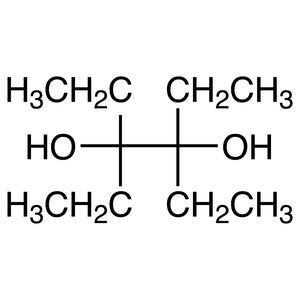
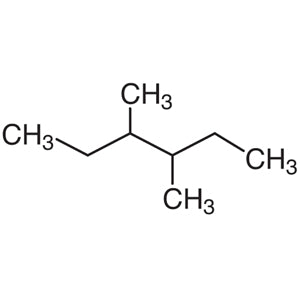
3,4-Diethylhexane is a branched saturated hydrocarbon (alkane) with the formula C10H22, one of the many structural isomers of decane. Its molecule is a hexane chain with two ethyl groups attached to carbon atoms 3 and 4. Saturated alkanes are relatively inert toward most reagents, so in the laboratory this compound is used mainly as a pure, well-defined substance for analytical work and for research on the physical properties of hydrocarbons, and seldom as a reactant in synthesis.
The main value of 3,4-Diethylhexane lies in its defined structure. In hydrocarbon mixtures such as fuels and crude oil, branched isomers are difficult to tell apart. A pure compound like this one serves as a reference for establishing retention times and mass fragmentation patterns, which helps analysts identify individual components. Because it is nonpolar and unreactive, it also works well as a model compound in studies of how molecular branching affects physical properties such as volatility, viscosity, and combustion behaviour. The TCI brand gives laboratories a consistent source of this specific isomer.
In Indonesia, this material is relevant to petroleum and fuel analysis laboratories that need to characterise branched alkanes in complex samples. Environmental laboratories that monitor hydrocarbon contaminants in soil, water, and air can use it as a reference compound when interpreting chromatographic data. Research groups in physical chemistry and chemical engineering at universities and research institutions also use it to study the thermodynamic properties of alkanes and to build or validate structure–property models for hydrocarbon systems.
- Gas chromatography reference standard: its defined branched structure lets analysts confirm the retention time of this specific decane isomer in fuel and petroleum samples.
- Mass spectrometry identification: the pure compound gives a clean fragmentation pattern that helps distinguish 3,4-Diethylhexane from other closely related C10H22 isomers in complex mixtures.
- Environmental hydrocarbon monitoring: laboratories tracking hydrocarbon contamination can use it as a reference point when identifying branched alkanes in environmental samples.
- Structure–property research: as a nonpolar, unreactive model compound, it suits studies linking molecular branching to volatility, viscosity, and other physical properties.
- Combustion and fuel behaviour studies: chemical engineering groups can use this well-defined isomer to investigate how branching influences the combustion characteristics of alkanes.
| Brand | TCI (product code D1367) |
|---|---|
| CAS number | 19398-77-7 |
| Molecular formula | C10H22 (branched decane isomer) |
| Purity | — |
| Category | Chemistry > Building Blocks > Non-Heterocyclic Building Blocks |
| Pack sizes | see the available options on the product page |
| Physical form | — |
| Storage | keep tightly closed in a cool, well-ventilated area away from ignition sources |
Store 3,4-Diethylhexane in its original, tightly sealed container in a cool, dry, well-ventilated place, away from heat, sparks, open flames, and strong oxidising agents. Like other low-molecular-weight alkanes, it should be treated as a flammable organic liquid. Handle it in a fume hood or a well-ventilated area, and wear safety glasses, chemical-resistant gloves, and a lab coat. Use clean glass or compatible containers to transfer it so that the reference material is not contaminated. Dispose of waste according to local regulations, and consult the supplier's Safety Data Sheet before use.
—
Produk Terkait
-
3-Methylhexane TCI M0340
Regular price From Rp 1.776.600,00Regular priceRp 1.242.150,00Sale price From Rp 1.776.600,00 -
2-Methylhexane TCI M0231
Regular price From Rp 2.094.750,00Regular priceRp 1.464.750,00Sale price From Rp 2.094.750,00 -
3,4-Diethylhexane-3,4-diol TCI D6137
Regular price From Rp 1.192.800,00Regular priceRp 849.450,00Sale price From Rp 1.192.800,00 -
2,2,4-Trimethylhexane TCI T0774
Regular price Rp 1.353.450,00Regular priceRp 946.050,00Sale price Rp 1.353.450,00 -
2,2,5-Trimethylhexane TCI T0475
Regular price Rp 11.343.150,00Regular priceRp 7.931.700,00Sale price Rp 11.343.150,00 -
3,4-Dimethylhexane TCI D1228
Regular price Rp 2.545.200,00Regular priceRp 1.779.750,00Sale price Rp 2.545.200,00 -
3,3-Dimethylhexane TCI D1227
Regular price Rp 4.743.900,00Regular priceRp 3.316.950,00Sale price Rp 4.743.900,00 -
2,3-Dimethylhexane TCI D1225
Regular price Rp 8.110.200,00Regular priceRp 5.671.050,00Sale price Rp 8.110.200,00