

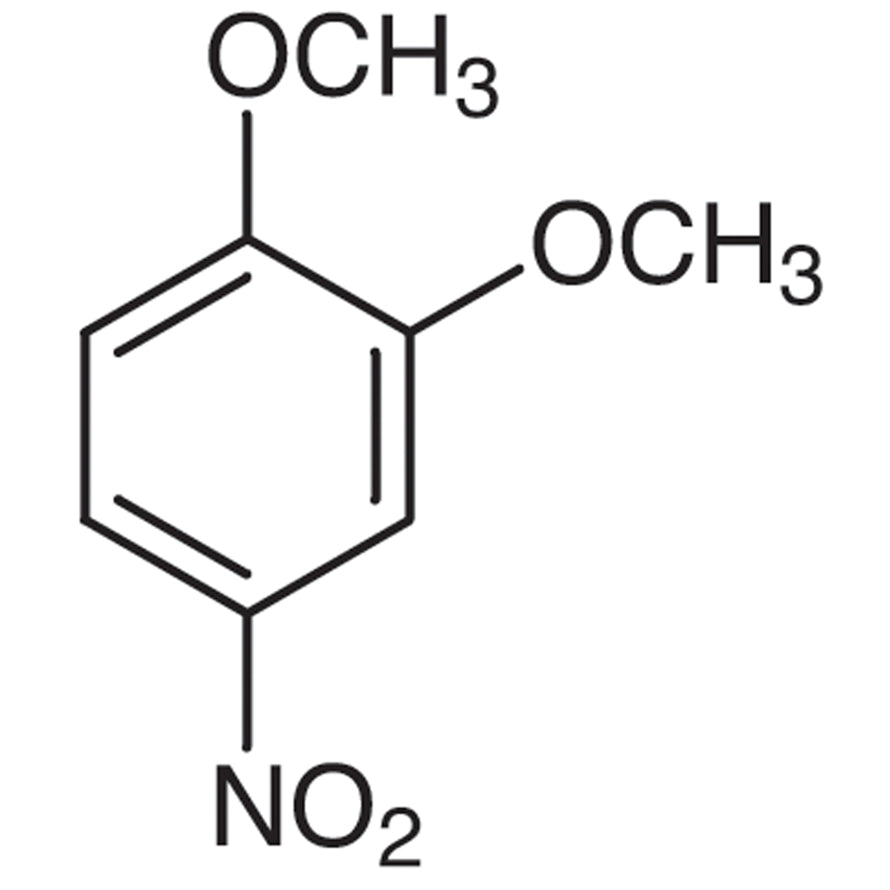
1,2-Dimethoxy-4-nitrobenzene is an organic chemical compound widely used in synthetic chemistry reactions. It serves as a key building block in the synthesis of complex compounds, particularly aromatic derivatives that require nitro and methoxy substitutions. This compound is commonly found in chemical laboratories as a raw material for the preparation of various functionalized aromatic compounds. Its role is crucial in the development of new chemical entities and in the exploration of reaction mechanisms involving electrophilic substitution.
The compound is valued for its stable chemical structure and controlled reactivity, making it a reliable choice for a wide range of synthetic applications. It exhibits good solubility in organic solvents such as ethyl acetate and ethanol, which enhances its versatility in different reaction conditions. Its ability to participate in substitution reactions makes it particularly useful in the synthesis of heterocyclic compounds and aromatic derivatives. The compound is available in solid form, which simplifies handling and storage, making it practical for use in both small and medium-sized laboratories.
In Indonesian laboratories, 1,2-Dimethoxy-4-nitrobenzene is extensively used in organic chemistry research, especially in projects involving the synthesis of new compounds. It is a preferred material for experiments requiring precision and consistency in chemical processes. Educational and research institutions in Indonesia rely on this compound for its reliability and effectiveness in synthetic applications. Its widespread use highlights its importance in advancing chemical research and development in the region.
Related TCI products
- Aromatic Compound Synthesis: This compound is ideal for the synthesis of aromatic derivatives due to its nitro and methoxy groups, which are essential for functional group modifications.
- Electrophilic Substitution Reactions: Its stable structure and controlled reactivity make it suitable for electrophilic substitution reactions, allowing for precise chemical modifications.
- Heterocyclic Compound Development: The compound is frequently used in the synthesis of heterocyclic compounds, where its substituents provide structural diversity.
- Organic Chemistry Research: It supports research in organic chemistry by enabling the creation of complex molecules with specific functional groups.
- Educational Laboratory Experiments: Its availability and predictable behavior make it a valuable tool for teaching and learning synthetic chemistry techniques.
| Brand | TCI |
|---|---|
| CAS number | 709-09-1 |
| Molecular formula | — |
| Purity | — |
| Category | Chemistry > Building Blocks > Non-Heterocyclic Building Blocks |
| Pack sizes | Available in various quantities as per standard laboratory supply |
| Physical form | Solid |
| Storage | Store in a cool, dry place away from direct sunlight |
This compound should be stored in a cool, dry environment, away from direct sunlight and sources of heat. It is recommended to use airtight containers to prevent moisture absorption and maintain its chemical integrity. Due to its organic nature, it should be kept in a well-ventilated area to minimize exposure to air. Avoid contact with incompatible materials such as strong oxidizers. Proper labeling and safe handling procedures are essential to ensure laboratory safety. Always follow standard safety protocols when working with this chemical to prevent any potential hazards.
—
Produk Terkait
-
1,4-Dimethoxy-2-nitrobenzene TCI D0638
Regular price From Rp 689.850,00Regular price -
1-Hexyloxy-4-nitrobenzene TCI N0373
Regular price Rp 3.021.900,00Regular price -
1-Isopropoxy-4-nitrobenzene TCI I0579
Regular price Rp 1.961.400,00Regular price -
1-Heptyloxy-4-nitrobenzene TCI H0435
Regular price Rp 3.525.900,00Regular price -
1-Dodecyloxy-4-nitrobenzene TCI D2029
Regular price Rp 3.100.650,00Regular price -
2,4-Dimethoxy-1-nitrobenzene TCI D4382
Regular price Rp 1.538.250,00Regular price -
1,2-Dimethoxy-4,5-dinitrobenzene TCI D6509
Regular price Rp 4.771.200,00Regular price -
4,5-Dimethoxy-2-nitrobenzylAlcohol TCI D4811
Regular price From Rp 1.353.450,00Regular price


