

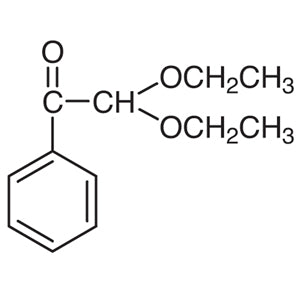
2,2-Diethoxyacetophenone is a chemical compound widely used in various chemical reactions, particularly in polymerization processes. This material plays a crucial role in laboratories where controlled chemical reactions are essential for producing polymers and composite materials. Its unique structure, containing a phenyl group and two ethoxy groups, contributes to its reactivity and makes it a valuable reagent in synthetic chemistry. It is especially important in applications where light-sensitive materials need to be synthesized efficiently and reliably.
The compound is known for its stability in liquid form and its high reactivity, which makes it a preferred choice for researchers seeking precision in their experiments. Its ability to act as a photoinitiator in photopolymerization reactions is a key factor in its popularity. This property allows it to be used in environments where light is the trigger for chemical transformations, ensuring consistent and reproducible results. Its chemical stability also ensures that it remains effective over time, even under standard laboratory conditions.
In Indonesian laboratories, 2,2-Diethoxyacetophenone is commonly used in the development of light-sensitive polymers, coatings, and composite materials. Its availability and consistent quality make it a reliable choice for researchers working on advanced materials. Its role in photopolymerization processes is particularly important in industries that rely on precise chemical reactions for product development and innovation.
TCI brochures (PDF)
- Biomaterials Research Reagents 2025-02-19 · p. 25
Related TCI products
- TCI A0104 121-71-1 3'-Hydroxyacetophenone
- TCI A0502 84-65-1 Anthraquinone
- TCI A0508 153277-35-1 Sodium Anthraquinone-2-sulfonate Monohydrate
- TCI A0061 98-86-2 Acetophenone
- TCI T4393 460731-17-3 Triphenylsulfonium Bis(trifluoromethanesulfonyl)imide
- TCI T4223 1195763-48-4 (9-Oxo-9H-thioxanthen-2-yl)[4-[(9-oxo-9H-thioxanthen-2-yl)thio]phenyl](phenyl)sulfonium Tetrakis(perfluorophenyl)borate
- Photopolymerization Reactions: This compound is ideal for initiating polymerization under light, making it suitable for creating light-sensitive materials used in coatings and composites.
- Composite Material Synthesis: Its reactivity allows it to be used in the production of advanced composites, enhancing the structural properties of the final product.
- Coating Formulations: It is commonly used in the development of UV-curable coatings, providing durability and resistance to environmental factors.
- Polymerization Research: Its stability and reactivity make it a preferred reagent in polymerization studies, supporting scientific innovation and material development.
- Light-Sensitive Polymer Development: It enables the creation of polymers that respond to light, useful in applications such as photolithography and 3D printing.
| Brand | TCI |
|---|---|
| CAS number | 6175-45-7 |
| Molecular formula | — |
| Purity | — |
| Category | Materials Science > Polymer/Macromolecule Reagents > Polymerization Reagents |
| Pack sizes | Available in various sizes as per standard laboratory requirements |
| Physical form | Liquid |
| Storage | Store in a cool, dark place away from direct sunlight |
This compound should be stored in a cool, dark place to maintain its stability and effectiveness. It is recommended to use airtight containers to prevent exposure to moisture and air, which may affect its reactivity. Due to its chemical nature, it should be handled with care, using appropriate personal protective equipment such as gloves and safety goggles. It is important to ensure that it is kept away from incompatible substances to avoid any potential chemical reactions. Regular monitoring of storage conditions is advised to ensure the compound remains in optimal condition for laboratory use.
—
Product Categories
Produk Terkait
-
3'-Hydroxyacetophenone TCI A0104
Regular price From Rp 1.060.500,00Regular price -
Anthraquinone TCI A0502
Regular price From Rp 477.750,00Regular price -
SodiumAnthraquinone-2-sulfonateMonohydrate TCI A0508
Regular price From Rp 769.650,00Regular price -
Acetophenone TCI A0061
Regular price From Rp 769.650,00Regular price -
TriphenylsulfoniumBis(trifluoromethanesulfonyl)imide TCI T4393
Regular price From Rp 1.246.350,00Regular price -
(9-Oxo-9H-thioxanthen-2-yl)[4-[(9-oxo-9H-thioxanthen-2-yl)thio]phenyl](phenyl)sulfoniumTetrakis(perfluorophenyl)borate TCI T4223
Regular price From Rp 1.590.750,00Regular price -
(9-Oxo-9H-thioxanthen-2-yl)[4-[(9-oxo-9H-thioxanthen-2-yl)thio]phenyl](phenyl)sulfoniumTrifluorotris(perfluoroethyl)phosphate(V) TCI T4222
Regular price From Rp 2.199.750,00Regular price -
1,2-Bis(4-methoxyphenyl)-2-oxoethylCyclohexylcarbamate TCI B5085
Regular price From Rp 1.829.100,00Regular price


![1195763-48-4 (9-Oxo-9H-thioxanthen-2-yl)[4-[(9-oxo-9H-thioxanthen-2-yl)thio]phenyl](phenyl)sulfonium Tetrakis(perfluorophenyl)borate - AMI Scientific](http://amiscientific.com/cdn/shop/files/TCI2510T4223.jpg?v=1767144890&width=533)
![1195763-42-8 (9-Oxo-9H-thioxanthen-2-yl)[4-[(9-oxo-9H-thioxanthen-2-yl)thio]phenyl](phenyl)sulfonium Trifluorotris(perfluoroethyl)phosphate(V) - AMI Scientific](http://amiscientific.com/cdn/shop/files/TCI2510T4222.jpg?v=1767144886&width=533)
