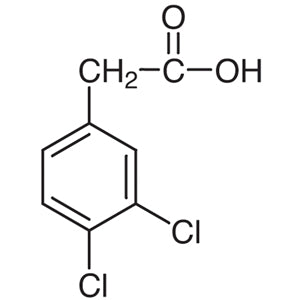
3,4-Dichlorophenylacetic Acid is a chemical compound widely used in laboratory settings for the synthesis of complex molecules. As a building block in organic chemistry, it plays a crucial role in the development of pharmaceuticals and other specialized chemical products. Its versatility makes it an essential component in various synthetic pathways, supporting both academic and industrial research. This compound is particularly valued for its ability to participate in a range of chemical reactions, including substitution and functional group modifications.
The compound's stable molecular structure and reactive nature make it a preferred choice for chemists. It exhibits good reactivity with a variety of reagents, allowing for the creation of new compounds with tailored properties. Its chemical stability ensures consistent performance in laboratory experiments, while its reactivity supports the development of novel synthetic strategies. These characteristics make it a reliable and effective tool for researchers working in diverse fields.
In Indonesian laboratories, 3,4-Dichlorophenylacetic Acid is commonly used in organic chemistry research, drug development, and the study of bioactive compounds. Its availability supports the execution of experiments requiring specific and reliable chemical building blocks. Its applications span across multiple scientific disciplines, making it a valuable resource for both academic and industrial research activities.
- Synthesis of pharmacological compounds requiring a phenylacetate structure, as it provides a stable and reactive core for further modification.
- Halogen substitution reactions on carbon chains to produce new organic compounds with tailored functional groups.
- Research into the biological activity of organic compounds, as it serves as a base for developing bioactive molecules.
- Development of chemical materials for pharmaceutical and industrial applications, due to its versatility in synthetic pathways.
- Organic chemistry experiments involving functional group transformations, where its reactivity supports efficient reaction conditions.
| Brand | TCI |
|---|---|
| CAS number | 5807-30-7 |
| Molecular formula | — |
| Purity | — |
| Category | Chemistry > Building Blocks > Non-Heterocyclic Building Blocks |
| Pack sizes | Available in various quantities as per standard laboratory supply |
| Physical form | Solid |
| Storage | Store in a cool, dry place away from direct sunlight |
This compound should be stored in a cool, dry environment, away from direct sunlight and sources of heat. It is recommended to use sealed containers to prevent moisture absorption and contamination. Due to its chemical reactivity, it should be handled with appropriate personal protective equipment, such as gloves and safety goggles. Ensure proper ventilation in the workspace to minimize exposure to vapors. Avoid contact with incompatible materials, such as strong oxidizers or acids. Regularly inspect storage containers for integrity to maintain the compound's stability and effectiveness in laboratory applications.
—
Produk Terkait
-
2,3-DichlorophenylaceticAcid TCI D2931
Regular price From Rp 1.246.350,00Regular price -
2,6-DichlorophenylaceticAcid TCI D1897
Regular price Rp 3.155.250,00Regular price -
2,4-DichlorophenylaceticAcid TCI D1812
Regular price Rp 717.150,00Regular price