

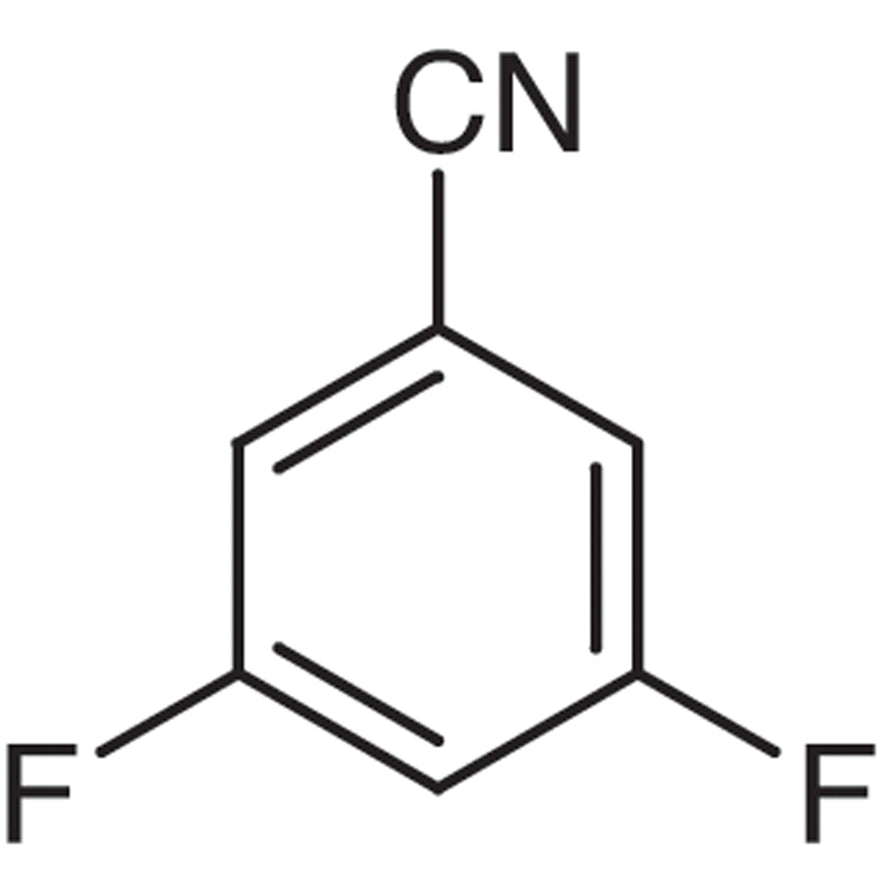
TCI D2081 3,5-Difluorobenzonitrile is a fluorinated building block consisting of a benzene ring that carries one nitrile group together with two fluorine atoms positioned meta to that nitrile. In the laboratory it is valued as a starting material for the synthesis of high-value molecules, particularly in medicinal chemistry and agrochemical research, because the introduction of fluorine atoms is a common strategy for improving the metabolic stability, solubility and binding affinity of an active compound candidate. The nitrile group simultaneously serves as an anchor point for transformation into the various other functional groups required in later synthetic steps.
The property that makes this compound a preferred choice is the balance it strikes between directed reactivity and the stability of the aromatic framework. The nitrile group is a strong electron-withdrawing substituent, so the ring becomes electron-deficient and the ring fluorine atoms are more readily displaced through nucleophilic aromatic substitution by amines, alkoxides or thiolates. The 3,5-substitution pattern provides a symmetry that simplifies the interpretation of NMR spectra and reduces the number of regioisomeric products that can form. In addition, the nitrile group can be hydrolysed toward carboxylic acid functionality, extending the range of accessible derivatives from a single intermediate.
In Indonesian laboratories, this building block is typically used in university and institutional synthetic chemistry groups, in medicinal chemistry and agrochemical research programmes, and in method development work where a well-defined fluorinated aromatic intermediate is required. It is normally handled at bench scale within a fume hood as part of multi-step synthetic routes, with reaction products characterised by NMR and other routine analytical techniques available in the host laboratory.
TCI brochures (PDF)
- Fluorination Reagents, Fluorinated Building Blocks 2026-03-18 · p. 30
Related TCI products
- Nucleophilic aromatic substitution studies — the electron-deficient ring activated by the nitrile group allows ring fluorine to be displaced cleanly by amine, alkoxide or thiolate nucleophiles.
- Medicinal chemistry intermediate synthesis — fluorine incorporation is a recognised strategy for improving metabolic stability, solubility and binding affinity of active compound candidates under investigation.
- Agrochemical research programmes — serves as a defined fluorinated aromatic starting material for building candidate structures explored in crop protection and related agrochemical discovery work.
- Functional group interconversion work — the nitrile group acts as an anchor that can be hydrolysed toward carboxylic acid functionality or converted into other groups needed downstream.
- Multi-step route development and NMR method work — the symmetrical 3,5-substitution pattern simplifies spectral interpretation and limits the number of possible regioisomeric products formed.
| Brand | TCI (Tokyo Chemical Industry) |
|---|---|
| CAS number | 64248-63-1 |
| Molecular formula | — |
| Purity | — |
| Category | Chemistry > Building Blocks > Fluorinated Building Blocks |
| Pack sizes | available in standard TCI research-scale packaging; please confirm the size required when ordering |
| Physical form | — |
| Storage | keep in the tightly closed original container in a cool, dry, well-ventilated place away from incompatible materials |
- Catalogue number: D2081
Store the material in its tightly closed original container in a cool, dry and well-ventilated area, protected from direct sunlight, heat sources and moisture, and kept separate from strong oxidising agents, strong acids and strong bases. Use chemically compatible containers and clean, dry spatulas or transfer tools to avoid contamination of the remaining stock. All weighing, transfer and reaction operations should be carried out inside a functioning fume hood by trained personnel wearing a laboratory coat, safety glasses and suitable chemical-resistant gloves. Avoid inhalation of dust and any contact with skin or eyes, and label all working solutions clearly. Consult the manufacturer's safety data sheet before first use and dispose of residues and contaminated consumables through the laboratory's chemical waste route in accordance with local regulations.
—
Produk Terkait
-
4-Bromo-2,6-difluorobenzonitrile TCI B4021
Regular price From Rp 980.700,00Regular price -
4-Amino-2,5-difluorobenzonitrile TCI A2106
Regular price From Rp 769.650,00Regular price -
2,3-Difluorobenzonitrile TCI D3500
Regular price From Rp 557.550,00Regular price -
3,4-Difluorobenzonitrile TCI D2341
Regular price From Rp 903.000,00Regular price -
2,5-Difluorobenzonitrile TCI D1834
Regular price From Rp 1.405.950,00Regular price -
2,4-Difluorobenzonitrile TCI D1826
Regular price From Rp 769.650,00Regular price -
2,6-Difluorobenzonitrile TCI D1650
Regular price From Rp 1.167.600,00Regular price


