

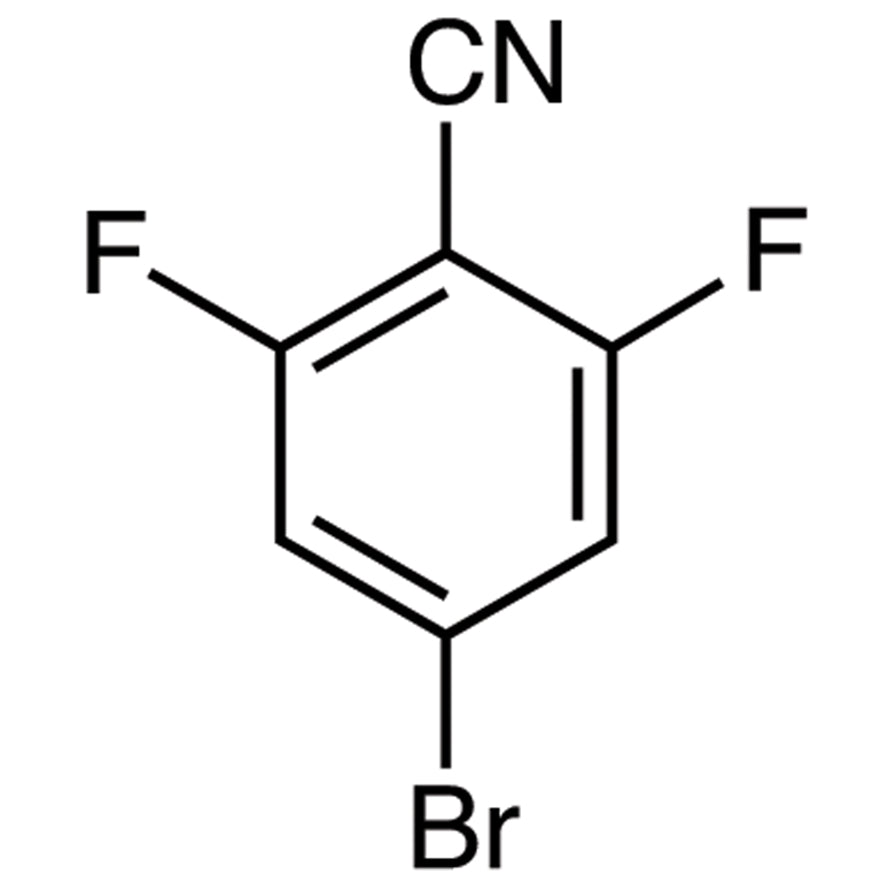
4-Bromo-2,6-difluorobenzonitrile is a versatile chemical compound widely used in organic synthesis as a building block in laboratory settings. It serves as a key intermediate in the development of complex organic molecules, particularly in pharmaceutical and materials science research. Its unique molecular structure, featuring a benzene ring substituted with bromo, fluoro, and nitrile groups, allows it to participate in a variety of chemical reactions. This compound plays a crucial role in the functionalization of aromatic systems and the introduction of halogen and nitrile functionalities into organic frameworks.
The compound's chemical properties make it a preferred choice for synthetic chemists. It exhibits high polarity due to its bromo and fluoro substituents, which enhance its solubility in organic solvents. This solubility profile facilitates its use in substitution reactions, nitrilation, and other high-reactivity processes. Additionally, its reactivity under specific conditions, such as elevated temperatures or the presence of catalysts, allows for controlled chemical transformations. These properties make it an essential reagent in the synthesis of compounds requiring precise functional group modifications.
In Indonesian laboratories, this compound is commonly utilized by researchers in chemistry, pharmacy, and academia. It is frequently employed in the development of new drugs, polymers, and specialty chemicals. Its availability through reliable suppliers like AMI Scientific ensures that Indonesian researchers have access to this important building block for their experimental work.
TCI brochures (PDF)
- Fluorination Reagents, Fluorinated Building Blocks 2026-03-18 · p. 29
- Organic synthesis for the preparation of halogenated and nitrile-containing compounds due to its reactive functional groups.
- Pharmaceutical research for the development of new drug molecules requiring specific halogen and nitrile substitutions.
- Materials science applications in the creation of advanced polymers and functional materials with tailored properties.
- Academic research in chemistry and pharmacology for the exploration of novel synthetic pathways and molecular structures.
- Industrial chemical production for the manufacture of specialty chemicals and intermediates used in various industries.
| Brand | TCI |
|---|---|
| CAS number | 123843-67-4 |
| Molecular formula | — |
| Purity | — |
| Category | Chemistry > Building Blocks > Fluorinated Building Blocks |
| Pack sizes | Available in various quantities as per supplier specifications |
| Physical form | Liquid or solid, depending on the specific product variant |
| Storage | Store in a cool, dry place away from light and incompatible materials |
This compound should be stored in a cool, dry environment, away from direct sunlight and sources of heat. It is recommended to use airtight containers made of materials compatible with its chemical properties, such as glass or high-density polyethylene. Due to its reactivity, it should be handled in a well-ventilated area, preferably under a fume hood, to minimize exposure. Avoid contact with incompatible substances like strong bases or reducing agents. Always follow standard laboratory safety protocols, including the use of personal protective equipment such as gloves and goggles. Proper labeling and storage conditions are essential to ensure the stability and safety of the compound during handling and use.
—
Produk Terkait
-
4-Amino-2,5-difluorobenzonitrile TCI A2106
Regular price From Rp 822.150,00Regular priceRp 590.100,00Sale price From Rp 822.150,00 -
2,3-Difluorobenzonitrile TCI D3500
Regular price From Rp 610.050,00Regular priceRp 442.050,00Sale price From Rp 610.050,00 -
3,4-Difluorobenzonitrile TCI D2341
Regular price From Rp 955.500,00Regular priceRp 683.550,00Sale price From Rp 955.500,00 -
3,5-Difluorobenzonitrile TCI D2081
Regular price Rp 1.405.950,00Regular priceRp 998.550,00Sale price Rp 1.405.950,00 -
2,5-Difluorobenzonitrile TCI D1834
Regular price From Rp 1.458.450,00Regular priceRp 1.035.300,00Sale price From Rp 1.458.450,00 -
2,4-Difluorobenzonitrile TCI D1826
Regular price From Rp 822.150,00Regular priceRp 590.100,00Sale price From Rp 822.150,00 -
2,6-Difluorobenzonitrile TCI D1650
Regular price From Rp 1.220.100,00Regular priceRp 868.350,00Sale price From Rp 1.220.100,00 -
2-Bromo-4'-(trifluoromethyl)acetophenone TCI T2747
Regular price From Rp 1.618.050,00Regular priceRp 1.146.600,00Sale price From Rp 1.618.050,00


