

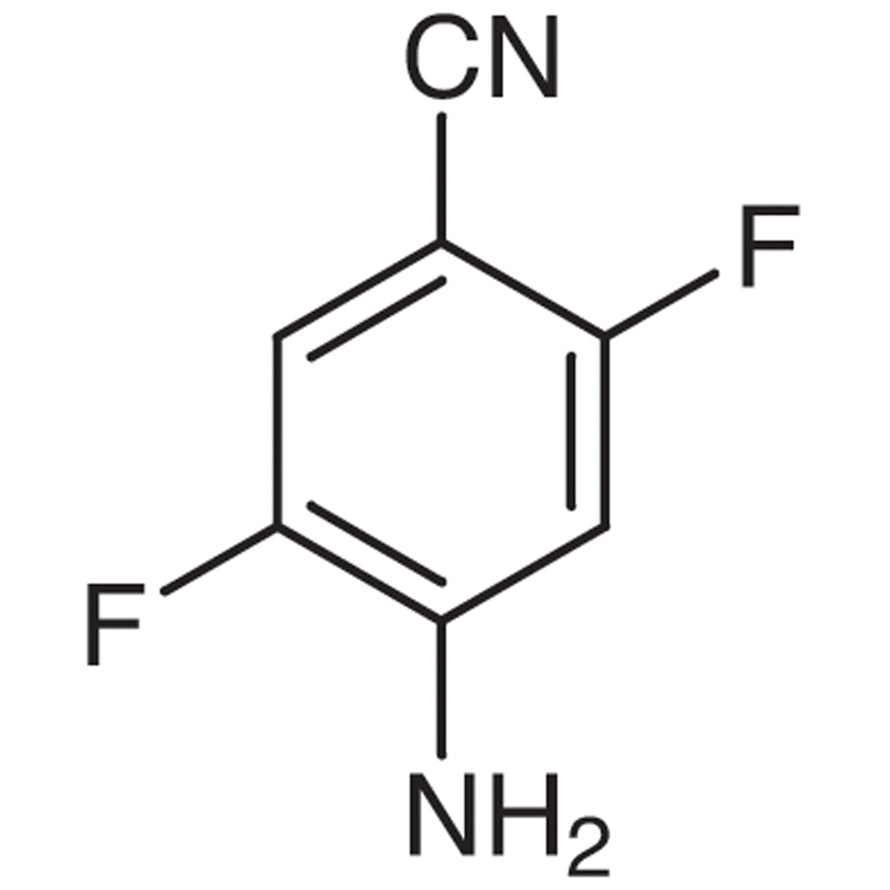
4-Amino-2,5-difluorobenzonitrile is a chemical compound widely used in organic synthesis reactions within laboratory settings. It serves as a crucial building block in the development of complex molecules, particularly in the synthesis of heterocyclic compounds, pharmaceuticals, and industrial chemicals. Its unique molecular structure, featuring an amino group, two fluorine atoms, and a nitrile group, makes it highly versatile for various chemical transformations. This compound is essential for researchers aiming to create new materials or compounds with specific functional properties.
The compound’s chemical properties, including its stability under controlled conditions and its reactivity in substitution, condensation, and electrophilic reactions, make it a preferred choice in synthetic chemistry. The presence of fluorine and nitrile groups significantly influences its polarity and reactivity, enabling it to participate in a wide range of chemical processes. These characteristics are particularly valuable in the design of compounds with tailored reactivity and selectivity. Its chemical versatility supports advanced research in multiple scientific disciplines.
In Indonesian laboratories, 4-Amino-2,5-difluorobenzonitrile is commonly used in organic chemistry, pharmaceutical research, and material science. It is a key component in the development of new drugs and industrial materials. Many research institutions and universities in Indonesia rely on this compound to advance their studies in chemical synthesis and innovation. Its application spans across various scientific fields, making it an essential reagent for modern laboratory work.
TCI brochures (PDF)
- Fluorination Reagents, Fluorinated Building Blocks 2026-03-18 · p. 31
- Organic synthesis is a primary application where this compound is used to construct complex molecules due to its versatile functional groups.
- Pharmaceutical research benefits from its ability to participate in reactions that lead to the development of new drug candidates.
- Material science applications leverage its chemical reactivity to create novel compounds with specific physical and chemical properties.
- Heterocyclic compound synthesis relies on its structural features to form ring systems essential in pharmaceutical and industrial applications.
- Industrial chemical production utilizes its reactivity to create intermediates for a wide range of chemical products.
| Brand | TCI |
|---|---|
| CAS number | 112279-61-5 |
| Molecular formula | — |
| Purity | — |
| Category | Chemistry > Building Blocks > Fluorinated Building Blocks |
| Pack sizes | Available in various quantities as per supplier specifications |
| Physical form | Solid or liquid, depending on the specific product variant |
| Storage | Store in a cool, dry place away from light and incompatible substances |
This compound should be stored in a cool, dry environment, away from direct sunlight and sources of heat. It is recommended to use airtight containers to prevent moisture absorption and contamination. Due to its chemical nature, it should be kept separate from incompatible materials such as strong oxidizers or acids. Proper labeling and storage conditions are essential to ensure safety and maintain its chemical integrity. Laboratory personnel should always wear appropriate personal protective equipment when handling this compound to minimize exposure risks. Regular monitoring of storage conditions helps ensure the compound remains stable and suitable for use in research applications.
—
Produk Terkait
-
4-Bromo-2,6-difluorobenzonitrile TCI B4021
Regular price From Rp 1.011.000,00Regular priceRp 703.000,00Sale price From Rp 1.011.000,00 -
2,3-Difluorobenzonitrile TCI D3500
Regular price From Rp 595.000,00Regular priceRp 421.000,00Sale price From Rp 595.000,00 -
3,4-Difluorobenzonitrile TCI D2341
Regular price From Rp 933.000,00Regular priceRp 651.000,00Sale price From Rp 933.000,00 -
3,5-Difluorobenzonitrile TCI D2081
Regular price Rp 1.375.000,00Regular priceRp 951.000,00Sale price Rp 1.375.000,00 -
2,5-Difluorobenzonitrile TCI D1834
Regular price From Rp 1.426.000,00Regular priceRp 986.000,00Sale price From Rp 1.426.000,00 -
2,4-Difluorobenzonitrile TCI D1826
Regular price From Rp 803.000,00Regular priceRp 562.000,00Sale price From Rp 803.000,00 -
2,6-Difluorobenzonitrile TCI D1650
Regular price From Rp 1.193.000,00Regular priceRp 827.000,00Sale price From Rp 1.193.000,00 -
2-Amino-5-fluorobenzamide TCI A3181
Regular price Rp 1.478.000,00Regular priceRp 1.021.000,00Sale price Rp 1.478.000,00


