

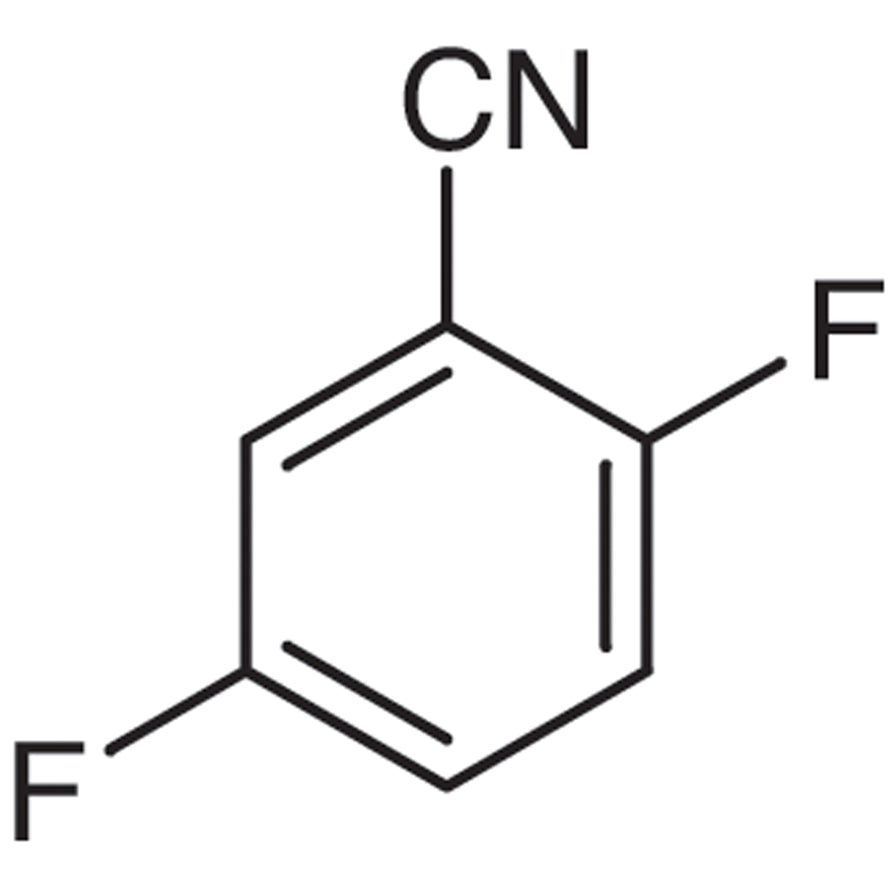
2,5-Difluorobenzonitrile is a chemical compound widely used as a building block in the synthesis of complex organic molecules. It plays a crucial role in laboratory settings, particularly in the development of new compounds within pharmaceutical and materials science research. This compound is a key reagent in various chemical reactions that involve fluorine substitution on aromatic structures, making it essential for synthetic chemists. Its unique chemical properties allow it to participate in nucleophilic substitution and covalent reactions, contributing to the creation of functionalized compounds with specific applications.
The compound’s electronic properties and reactivity make it a preferred choice for chemists seeking to modify aromatic systems with fluorine atoms. Its stability under controlled conditions, combined with its reactivity, enables it to be easily transformed into a wide range of functional compounds, such as pharmaceuticals, polymers, and electronic materials. The presence of two fluorine atoms at positions 2 and 5 on the benzene ring imparts unique characteristics that are beneficial in both academic and industrial research. These properties make it a versatile tool in the chemical synthesis toolkit.
In Indonesian laboratories, 2,5-Difluorobenzonitrile is extensively used in scientific research and educational settings. Many research institutions and universities rely on this compound for chemical experiments, compound development, and teaching synthesis techniques. Its availability and reliable chemical properties make it a top choice for various scientific applications. Its role in advancing both academic and industrial research is well established in the Indonesian scientific community.
TCI brochures (PDF)
- Fluorination Reagents, Fluorinated Building Blocks 2026-03-18 · p. 32
Related TCI products
- Organic Synthesis: This compound is ideal for creating complex organic molecules due to its reactivity and ability to undergo nucleophilic substitution.
- Pharmaceutical Research: It is used in drug development to introduce fluorine atoms into aromatic structures, enhancing compound stability and biological activity.
- Materials Science: Its unique electronic properties make it suitable for synthesizing advanced polymers and electronic materials.
- Academic Teaching: It is commonly used in educational settings to demonstrate fluorine substitution reactions and synthetic techniques.
- Industrial Chemistry: It serves as a building block for the production of specialized chemical products in industrial laboratories.
| Brand | TCI |
|---|---|
| CAS number | 64248-64-2 |
| Molecular formula | — |
| Purity | — |
| Category | Chemistry > Building Blocks > Fluorinated Building Blocks |
| Pack sizes | Available in various quantities as per standard laboratory supply |
| Physical form | Liquid |
| Storage | Store in a cool, dry place away from light and incompatible materials |
This compound should be stored in a cool, dry environment, away from direct sunlight and sources of heat. It is recommended to keep it in a tightly sealed container to prevent exposure to moisture and air. Due to its chemical reactivity, it should be handled with appropriate personal protective equipment, including gloves and safety goggles. Storage should be in a well-ventilated area, and it should not be stored near incompatible substances such as strong oxidizers or acids. Proper labeling and safe handling are essential to ensure the safety of laboratory personnel and the integrity of the compound.
—
Produk Terkait
-
4-Bromo-2,6-difluorobenzonitrile TCI B4021
Regular price From Rp 980.700,00Regular price -
4-Amino-2,5-difluorobenzonitrile TCI A2106
Regular price From Rp 769.650,00Regular price -
2,3-Difluorobenzonitrile TCI D3500
Regular price From Rp 557.550,00Regular price -
3,4-Difluorobenzonitrile TCI D2341
Regular price From Rp 903.000,00Regular price -
3,5-Difluorobenzonitrile TCI D2081
Regular price Rp 1.353.450,00Regular price -
2,4-Difluorobenzonitrile TCI D1826
Regular price From Rp 769.650,00Regular price -
2,6-Difluorobenzonitrile TCI D1650
Regular price From Rp 1.167.600,00Regular price


