2,4-Diethylthioxanthen-9-one from TCI is a thioxanthone derivative widely known as a Type II photoinitiator in materials science and polymer chemistry. When the compound absorbs ultraviolet light, it enters an excited state. In that state it abstracts a hydrogen atom from a co-initiator, usually a tertiary amine, and the resulting radicals start the polymerization of acrylate and similar monomers. In the laboratory, this material is a key component in formulating UV curing systems, in photopolymerization research, and in developing light-shaped materials.
Researchers choose 2,4-Diethylthioxanthen-9-one because its thioxanthone framework absorbs at relatively long wavelengths within the UV region. This makes it suitable for light sources such as mercury lamps and certain UV LEDs. The two ethyl groups on the aromatic ring improve its solubility in organic monomers and resins, so it is easier to blend into formulations. The compound is also often combined with other photoinitiators to improve curing in pigmented coatings and thick layers, where light penetration is more limited.
In Indonesia, this material is relevant to materials chemistry laboratories at universities, research centers, and industrial research and development departments that work with coatings, inks, adhesives, and photocurable resins. Graduate students and researchers use it to study curing kinetics, to compare photoinitiator systems, and to prepare test formulations for UV-cured products. Laboratories that are developing light-based processing methods also find it a practical reference compound, because it is so well established in the photopolymerization literature.
TCI brochures (PDF)
- Polymerization Initiators 2025-09-17 · p. 4
- Biomaterials Research Reagents 2025-02-19 · p. 25
Related TCI products
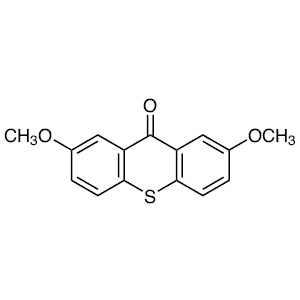
- TCI D5917 435344-88-0 2,7-Dimethoxy-9H-thioxanthen-9-one
- TCI T4223 1195763-48-4 (9-Oxo-9H-thioxanthen-2-yl)[4-[(9-oxo-9H-thioxanthen-2-yl)thio]phenyl](phenyl)sulfonium Tetrakis(perfluorophenyl)borate
- TCI T4222 1195763-42-8 (9-Oxo-9H-thioxanthen-2-yl)[4-[(9-oxo-9H-thioxanthen-2-yl)thio]phenyl](phenyl)sulfonium Trifluorotris(perfluoroethyl)phosphate(V)
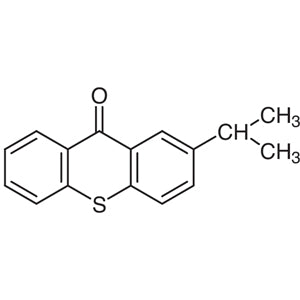
- TCI I0678 5495-84-1 2-Isopropylthioxanthone
- TCI A0104 121-71-1 3'-Hydroxyacetophenone
- TCI A0502 84-65-1 Anthraquinone
- UV curing formulation development: the compound acts as a Type II photoinitiator that, together with an amine co-initiator, generates radicals that cure acrylate coatings and resins under ultraviolet light.
- Photopolymerization research: its well-characterized hydrogen-abstraction mechanism makes it a useful model photoinitiator for studying radical generation, curing behavior, and monomer conversion in laboratory experiments.
- Pigmented and thick-layer curing studies: researchers pair it with other photoinitiators because its longer-wavelength UV absorption helps improve curing in pigmented coatings and thicker layers.
- LED and mercury lamp curing systems: its absorption in the longer-wavelength UV region allows it to work with mercury lamps and certain UV LEDs, so it supports comparisons between light sources.
- Inks, adhesives, and photocurable resin research: the ethyl groups improve its solubility in organic monomers and resins, so it blends readily into experimental ink, adhesive, and resin formulations.
| Brand | TCI (product code D2375) |
|---|---|
| CAS number | 82799-44-8 |
| Molecular formula | — |
| Purity | — |
| Category | Materials Science > Polymer/Macromolecule Reagents > Polymerization Reagents |
| Pack sizes | available in the pack sizes offered by TCI; please contact AMI Scientific for current options |
| Physical form | — |
| Storage | keep tightly closed and protected from light, following the manufacturer's label and SDS |
- Chemical class: thioxanthone derivative, Type II photoinitiator
Because 2,4-Diethylthioxanthen-9-one is designed to respond to ultraviolet light, it should be stored in its original tightly sealed container, protected from light, in a cool, dry, and well-ventilated area. Amber or opaque containers help prevent unwanted exposure when portions are transferred. Keep the material away from strong oxidizing agents and sources of heat. When handling it, wear standard laboratory protective equipment, including gloves, safety glasses, and a lab coat, and work in a fume hood or well-ventilated area to avoid inhaling dust or vapors. Prepare photocurable formulations under subdued or filtered lighting to prevent premature curing. Always consult the Safety Data Sheet supplied by TCI for specific hazard, storage, and disposal information, and dispose of waste according to local regulations.
—
Product Categories
Produk Terkait
-
2,7-Dimethoxy-9H-thioxanthen-9-one TCI D5917
Regular price From Rp 2.048.000,00Regular priceRp 1.409.000,00Sale price From Rp 2.048.000,00 -
(9-Oxo-9H-thioxanthen-2-yl)[4-[(9-oxo-9H-thioxanthen-2-yl)thio]phenyl](phenyl)sulfoniumTetrakis(perfluorophenyl)borate TCI T4223
Regular price From Rp 1.608.000,00Regular priceRp 1.109.000,00Sale price From Rp 1.608.000,00 -
(9-Oxo-9H-thioxanthen-2-yl)[4-[(9-oxo-9H-thioxanthen-2-yl)thio]phenyl](phenyl)sulfoniumTrifluorotris(perfluoroethyl)phosphate(V) TCI T4222
Regular price From Rp 2.204.000,00Regular priceRp 1.515.000,00Sale price From Rp 2.204.000,00 -
2-Isopropylthioxanthone TCI I0678
Regular price Rp 1.945.000,00Regular priceRp 1.339.000,00Sale price Rp 1.945.000,00 -
3'-Hydroxyacetophenone TCI A0104
Regular price From Rp 1.089.000,00Regular priceRp 756.000,00Sale price From Rp 1.089.000,00 -
Anthraquinone TCI A0502
Regular price From Rp 468.000,00Regular priceRp 318.000,00Sale price From Rp 468.000,00 -
SodiumAnthraquinone-2-sulfonateMonohydrate TCI A0508
Regular price From Rp 803.000,00Regular priceRp 562.000,00Sale price From Rp 803.000,00 -
Acetophenone TCI A0061
Regular price From Rp 753.000,00Regular priceRp 512.000,00Sale price From Rp 753.000,00

![TCI T4223 1195763-48-4 (9-Oxo-9H-thioxanthen-2-yl)[4-[(9-oxo-9H-thioxanthen-2-yl)thio]phenyl](phenyl)sulfonium Tetrakis(perfluorophenyl)borate](http://amiscientific.com/cdn/shop/files/TCI2510T4223_cf7e9d09-4622-438c-8f99-db5b99de2771.jpg?v=1792664587&width=533)
![1195763-48-4 (9-Oxo-9H-thioxanthen-2-yl)[4-[(9-oxo-9H-thioxanthen-2-yl)thio]phenyl](phenyl)sulfonium Tetrakis(perfluorophenyl)borate - AMI Scientific](http://amiscientific.com/cdn/shop/files/TCI2510T4223.jpg?v=1767144890&width=533)
![TCI T4222 1195763-42-8 (9-Oxo-9H-thioxanthen-2-yl)[4-[(9-oxo-9H-thioxanthen-2-yl)thio]phenyl](phenyl)sulfonium Trifluorotris(perfluoroethyl)phosphate(V)](http://amiscientific.com/cdn/shop/files/TCI2510T4222_7a31efd1-7ca2-41c4-a301-b134fb356b52.jpg?v=1792664585&width=533)
![1195763-42-8 (9-Oxo-9H-thioxanthen-2-yl)[4-[(9-oxo-9H-thioxanthen-2-yl)thio]phenyl](phenyl)sulfonium Trifluorotris(perfluoroethyl)phosphate(V) - AMI Scientific](http://amiscientific.com/cdn/shop/files/TCI2510T4222.jpg?v=1767144886&width=533)