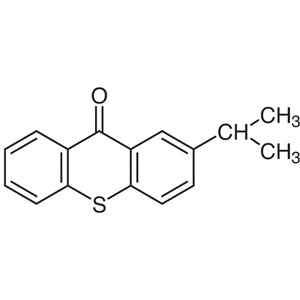
2-Isopropylthioxanthone is a chemical compound widely used as a photoinitiator in chemical reactions that require light activation. This compound plays a crucial role in laboratories where light-induced chemical processes are essential. It is commonly applied in various chemical applications such as photopolymerization, synthesis of complex compounds, and photchemical reactions. In the laboratory setting, it functions as an activator that triggers chemical reactions through exposure to ultraviolet (UV) light. Its ability to absorb UV light and initiate reactions efficiently makes it a valuable tool in modern chemical research.
One of the key properties that make 2-Isopropylthioxanthone a preferred choice is its stability under certain conditions, allowing for broader application in different experimental setups. Its complex molecular structure also makes it an attractive material for organic synthesis research. The compound's effectiveness in initiating photochemical reactions without requiring high energy input further enhances its appeal. These characteristics contribute to its reliability and consistency in laboratory environments, ensuring reproducible results.
In Indonesian laboratories, 2-Isopropylthioxanthone is frequently used in organic chemistry research, particularly in the fields of materials and technology. It is a popular choice due to its availability and its ability to participate in a variety of light-activated chemical reactions. Its role in advancing research in synthetic chemistry makes it an essential component in many laboratory workflows.
- Organic synthesis of complex compounds requires light activation, and this compound is ideal for initiating such reactions efficiently.
- Photopolymerization processes benefit from its ability to absorb UV light and trigger cross-linking reactions in polymers.
- Photocatalytic reactions in material science rely on its stability and effectiveness in light-activated environments.
- UV-sensitive chemical processes in analytical chemistry utilize its consistent performance under controlled light exposure.
- Research in photochemical reactions demands reliable initiators, and this compound provides a stable and efficient option.
| Brand | TCI |
|---|---|
| CAS number | 5495-84-1 |
| Molecular formula | — |
| Purity | — |
| Category | Chemistry > Building Blocks > Heterocyclic Building Blocks |
| Pack sizes | Available in various quantities as per supplier specifications |
| Physical form | Solid |
| Storage | Store in a cool, dry place away from direct sunlight |
This compound should be stored in a cool, dry environment, away from direct sunlight to maintain its stability and effectiveness. It is recommended to use airtight containers to prevent moisture absorption and contamination. Proper labeling of containers is essential for safe handling and easy identification. Laboratory personnel should wear appropriate personal protective equipment, such as gloves and safety goggles, when handling this material. It should be kept in a designated chemical storage area that is inaccessible to unauthorized individuals. Regular inspection of storage conditions ensures the compound remains in optimal condition for use in experiments.
—
Produk Terkait
-
TCI B5774 5,10-Bis(4,4,5,5-tetramethyl-1,3,2-dioxaborolan-2-yl)naphtho[1,2-c:5,6-c']bis([1,2,5]oxadiazole)
Regular price Rp 10.255.350,00Regular price -
Dihydroiodide TCI B6569
Regular price From Rp 1.936.200,00Regular price -
Trifluoromethanesulfonate TCI B7003
Regular price From Rp 1.936.200,00Regular price
![5,10-Bis(4,4,5,5-tetramethyl-1,3,2-dioxaborolan-2-yl)naphtho[1,2-c:5,6-c']bis([1,2,5]oxadiazole) - TCI B5774 - AMI Scientific](http://amiscientific.com/cdn/shop/files/TCI2510B5774.jpg?v=1769180228&width=533)