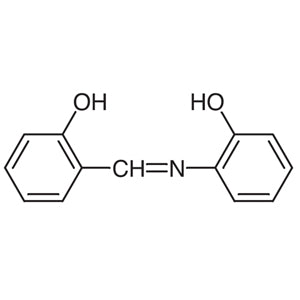
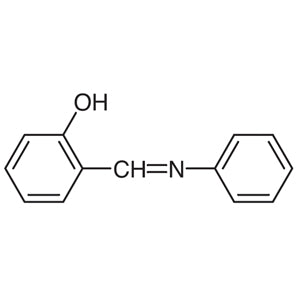
TCI D2572 N,N'-Bis(salicylidene)-1,2-phenylenediamine is a Schiff base ligand formed by the condensation of two molecules of salicylaldehyde with one molecule of ortho-phenylenediamine. The compound belongs to the family of aromatic salen ligands, which are widely recognised in coordination chemistry and catalysis. In the laboratory, its role is to provide a ready-to-use tetradentate binding framework for forming complexes with a range of transition metal ions such as copper, nickel, cobalt, manganese, iron, and zinc, so that researchers do not need to design and synthesise their own ligand from scratch.
The principal characteristic that makes this ligand a preferred choice is its strong chelating ability through four donor atoms: two imine nitrogens and two phenolic oxygens. The rigid ortho-phenylene backbone forces these four donors into a nearly coplanar arrangement, producing stable metal complexes with well-defined geometry. This rigidity and full conjugation also give the ligand interesting electronic and optical properties, so its complexes frequently display intense colours and photophysical behaviour that can be studied directly. Good thermal stability and straightforward complex formation under ordinary laboratory conditions further add to its practicality.
In Indonesian laboratories, this ligand is typically used in university and institutional research settings working on coordination chemistry, catalysis, and materials characterisation. It suits synthesis groups preparing metal–salen complexes for structural and spectroscopic study, as well as teaching laboratories demonstrating chelation and Schiff base condensation. Because complexation proceeds under ordinary bench conditions, it fits well into laboratories equipped with standard reflux, filtration, and spectroscopic instrumentation.
TCI brochures (PDF)
- Ligands 2025-12-01 · p. 10
Related TCI products
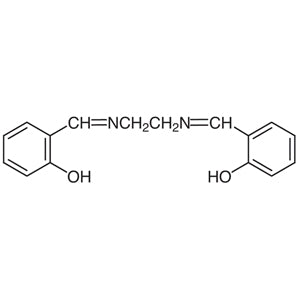
- TCI H0199 94-93-9 N,N'-Bis(salicylidene)ethylenediamine
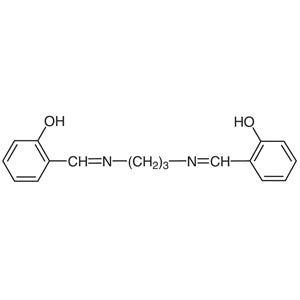
- TCI D1422 120-70-7 N,N'-Bis(salicylidene)-1,3-propanediamine
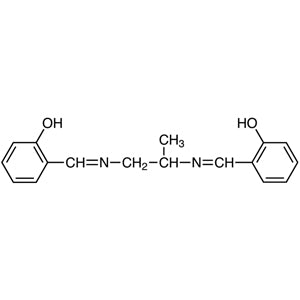
- TCI D1307 94-91-7 N,N'-Bis(salicylidene)-1,2-propanediamine
- TCI B4647 135616-36-3 (S,S)-(+)-N,N'-Bis(3,5-di-tert-butylsalicylidene)-1,2-cyclohexanediamine
- TCI B4418 135616-40-9 (R,R)-(-)-N,N'-Bis(3,5-di-tert-butylsalicylidene)-1,2-cyclohexanediamine
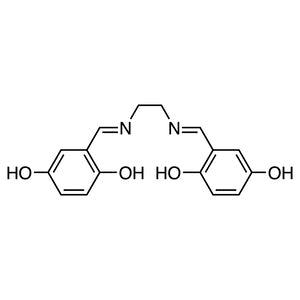
- TCI B3015 124061-43-4 N,N'-Bis(5-hydroxysalicylidene)ethylenediamine
- Preparation of metal–salen complexes: the tetradentate framework binds copper, nickel, cobalt, manganese, iron, and zinc directly, removing the need to synthesise a ligand in-house.
- Coordination chemistry research: the four donor atoms and rigid backbone give predictable, well-defined complex geometry, making structural interpretation of the resulting compounds far more straightforward.
- Catalysis studies: salen-type ligands are a well-established family in catalysis, and this compound provides a standard aromatic scaffold for preparing transition metal catalyst candidates.
- Spectroscopic and photophysical investigation: full conjugation across the ligand produces intensely coloured complexes whose electronic and optical behaviour can be examined by routine laboratory techniques.
- Teaching and demonstration work: the compound illustrates Schiff base condensation and chelation clearly, allowing students to observe complex formation under ordinary laboratory conditions.
| Brand | TCI |
|---|---|
| CAS number | 3946-91-6 |
| Molecular formula | — |
| Purity | — |
| Category | Chemistry > Catalysis and Inorganic Chemistry > Nitrogen-Donor Ligands [Catalysis] |
| Pack sizes | available in the standard TCI catalogue pack sizes; please confirm the required size when ordering |
| Physical form | — |
| Storage | keep in the tightly closed original container as indicated on the manufacturer's label |
- Chemical name: N,N'-Bis(salicylidene)-1,2-phenylenediamine
Store the material in its tightly closed original container, kept in a cool, dry, and well-ventilated area away from direct sunlight, moisture, and incompatible substances. Follow the storage conditions stated on the manufacturer's label and Safety Data Sheet, as these take precedence over general guidance. Handle the compound in a fume hood or a well-ventilated workspace, and wear appropriate personal protective equipment including safety goggles, a laboratory coat, and chemical-resistant gloves. Avoid generating dust, avoid inhalation and direct skin or eye contact, and use clean, dry spatulas and glassware when weighing or transferring to prevent contamination. Reseal the container promptly after use, label any working solutions clearly, and dispose of residues and contaminated materials in accordance with institutional chemical waste procedures.
—
Produk Terkait
-
N,N'-Bis(salicylidene)ethylenediamine TCI H0199
Regular price From Rp 1.298.850,00Regular price -
N,N'-Bis(salicylidene)-1,3-propanediamine TCI D1422
Regular price Rp 1.273.650,00Regular price -
N,N'-Bis(salicylidene)-1,2-propanediamine TCI D1307
Regular price From Rp 848.400,00Regular price -
(S,S)-(+)-N,N'-Bis(3,5-di-tert-butylsalicylidene)-1,2-cyclohexanediamine TCI B4647
Regular price From Rp 4.877.250,00Regular price -
(R,R)-(-)-N,N'-Bis(3,5-di-tert-butylsalicylidene)-1,2-cyclohexanediamine TCI B4418
Regular price From Rp 2.782.500,00Regular price -
N,N'-Bis(5-hydroxysalicylidene)ethylenediamine TCI B3015
Regular price From Rp 4.028.850,00Regular price -
2-Salicylideneaminophenol TCI S0328
Regular price From Rp 1.220.100,00Regular price -
N-Salicylideneaniline TCI S0267
Regular price From Rp 875.700,00Regular price