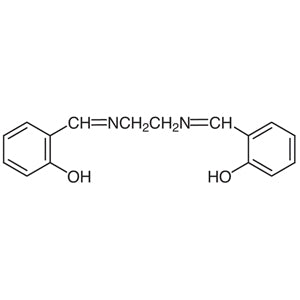
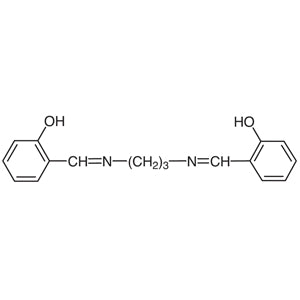
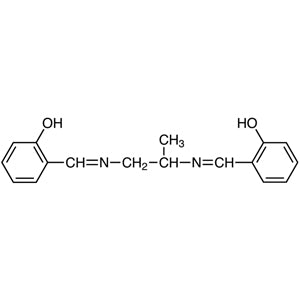
N,N’-Bis(5-hydroxysalicylidene)ethylenediamine is a nitrogen-donor ligand widely used in catalytic and inorganic chemistry applications within laboratory settings. This compound plays a crucial role in facilitating metal complex formation, which is essential for various chemical reactions. Its unique molecular structure allows it to act as a versatile ligand, enhancing the efficiency of catalytic processes. In research environments, it is frequently employed to accelerate chemical reactions, particularly in the synthesis of organic and inorganic compounds.
The compound’s chemical properties make it a preferred choice for laboratory use. It exhibits stability under certain conditions and can form active, selective metal complexes. Its ability to coordinate with a variety of transition metals enhances its applicability in different catalytic systems. Additionally, its structural complexity contributes to its effectiveness in creating highly reactive and functional metal-based compounds. These properties make it a valuable tool for researchers working in catalysis and inorganic chemistry.
In Indonesian laboratories, N,N’-Bis(5-hydroxysalicylidene)ethylenediamine is commonly used in scientific research, especially in the fields of organic and inorganic chemistry. It is frequently utilized in academic and research institutions for developing new catalytic methods and studying reaction mechanisms. Its role in advancing chemical synthesis and catalytic processes makes it an essential component in many laboratory workflows.
TCI brochures (PDF)
- Ligands 2025-12-01 · p. 10
Related TCI products
- TCI H0199 94-93-9 N,N'-Bis(salicylidene)ethylenediamine
- TCI D2572 3946-91-6 N,N'-Bis(salicylidene)-1,2-phenylenediamine
- TCI D1422 120-70-7 N,N'-Bis(salicylidene)-1,3-propanediamine
- TCI D1307 94-91-7 N,N'-Bis(salicylidene)-1,2-propanediamine
- TCI B4647 135616-36-3 (S,S)-(+)-N,N'-Bis(3,5-di-tert-butylsalicylidene)-1,2-cyclohexanediamine
- TCI B4418 135616-40-9 (R,R)-(-)-N,N'-Bis(3,5-di-tert-butylsalicylidene)-1,2-cyclohexanediamine
- Catalytic Reaction Development: This compound is ideal for designing and optimizing catalytic systems due to its ability to form stable metal complexes that enhance reaction efficiency.
- Metal Complex Synthesis: Its structural versatility allows for the creation of various metal-based complexes, making it suitable for inorganic chemistry research.
- Organic Synthesis: It is widely used in organic synthesis to facilitate selective and efficient chemical transformations, particularly in complex molecule formation.
- Oxidation Reactions: The compound's ability to coordinate with transition metals makes it effective in oxidation processes, supporting the development of new catalytic methods.
- Heterogeneous Catalysis Studies: Its role in forming active metal complexes supports research into heterogeneous catalytic systems and their applications in industrial chemistry.
| Brand | TCI |
|---|---|
| CAS number | 124061-43-4 |
| Molecular formula | — |
| Purity | — |
| Category | Chemistry > Catalysis and Inorganic Chemistry > Nitrogen-Donor Ligands [Catalysis] |
| Pack sizes | Available in various quantities as per standard laboratory supply options |
| Physical form | Solid, typically in crystalline or powder form |
| Storage | Store in a cool, dry place away from moisture and direct sunlight |
This compound should be stored in a cool, dry environment to maintain its chemical stability. It is recommended to keep it in a sealed container to prevent exposure to moisture and air. Suitable storage containers include glass or high-density polyethylene (HDPE) bottles with airtight closures. Due to its chemical nature, it should be handled with care, using appropriate personal protective equipment such as gloves and safety goggles. Avoid contact with incompatible substances, and ensure proper ventilation in the laboratory. Regular inspection of storage conditions is advised to ensure the integrity of the material remains intact.
—
Produk Terkait
-
N,N'-Bis(salicylidene)ethylenediamine TCI H0199
Regular price From Rp 1.351.350,00Regular priceRp 960.750,00Sale price From Rp 1.351.350,00 -
N,N'-Bis(salicylidene)-1,2-phenylenediamine TCI D2572
Regular price From Rp 1.246.350,00Regular priceRp 887.250,00Sale price From Rp 1.246.350,00 -
N,N'-Bis(salicylidene)-1,3-propanediamine TCI D1422
Regular price Rp 1.326.150,00Regular priceRp 942.900,00Sale price Rp 1.326.150,00 -
N,N'-Bis(salicylidene)-1,2-propanediamine TCI D1307
Regular price From Rp 900.900,00Regular priceRp 645.750,00Sale price From Rp 900.900,00 -
(S,S)-(+)-N,N'-Bis(3,5-di-tert-butylsalicylidene)-1,2-cyclohexanediamine TCI B4647
Regular price From Rp 4.929.750,00Regular priceRp 3.462.900,00Sale price From Rp 4.929.750,00 -
(R,R)-(-)-N,N'-Bis(3,5-di-tert-butylsalicylidene)-1,2-cyclohexanediamine TCI B4418
Regular price From Rp 2.835.000,00Regular priceRp 1.998.150,00Sale price From Rp 2.835.000,00 -
(1S,2S)-1,2-Bis(2,4,6-trimethylphenyl)ethylenediamine TCI B2317
Regular price From Rp 2.199.750,00Regular priceRp 1.554.000,00Sale price From Rp 2.199.750,00 -
(1R,2R)-1,2-Bis(2,4,6-trimethylphenyl)ethylenediamine TCI B2316
Regular price From Rp 3.365.250,00Regular priceRp 2.368.800,00Sale price From Rp 3.365.250,00