

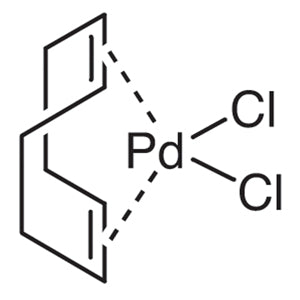
TCI D2604 Dichloro(1,5-cyclooctadiene)palladium(II) is an organopalladium complex in which a 1,5-cyclooctadiene diene ligand is bound to palladium together with two chloride ligands. In catalysis laboratories, this compound serves as a highly practical palladium catalyst precursor: the cyclooctadiene ligand binds firmly enough to keep the complex stable during storage, yet remains labile enough to be displaced by other ligands such as phosphines, N-heterocyclic carbenes, bipyridine, or other nitrogen donor ligands when an active catalyst needs to be formed in situ. For that reason, this reagent has become a flexible starting point for many palladium-based catalytic systems.
The properties that make it a widely chosen reagent are the ease of ligand exchange and the clearly defined palladium content in the +2 oxidation state. Researchers can design catalysts with ligands of their own choosing without having to prepare palladium complexes from raw metal, so stoichiometry is better controlled and reaction outcomes are more reproducible. Because the complex is supplied as a solid, it is also easier to weigh and measure out than a precursor solution, while remaining straightforward to store under ordinary laboratory conditions.
In Indonesian laboratories, this reagent is typically used in university and institutional research groups working on catalysis and synthetic organic chemistry, particularly in studies of C–H bond activation and related transformations. Its solid form suits laboratories that prepare catalyst systems batch by batch on a small scale, where accurate weighing and predictable ligand substitution behaviour matter more than bulk handling. It fits naturally into method development work in which several ligand sets are screened against the same palladium source.
TCI brochures (PDF)
- Trifluoroborate Salts for Direct Introduction of Hydroxymethyl Group and Aminomethyl Group 2026-01-05 · p. 1
- C-H Bond Activation Reaction 2025-06-20 · p. 4
- Transition Metal Catalysts 2026-04-10 · p. 14
- Suzuki-Miyaura Cross Coupling Reaction 2025-12-01 · p. 23
Related TCI products
- TCI B2064 95464-05-4 [1,1'-Bis(diphenylphosphino)ferrocene]palladium(II) Dichloride Dichloromethane Adduct
- TCI B2042 14588-08-0 Bis(triphenylphosphine)palladium(II) Diacetate
- TCI B2026 40691-33-6 Bis(tri-o-tolylphosphine)palladium(II) Dichloride
- TCI B1668 14220-64-5 Bis(benzonitrile)palladium(II) Dichloride
- TCI B1667 13965-03-2 Bis(triphenylphosphine)palladium(II) Dichloride
- TCI P1489 7647-10-1 Palladium(II) Chloride
- C–H bond activation studies: the complex delivers a well-defined palladium(II) source whose labile diene ligand can be exchanged for the directing ligand required by the activation system under investigation.
- In situ catalyst generation: researchers combine the precursor with phosphines or N-heterocyclic carbenes directly in the reaction vessel, forming the active palladium species without isolating an intermediate complex.
- Ligand screening in method development: a single palladium source can be paired with many different donor ligands, allowing systematic comparison of catalytic performance while keeping the metal input constant.
- Coordination chemistry teaching and research: the straightforward substitution of 1,5-cyclooctadiene by nitrogen donor ligands such as bipyridine illustrates ligand exchange behaviour clearly for synthesis and characterisation exercises.
- Reproducible small-scale synthetic work: because the palladium oxidation state is clearly defined, stoichiometry can be calculated precisely, which supports repeatable results across successive experimental runs.
| Brand | TCI |
|---|---|
| CAS number | 12107-56-1 |
| Molecular formula | — |
| Purity | — |
| Category | Chemistry > Catalysis and Inorganic Chemistry > C–H Activation [Catalysis] |
| Pack sizes | please refer to the available TCI catalogue packaging options for this product code |
| Physical form | solid |
| Storage | store under ordinary laboratory storage conditions in a closed container |
- Chemical name: Dichloro(1,5-cyclooctadiene)palladium(II)
Store the material in its original tightly closed container, kept dry and protected from moisture, in a cool and well-ventilated chemical storage area away from incompatible reagents. Glass or the manufacturer's supplied container is suitable; reseal promptly after each use to limit exposure to air and humidity. Handle the solid in a fume hood using gloves, safety glasses, and a laboratory coat, and avoid generating dust when weighing. Transfer with clean, dry spatulas to prevent contamination that could affect catalytic performance. Collect residues and spent catalyst as heavy-metal chemical waste according to institutional disposal procedures, and consult the manufacturer's safety data sheet before first use.
References cited in the TCI brochure
- Gary A. Molander. Cross-Coupling of Mesylated Phenol Derivatives with Potassium Alkoxymethyltrifluoroborates Organic Letters, 2011. doi:10.1021/ol201469r
Product Categories
- Catalysis and Inorganic ChemistryC-H Activation [Catalysis]Palladium Compounds [C-H Activation]
- Catalysis and Inorganic ChemistryTransition Elements [Catalysis and Inorganic Chemistry]Palladium [Catalysis and Inorganic Chemistry]
- Synthetic ReagentsC-X(Non-Halogen) Bond Formation [Synthetic Reagents]C-H Bond Activation Reaction [Synthetic Reagents]
Produk Terkait
-
[1,1'-Bis(diphenylphosphino)ferrocene]palladium(II)DichlorideDichloromethaneAdduct TCI B2064
Regular price From Rp 2.068.500,00Regular price -
Bis(triphenylphosphine)palladium(II)Diacetate TCI B2042
Regular price From Rp 2.889.600,00Regular price -
Bis(tri-o-tolylphosphine)palladium(II)Dichloride TCI B2026
Regular price From Rp 2.068.500,00Regular price -
Bis(benzonitrile)palladium(II)Dichloride TCI B1668
Regular price From Rp 2.889.600,00Regular price -
Bis(triphenylphosphine)palladium(II)Dichloride TCI B1667
Regular price From Rp 1.565.550,00Regular price -
Palladium(II)Chloride TCI P1489
Regular price From Rp 3.075.450,00Regular price -
2,5-NorbornadienePalladium(II)Dichloride TCI N0842
Regular price Rp 2.677.500,00Regular price -
Dichloro[9,9-dimethyl-4,5-bis(diphenylphosphino)xanthene]palladium(II) TCI D4333
Regular price From Rp 875.700,00Regular price
![95464-05-4 [1,1'-Bis(diphenylphosphino)ferrocene]palladium(II) Dichloride Dichloromethane Adduct - AMI Scientific](http://amiscientific.com/cdn/shop/files/TCI2510B2064_55725750-1d93-4607-a5e5-5c490594863a.jpg?v=1767330765&width=533)



![Dichloro[9,9-dimethyl-4,5-bis(diphenylphosphino)xanthene]palladium(II) (CAS 205319-10-4) - TCI D4333 - AMI Scientific](http://amiscientific.com/cdn/shop/files/TCI2510D4333.jpg?v=1767107422&width=533)