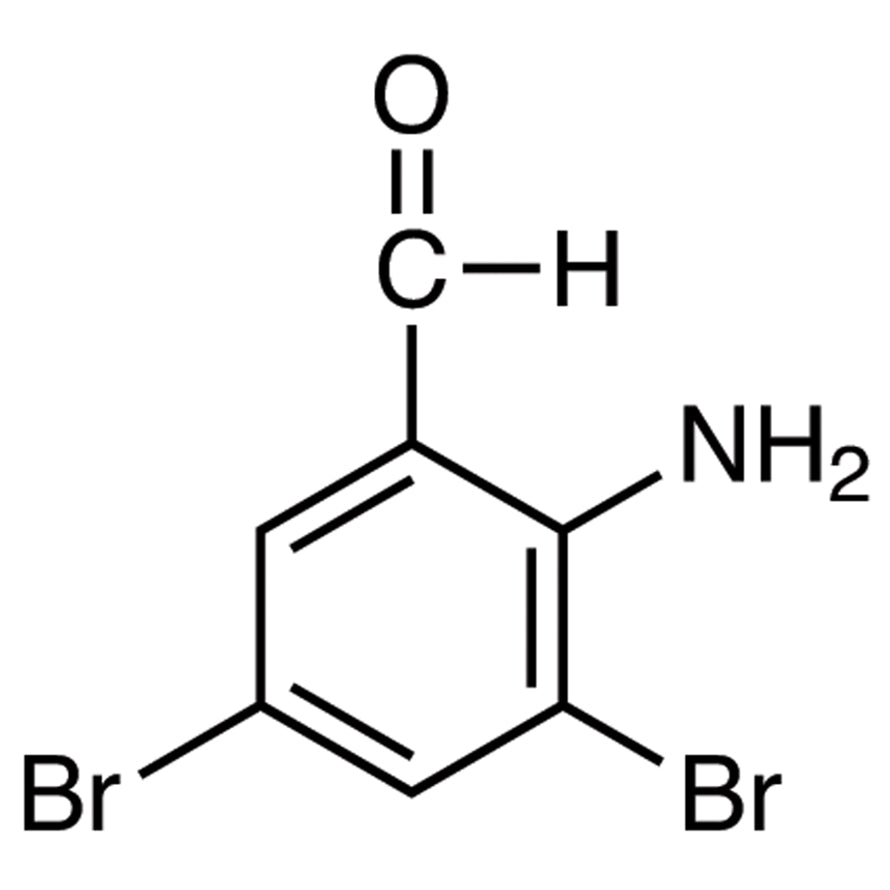
TCI D2625 2-Amino-3,5-dibromobenzaldehyde is a substituted benzaldehyde carrying an amino group together with two bromine atoms on its aromatic ring. Because the amino and aldehyde groups sit adjacent to one another, this compound serves as a classic starting material for building nitrogen heterocyclic rings, particularly through annulation reactions that combine both groups with a reaction partner. In synthetic laboratories, a material like this saves a considerable number of steps, since the required substitution pattern is already embedded from the outset, allowing researchers to move directly toward the target framework they have in mind.
The property that makes it so widely chosen is the combination of three functional groups with distinct roles. The aldehyde and the aromatic amino group work together to enable quinoline synthesis via the Friedländer reaction, as well as the formation of Schiff bases with amines or diamines. The two bromine atoms, meanwhile, are far from passive substituents: they are highly valuable connection points for palladium-catalysed cross-coupling reactions such as Suzuki, Sonogashira, or Buchwald–Hartwig. A single molecule can therefore be developed in several different directions, and the heavy bromine atoms also assist in characterisation work.
In Indonesian laboratories, this building block is typically used in university and institutional research groups working on organic synthesis, medicinal chemistry, and coordination chemistry, where multi-step routes toward heterocyclic and ligand frameworks are common. It is handled at bench scale for exploratory and methodology work, where having the bromination and the amino-aldehyde pattern already in place shortens the route considerably and lets a small group complete a synthetic sequence with the glassware and catalysts they already have available.
- Friedländer quinoline synthesis — the neighbouring amino and aldehyde groups condense directly with a ketone partner, delivering the quinoline core in a single annulation step without prior functional group installation.
- Schiff base and imine formation — the aromatic aldehyde reacts readily with primary amines or diamines, giving imine ligands and salen-type frameworks that are widely used in coordination chemistry studies.
- Suzuki cross-coupling — both bromine positions act as reliable handles for palladium-catalysed carbon–carbon bond formation, allowing aryl and heteroaryl groups to be introduced onto the ring selectively.
- Sonogashira alkynylation — the aryl bromide sites accept terminal alkynes under palladium and copper catalysis, opening routes to conjugated and rigid molecular scaffolds from a single starting material.
- Buchwald–Hartwig amination — the brominated ring positions allow carbon–nitrogen bond formation with a wide range of amine partners, extending the molecule toward more elaborate nitrogen-containing target structures.
| Brand | TCI (Tokyo Chemical Industry) |
|---|---|
| CAS number | 50910-55-9 |
| Molecular formula | — |
| Purity | — |
| Category | Chemistry > Building Blocks > Non-Heterocyclic Building Blocks |
| Pack sizes | available in standard TCI research and laboratory pack sizes; please confirm the currently offered pack size when ordering |
| Physical form | — |
| Storage | keep in a tightly closed original container, protected from light and moisture |
- Chemical name: 2-Amino-3,5-dibromobenzaldehyde
Store the material in its original tightly closed container in a cool, dry, and well-ventilated area, away from direct sunlight, heat sources, and moisture. Amino-substituted aromatic aldehydes are generally sensitive to air and light, so the container should be reclosed promptly after each use and, where practical, kept under an inert atmosphere. Handle the compound in a fume hood using safety glasses, chemical-resistant gloves, and a laboratory coat, and avoid inhaling dust or allowing contact with skin and eyes. Use clean, dry spatulas and glassware to prevent contamination, keep it separated from strong oxidising agents and strong acids or bases, and dispose of residues and contaminated materials in accordance with your institution's chemical waste procedures. Always consult the manufacturer's safety data sheet before use.
—
Produk Terkait
-
2,6-Dibromobenzaldehyde TCI D4552
Regular price From Rp 2.491.650,00Regular price -
3,5-Dibromobenzaldehyde TCI D2832
Regular price From Rp 1.749.300,00Regular price -
2-Bromobenzaldehyde TCI B0836
Regular price From Rp 1.246.350,00Regular price -
4-Bromobenzaldehyde TCI B0549
Regular price From Rp 2.199.750,00Regular price -
3-Bromobenzaldehyde TCI B0548
Regular price From Rp 795.900,00Regular price -
2-Amino-5-bromobenzaldehyde TCI A3063
Regular price From Rp 1.008.000,00Regular price -
3-BromobenzaldehydeDiethylAcetal TCI B3822
Regular price Rp 2.625.000,00Regular price -
2-BromobenzaldehydeDiethylAcetal TCI B3800
Regular price Rp 2.121.000,00Regular price