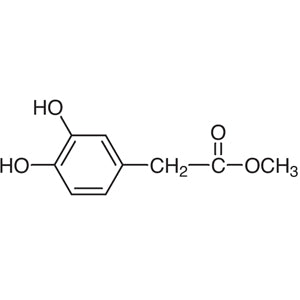
Methyl 3,4-Dihydroxyphenylacetate from TCI is the methyl ester of 3,4-dihydroxyphenylacetic acid, a non-heterocyclic building block that combines two important motifs within a single small molecule: a catechol ring and an aliphatic ester group. The catechol ring provides metal-binding character together with the ability to quench radicals, while the ester group serves as a transformation point toward amides, alcohols, carboxylic acids, or hydrazides. This combination makes the compound a frequent choice as a starting framework in the synthesis of bioactive compounds, natural product analogues, and phenolic derivatives designed for structure–activity studies.
The property that makes this material attractive is its dual reactivity, which can be controlled in stages. The two phenolic hydroxyl groups are weakly acidic and are readily protected as benzyl ethers, methyl ethers, acetonides, or esters, so researchers can modify the ester group first without disturbing the catechol. Conversely, a catechol group left free is ready to form complexes with iron, boron, or titanium, and it adheres strongly to metal oxide surfaces. It should be noted that catechols are relatively sensitive to oxidation by air and light, so handling under controlled conditions is advisable.
In Indonesian laboratories, this building block is typically used in university and institutional research settings where synthetic chemistry, natural product chemistry, and materials work overlap. It suits multi-step preparations in which a phenolic scaffold must be elaborated selectively, as well as coordination and surface-modification studies that depend on a free catechol. Because it is supplied as a defined TCI catalogue item, it fits routine procurement for teaching, method development, and small-scale synthetic programmes.
Related TCI products
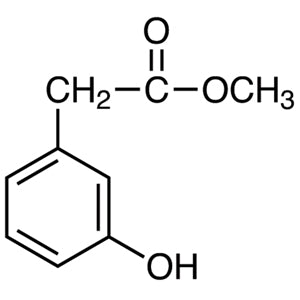
- TCI M2925 42058-59-3 Methyl 3-Hydroxyphenylacetate
- TCI E1234 70289-12-2 2-Ethoxyphenylacetic Acid
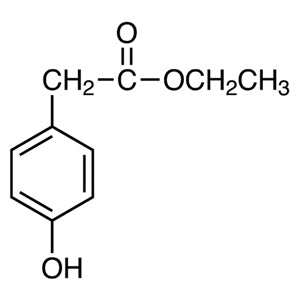
- TCI E1034 17138-28-2 Ethyl 4-Hydroxyphenylacetate
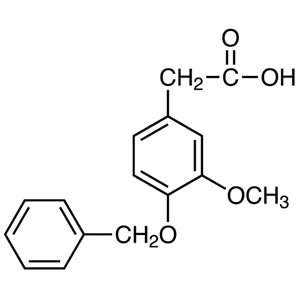
- TCI B4800 29973-91-9 4-Benzyloxy-3-methoxyphenylacetic Acid
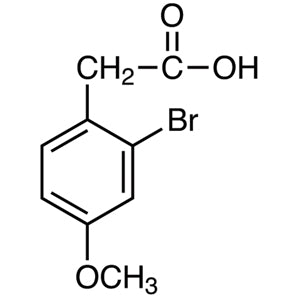
- TCI B4737 66916-99-2 2-Bromo-4-methoxyphenylacetic Acid
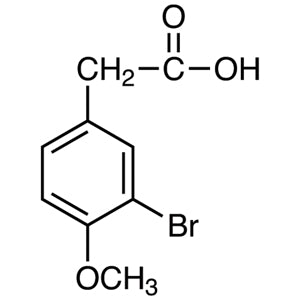
- TCI B4677 774-81-2 3-Bromo-4-methoxyphenylacetic Acid
- Bioactive compound synthesis: the ester group offers a controllable handle for conversion into amides, alcohols, carboxylic acids, or hydrazides during multi-step preparation of target molecules.
- Natural product analogue preparation: the catechol ring reproduces a motif common to many phenolic natural products, giving chemists a ready-made core for analogue construction.
- Structure–activity relationship studies: selective protection of the two phenolic hydroxyls allows systematic variation of one region of the molecule while the other remains intact.
- Metal complexation chemistry: the free catechol forms complexes with iron, boron, or titanium, supporting coordination studies and the preparation of defined metal-ligand systems.
- Metal oxide surface modification: the catechol group adheres strongly to metal oxide surfaces, making the compound useful for anchoring and surface-functionalisation experiments in materials laboratories.
| Brand | TCI |
|---|---|
| CAS number | 25379-88-8 |
| Molecular formula | — |
| Purity | — |
| Category | Chemistry > Building Blocks > Non-Heterocyclic Building Blocks |
| Pack sizes | available in TCI catalogue research-scale packaging; please confirm the size required when ordering |
| Physical form | — |
| Storage | keep protected from air and light owing to the oxidation sensitivity of the catechol group |
- Chemical identity: methyl ester of 3,4-dihydroxyphenylacetic acid; non-heterocyclic building block
Store the material in a cool, dry place in its original tightly closed container, protected from light and from prolonged contact with air, since the catechol group is relatively sensitive to oxidation by air and light. Amber glass or opaque containers are suitable, and headspace may be reduced or replaced with an inert gas for material that will be stored after opening. Handle the compound in a fume hood using gloves, safety glasses, and a laboratory coat, weigh it promptly, and reseal the container immediately after use. Consult the manufacturer's safety data sheet before first use and follow institutional waste-handling procedures.
—
Produk Terkait
-
Methyl3-Hydroxyphenylacetate TCI M2925
Regular price From Rp 1.458.450,00Regular price -
2-EthoxyphenylaceticAcid TCI E1234
Regular price From Rp 664.650,00Regular price -
Ethyl4-Hydroxyphenylacetate TCI E1034
Regular price From Rp 1.087.800,00Regular price -
4-Benzyloxy-3-methoxyphenylaceticAcid TCI B4800
Regular price Rp 2.518.950,00Regular price -
2-Bromo-4-methoxyphenylaceticAcid TCI B4737
Regular price From Rp 848.400,00Regular price -
3-Bromo-4-methoxyphenylaceticAcid TCI B4677
Regular price From Rp 689.850,00Regular price -
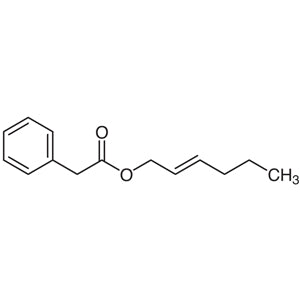
trans-2-Hexen-1-ylPhenylacetate TCI P1045
Regular price Rp 1.298.850,00Regular price -
MethylPhenylacetate TCI P0125
Regular price From Rp 505.050,00Regular price