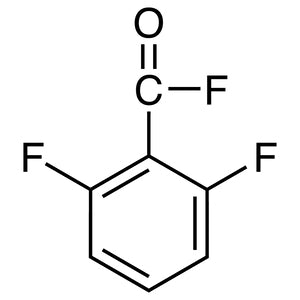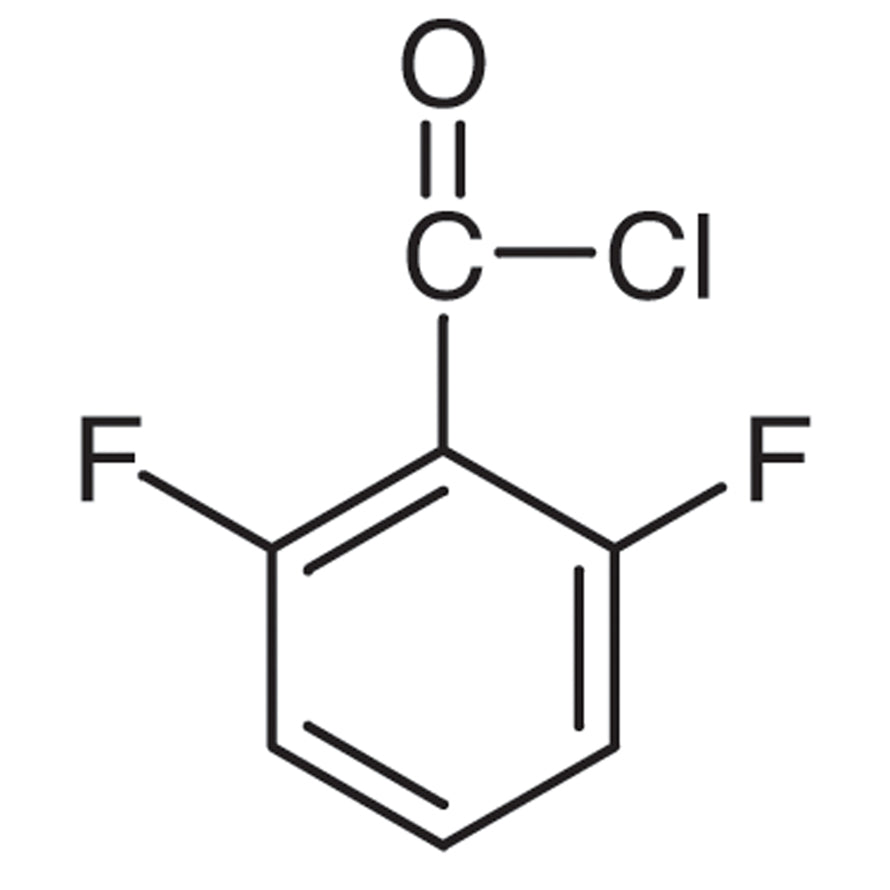
2,6-Difluorobenzoyl Chloride is a chemical compound widely utilized as a building block in the synthesis of complex organic molecules. This compound features two fluorine atoms at the 2 and 6 positions of a benzene ring, along with a chloride group at the 1 position. Its unique molecular structure makes it a valuable reagent in organic chemistry, particularly for reactions involving fluorine substitution or coupling with other compounds. In laboratory settings, it plays a critical role in the development of new synthetic pathways and the exploration of functional group transformations.
The compound's stability and reactivity make it a preferred choice for various chemical reactions, including nucleophilic substitutions and electrophilic additions. Its ability to participate in a wide range of synthetic processes enhances its utility in both academic and industrial research. The presence of fluorine atoms imparts unique electronic properties, enabling the formation of compounds with specific biological activities. This makes it particularly relevant in pharmaceutical research and the development of novel drug molecules.
In Indonesian laboratories, 2,6-Difluorobenzoyl Chloride is commonly used in organic chemistry research, especially in pharmaceutical and materials science applications. Its availability in small pack sizes, such as 25 grams, facilitates small-scale experiments without compromising the stability of the compound. This accessibility supports both educational and research activities, ensuring that scientists can efficiently explore its chemical potential in various experimental contexts.
Related TCI products
- TCI D3407 129714-97-2 3,5-Difluorobenzoyl Chloride
- TCI D3406 35730-09-7 2,5-Difluorobenzoyl Chloride
- TCI D1882 72482-64-5 2,4-Difluorobenzoyl Chloride
- TCI D6292 13656-41-2 2,6-Difluorobenzoyl Fluoride
- TCI D4585 110931-77-6 3-(2,4-Difluorobenzoyl)propionic Acid
- TCI T1868 157373-08-5 2,3,4-Trifluorobenzoyl Chloride
- Organic synthesis applications benefit from its fluorine-containing structure, enabling the creation of complex molecules with tailored properties.
- Pharmaceutical research utilizes this compound to develop drugs with enhanced bioavailability and specific therapeutic effects.
- Materials science studies incorporate it to design fluorinated polymers and functional materials with unique chemical properties.
- Fluorination reactions rely on its reactivity to introduce fluorine atoms into organic frameworks efficiently.
- Analytical chemistry experiments use it as a standard reference for testing reaction mechanisms and spectroscopic properties.
| Brand | TCI |
|---|---|
| CAS number | 18063-02-0 |
| Molecular formula | — |
| Purity | — |
| Category | Chemistry > Building Blocks > Fluorinated Building Blocks |
| Pack sizes | 25 grams |
| Physical form | Solid (may vary slightly depending on batch) |
| Storage | Store in a cool, dry place away from moisture and direct sunlight |
This compound should be stored in a cool, dry environment, away from moisture and direct sunlight to maintain its chemical integrity. It is recommended to use airtight containers made of glass or high-density polyethylene to prevent exposure to air and humidity. Due to its reactivity, it should be handled in a well-ventilated area, preferably under a fume hood, to minimize inhalation risks. Avoid contact with skin and eyes, and ensure proper personal protective equipment is worn during handling. Keep the material away from incompatible substances such as strong bases or reducing agents to prevent unwanted reactions. Regular monitoring of storage conditions is advised to ensure long-term stability and safety in laboratory settings.
—
Produk Terkait
-
3,5-DifluorobenzoylChloride TCI D3407
Regular price From Rp 1.115.100,00Regular price -
2,5-DifluorobenzoylChloride TCI D3406
Regular price From Rp 1.035.300,00Regular price -
2,4-DifluorobenzoylChloride TCI D1882
Regular price Rp 1.115.100,00Regular price -
2,6-DifluorobenzoylFluoride TCI D6292
Regular price From Rp 1.220.100,00Regular price -
3-(2,4-Difluorobenzoyl)propionicAcid TCI D4585
Regular price From Rp 1.749.300,00Regular price -
2,3,4-TrifluorobenzoylChloride TCI T1868
Regular price Rp 1.856.400,00Regular price -
2,3,4,5-TetrafluorobenzoylChloride TCI T1855
Regular price From Rp 477.750,00Regular price -
2,4,5-TrifluorobenzoylChloride TCI T1653
Regular price Rp 1.167.600,00Regular price