

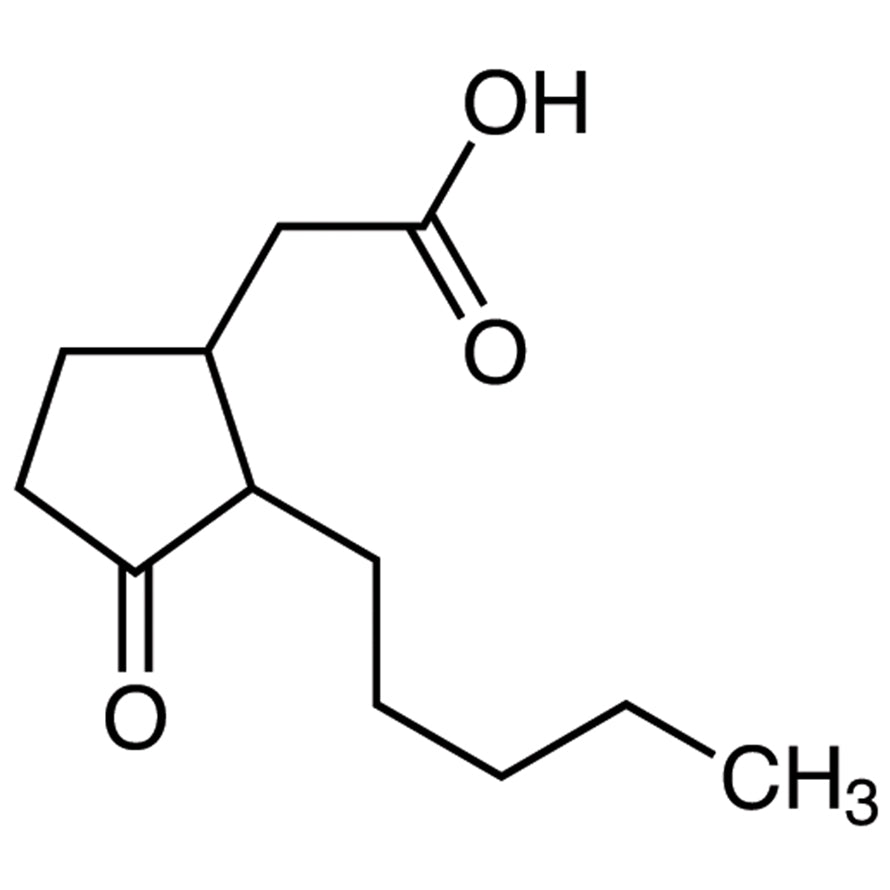
Dihydrojasmonic Acid is an organic compound widely used in plant biotechnology research within laboratory settings. As a key component in the study of plant secondary metabolism, it plays a vital role in the development of bioactive compounds. This compound is essential for researchers aiming to synthesize other molecules with pharmacological or biological activity. Its unique chemical structure enables it to participate in various biochemical reactions, making it a versatile tool in molecular biology applications. Its presence in plant-based research underscores its importance in understanding natural product chemistry and its potential applications in pharmaceutical and agricultural sciences.
Dihydrojasmonic Acid is valued for its stable chemical properties and controlled reactivity, which make it ideal for high-precision experiments. It is a colorless solid with consistent quality, ensuring reliable results in scientific studies. Its high purity and reproducible performance make it a preferred choice for laboratories requiring strict standards. The compound’s resistance to degradation under normal storage conditions further enhances its utility, allowing for long-term use without compromising its integrity. These characteristics ensure that Dihydrojasmonic Acid remains a dependable material in both academic and industrial research environments.
In Indonesian laboratories, Dihydrojasmonic Acid is commonly used in plant biotechnology research, particularly in studies focused on natural product synthesis and metabolic pathways. Its application supports the development of bioactive compounds and contributes to advancements in agricultural and pharmaceutical research. Researchers in Indonesia rely on its consistent quality and chemical stability to conduct experiments that require precision and reliability. Its use in local laboratories reflects the growing importance of plant-based research in the region.
TCI brochures (PDF)
- Plant Hormones 2025-01-30 · p. 1
- Agrochemical Ingredients for Research and Experimental Use 2026-01-08 · p. 8
- Plant Research Reagents 2026-02-24 · p. 13
- Reagents for Biological Research 2025-03-11 · p. 55
- Plant secondary metabolism studies benefit from Dihydrojasmonic Acid's role in synthesizing bioactive compounds, aiding in the exploration of natural products.
- Molecular biology experiments utilize this compound for its controlled reactivity, enabling precise chemical reactions in synthetic pathways.
- Bioactive compound development relies on Dihydrojasmonic Acid as a precursor, supporting the creation of pharmaceutical and agricultural products.
- Metabolic pathway analysis uses the compound to understand plant biochemical processes, enhancing research into natural product chemistry.
- Agricultural research incorporates Dihydrojasmonic Acid to study plant-derived compounds with potential applications in crop improvement and pest control.
| Brand | TCI |
|---|---|
| CAS number | 3572-64-3 |
| Molecular formula | — |
| Purity | — |
| Category | Life Science > Molecular Biology > Plant Biotechnology |
| Pack sizes | Available in standard laboratory quantities as per supplier specifications |
| Physical form | Solid |
| Storage | Store in a cool, dry place away from direct light |
Dihydrojasmonic Acid should be stored in a cool, dry environment to maintain its chemical stability and prevent degradation. It is recommended to keep the compound in airtight containers to minimize exposure to moisture and air, which could affect its purity. Due to its solid form, it is best stored in a desiccator or sealed containers to ensure long-term consistency. Laboratory personnel should handle the compound with care, using appropriate personal protective equipment when necessary. While it is not highly reactive under normal conditions, it is important to follow standard laboratory safety protocols to ensure safe handling and storage. Proper storage conditions help preserve the compound’s integrity and ensure reliable results in research applications.
—
Product Categories
Produk Terkait
-
MethylDihydrojasmonate(cis-andtrans-mixture) TCI D1431
Regular price From Rp 557.550,00Regular price -
Dihydrojasmone TCI D1440
Regular price Rp 2.068.500,00Regular price -
Adenine TCI A0149
Regular price From Rp 1.696.800,00Regular price -
trans-Zeatin TCI Z0012
Regular price Rp 6.520.500,00Regular price -
XyleminDihydrochloride TCI X0080
Regular price From Rp 2.518.950,00Regular price -
Uniconazole TCI U0155
Regular price From Rp 1.565.550,00Regular price -
Brassinazole TCI B2829
Regular price From Rp 6.465.900,00Regular price -
4-BromophenoxyaceticAcid TCI B2746
Regular price From Rp 637.350,00Regular price


