

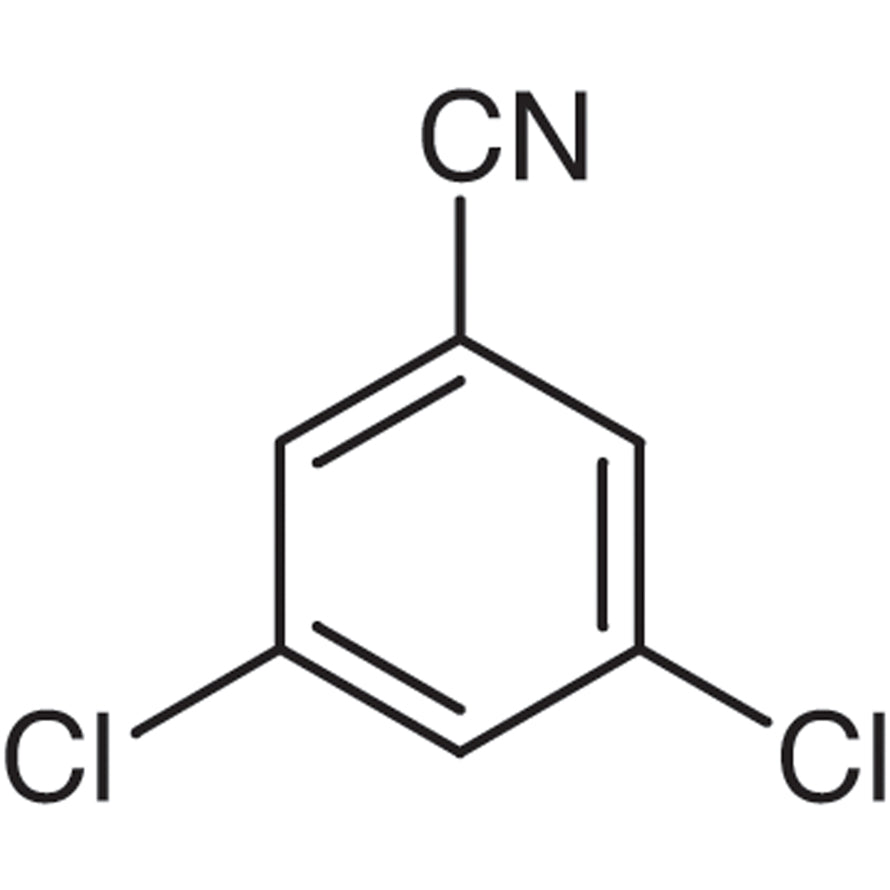
3,5-Dichlorobenzonitrile is a chemical compound widely used as a building block in the synthesis of complex organic compounds. It features an aromatic ring with two chlorine atoms at positions 3 and 5, along with a nitrile group at position 1. This compound plays a crucial role in organic chemistry laboratories, where it serves as a versatile reagent for introducing chlorine and nitrile functionalities into aromatic systems. Its structural simplicity and functional versatility make it a valuable tool for chemists working on synthetic pathways.
The reactivity of 3,5-Dichlorobenzonitrile is primarily due to the presence of the nitrile group and the electron-withdrawing nature of the chlorine atoms. These groups influence the electronic environment of the aromatic ring, making it more susceptible to electrophilic and nucleophilic substitution reactions. The nitrile group also contributes to the overall stability of the molecule, while the chlorine atoms enhance its reactivity in various synthetic transformations. This combination of stability and reactivity makes it a preferred choice for organic synthesis.
In Indonesian laboratories, 3,5-Dichlorobenzonitrile is commonly used in research and educational settings. It is particularly favored in organic chemistry courses and research projects where students and scientists are exploring the synthesis of pharmaceuticals, dyes, and other functional compounds. Its availability and chemical properties make it a staple in both academic and industrial research environments.
Related TCI products
- Organic synthesis applications benefit from the reactivity of 3,5-Dichlorobenzonitrile, enabling the efficient introduction of chlorine and nitrile groups into aromatic compounds.
- Pharmaceutical research utilizes this compound for the development of new drugs, as its functional groups can be modified to create bioactive molecules.
- Dye and pigment synthesis often incorporates 3,5-Dichlorobenzonitrile due to its ability to participate in complex aromatic substitution reactions.
- Teaching laboratories use this compound to demonstrate electrophilic and nucleophilic substitution reactions, providing hands-on learning experiences for students.
- Industrial chemical processes rely on its stability and reactivity for the production of intermediate compounds used in various chemical industries.
| Brand | TCI |
|---|---|
| CAS number | 6575-00-4 |
| Molecular formula | — |
| Purity | — |
| Category | Chemistry > Building Blocks > Non-Heterocyclic Building Blocks |
| Pack sizes | Available in various quantities as per supplier specifications |
| Physical form | Solid, typically in crystalline or powder form |
| Storage | Store in a cool, dry place away from moisture and direct sunlight |
3,5-Dichlorobenzonitrile should be stored in a cool, dry environment to maintain its chemical stability. It is recommended to keep the compound in a tightly sealed container to prevent moisture absorption, which can affect its reactivity. Due to its potential for reactive behavior, it should be handled in a well-ventilated area, preferably under a fume hood. Suitable containers for storage include glass or high-density polyethylene vessels, which are resistant to chemical degradation. Always wear appropriate personal protective equipment, such as gloves and safety goggles, when handling this compound to ensure laboratory safety.
—
Produk Terkait
-
2-Amino-3,5-dichlorobenzonitrile TCI A3062
Regular price From Rp 717.150,00Regular price -
4-Amino-3,5-dichlorobenzonitrile TCI A1928
Regular price From Rp 769.650,00Regular price -
2,3-Dichlorobenzonitrile TCI D4398
Regular price Rp 1.298.850,00Regular price -
2,5-Dichlorobenzonitrile TCI D4018
Regular price From Rp 1.035.300,00Regular price -
3,4-Dichlorobenzonitrile TCI D3415
Regular price From Rp 1.485.750,00Regular price -
2,4-Dichlorobenzonitrile TCI D3349
Regular price Rp 1.431.150,00Regular price -
2,6-Dichlorobenzonitrile TCI D1137
Regular price Rp 823.200,00Regular price


