

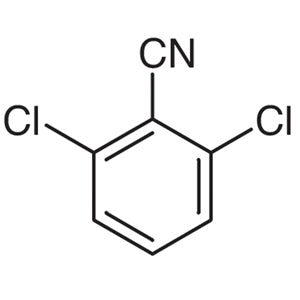
2,6-Dichlorobenzonitrile is a chemical compound widely used as a building block in the synthesis of complex organic molecules. It serves as a fundamental reagent in various chemical reactions, particularly those involving substitution and electrophilic processes. Its simple molecular structure plays a crucial role in enabling versatile chemical transformations, making it a valuable resource for researchers and chemists. This compound is commonly found in laboratory settings where the development of new materials, pharmaceuticals, and specialty chemicals is required. Its reactivity and stability under controlled conditions contribute to its widespread use in both academic and industrial research.
The key properties of 2,6-Dichlorobenzonitrile include its reactivity due to the presence of the nitrile group, which makes it highly suitable for a range of chemical reactions. The compound is known for its ability to participate in reactions with alkyl halides, amines, and alkali metals, making it a versatile reagent. Its stability in specific conditions ensures that it remains effective during various synthetic processes. These characteristics make it a preferred choice for chemists seeking reliable and efficient reagents for their experiments.
In Indonesian laboratories, 2,6-Dichlorobenzonitrile is extensively used in scientific research and the development of chemical products. Its availability in solid form and ease of storage make it ideal for a wide range of chemical experiments. The compound supports local research efforts by providing a reliable source of chemical building blocks. Its role in the synthesis of pharmaceuticals and industrial materials further highlights its importance in the chemical industry.
TCI brochures (PDF)
- Agrochemical Ingredients for Research and Experimental Use 2026-01-08 · p. 2
- Plant Research Reagents 2026-02-24 · p. 10
Related TCI products
- Organic synthesis is a primary application where 2,6-Dichlorobenzonitrile is used due to its reactivity and ability to participate in substitution and electrophilic reactions.
- Pharmaceutical research benefits from this compound as it is a key building block in the development of new drug molecules.
- Material science applications rely on this reagent for the synthesis of polymers and specialty chemicals with unique properties.
- Industrial chemical production uses this compound to create intermediates for various chemical processes.
- Analytical chemistry laboratories utilize it as a standard reference material for qualitative and quantitative analysis.
| Brand | TCI |
|---|---|
| CAS number | 1194-65-6 |
| Molecular formula | — |
| Purity | — |
| Category | Chemistry > Building Blocks > Non-Heterocyclic Building Blocks |
| Pack sizes | Available in various quantities as per standard laboratory requirements |
| Physical form | Solid |
| Storage | Store in a cool, dry place away from light and moisture |
2,6-Dichlorobenzonitrile should be stored in a cool, dry place, away from light and moisture to maintain its chemical integrity. It is recommended to use airtight containers made of materials that are chemically inert, such as glass or stainless steel, to prevent contamination and degradation. In laboratory settings, it is essential to handle the compound with appropriate personal protective equipment, including gloves and safety goggles, to ensure safety. Due to its reactivity, it should be stored separately from incompatible substances like strong bases or reducing agents. Regular inspection of storage conditions and proper labeling of containers are also important for safe handling and long-term stability.
—
Product Categories
Produk Terkait
-
2-Amino-3,5-dichlorobenzonitrile TCI A3062
Regular price From Rp 717.150,00Regular price -
4-Amino-3,5-dichlorobenzonitrile TCI A1928
Regular price From Rp 769.650,00Regular price -
2,3-Dichlorobenzonitrile TCI D4398
Regular price Rp 1.298.850,00Regular price -
2,5-Dichlorobenzonitrile TCI D4018
Regular price From Rp 1.035.300,00Regular price -
3,4-Dichlorobenzonitrile TCI D3415
Regular price From Rp 1.485.750,00Regular price -
2,4-Dichlorobenzonitrile TCI D3349
Regular price Rp 1.431.150,00Regular price -
3,5-Dichlorobenzonitrile TCI D3261
Regular price From Rp 875.700,00Regular price -
2-Amino-3-chloro-1,4-naphthoquinone TCI A1288
Regular price From Rp 1.060.500,00Regular price


