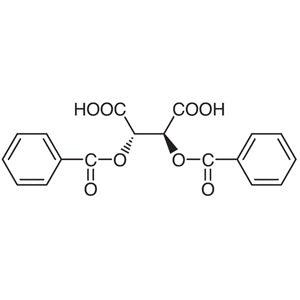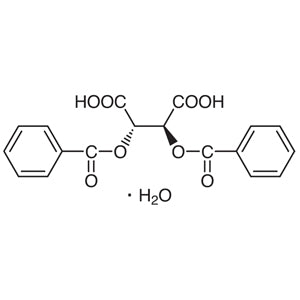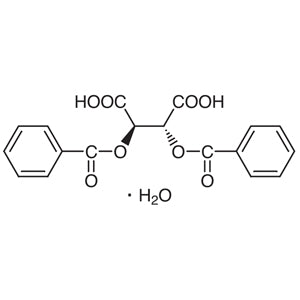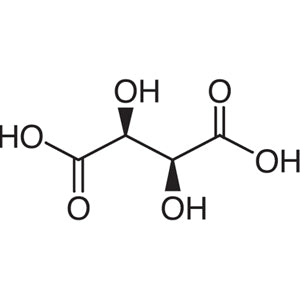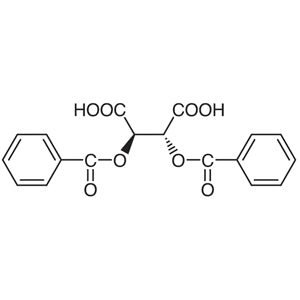
TCI D3492 is (−)-dibenzoyl-L-tartaric acid, one of the most classical and most frequently used chiral resolving agents in organic chemistry. The compound is L-tartaric acid in which both hydroxyl groups have been esterified with benzoyl groups, giving a molecule that carries two stereogenic centres together with two free carboxylic acid functions. In the laboratory, its role is to form salts with racemic basic compounds, particularly amines, so that a mixture of enantiomers that cannot be separated directly is converted into a mixture of diastereomers with different solubilities that can be separated by crystallisation.
The property that makes this reagent the reagent of choice is the balance between a simple structure, a rigid chiral framework, and aromatic benzoyl groups large enough to direct the packing of the crystal lattice. The combination of hydrogen bonding from the carboxylic acid groups and aromatic interactions contributed by the benzoyl groups means that the diastereomeric salts formed often crystallise well in a wide range of solvent systems, including the alcohol–water mixtures that are easy to prepare in any laboratory. The reagent is also widely documented in the literature, so researchers can refer to a large body of established procedures.
In Indonesian laboratories, this reagent is used wherever a single enantiomer has to be obtained from a racemic base without recourse to specialised chromatographic equipment. Because the resolution is carried out with ordinary glassware, common solvents and simple crystallisation, it fits well into academic research groups, university teaching and research laboratories, and process development work in which reliable, well-referenced procedures are preferred over methods that require dedicated instrumentation.
TCI brochures (PDF)
- Chiral Auxiliaries and Optical Resolving Agents 2025-06-17 · p. 7
- Chiral Building Blocks 2025-04-14 · p. 13
Related TCI products
- TCI D3826 17026-42-5 (+)-Dibenzoyl-D-tartaric Acid
- TCI D1398 80822-15-7 (+)-Dibenzoyl-D-tartaric Acid Monohydrate
- TCI D1354 62708-56-9 (-)-Dibenzoyl-L-tartaric Acid Monohydrate
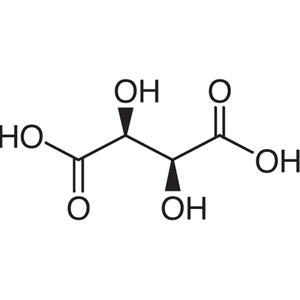
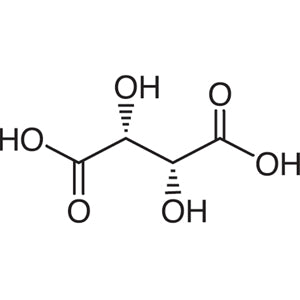
- TCI T0026 147-71-7 D-(-)-Tartaric Acid
- TCI T0025 87-69-4 L-(+)-Tartaric Acid
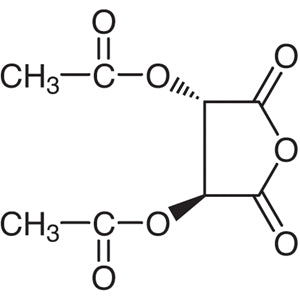
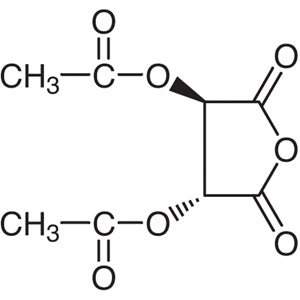
- TCI D2645 70728-23-3 (-)-Diacetyl-D-tartaric Anhydride
- Classical resolution of racemic amines: the two free carboxylic acid groups form salts with basic nitrogen centres, converting inseparable enantiomers into diastereomers that differ in solubility.
- Preparation of single-enantiomer chiral building blocks: the resolved amine or base recovered from the diastereomeric salt can be carried directly into asymmetric synthesis as a defined stereochemical starting point.
- Diastereomeric salt crystallisation studies: the rigid tartrate backbone and aromatic benzoyl groups promote well-formed crystals, making the reagent suitable for screening solvent systems and crystallisation conditions.
- Reproduction of established literature procedures: because the reagent appears extensively in the published literature, researchers can follow documented resolution protocols rather than developing conditions from scratch.
- Teaching and demonstration of stereochemistry: the resolution can be performed with standard glassware and common alcohol–water solvent mixtures, which makes it a practical exercise for illustrating enantiomer separation.
| Brand | TCI (Tokyo Chemical Industry) |
|---|---|
| CAS number | 2743-38-6 |
| Molecular formula | — |
| Purity | — |
| Category | Chemistry > Asymmetric Synthesis > Chiral Building Blocks |
| Pack sizes | available in the standard TCI catalogue pack sizes; please confirm the required pack size when ordering |
| Physical form | — |
| Storage | keep in a tightly closed original container in a cool, dry place, away from moisture |
- Chemical identity: (−)-dibenzoyl-L-tartaric acid, the dibenzoate ester of L-tartaric acid bearing two free carboxylic acid groups
Store the material in its tightly closed original container in a cool, dry and well-ventilated place, protected from moisture and kept away from strong bases and other incompatible reagents. Amber glass or the supplier's original packaging is suitable; transfer only the quantity required for the experiment and reseal the container promptly to avoid moisture uptake. As with any organic acid, handle the solid in a fume hood or well-ventilated area and wear safety glasses, gloves and a laboratory coat, since the compound may irritate skin, eyes and the respiratory tract. Avoid generating dust during weighing, clean spills immediately, and dispose of residues and contaminated materials in accordance with the applicable chemical waste procedures of the laboratory. Always consult the manufacturer's safety data sheet before use.
—
Produk Terkait
-
(+)-Dibenzoyl-D-tartaricAcid TCI D3826
Regular price From Rp 903.000,00Regular price -
(+)-Dibenzoyl-D-tartaricAcidMonohydrate TCI D1398
Regular price From Rp 637.350,00Regular price -
(-)-Dibenzoyl-L-tartaricAcidMonohydrate TCI D1354
Regular price From Rp 823.200,00Regular price -
D-(-)-TartaricAcid TCI T0026
Regular price From Rp 928.200,00Regular price -
L-(+)-TartaricAcid TCI T0025
Regular price From Rp 477.750,00Regular price -
(-)-Diacetyl-D-tartaricAnhydride TCI D2645
Regular price From Rp 743.400,00Regular price -
(+)-Diacetyl-L-tartaricAnhydride TCI D1911
Regular price Rp 1.220.100,00Regular price -
(+)-Di-p-toluoyl-D-tartaricAcid TCI D1417
Regular price From Rp 1.193.850,00Regular price