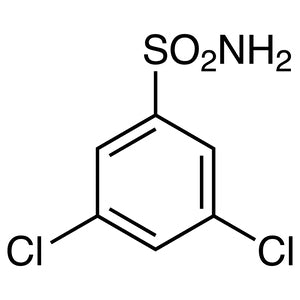
TCI D3502 3,5-Dichlorobenzenesulfonamide, CAS 19797-32-1, is an aromatic building block classified as a primary sulfonamide, carrying two chlorine atoms at the 3 and 5 positions of the benzene ring. The sulfonamide group is one of the most frequently encountered functional groups in medicinal chemistry, which places compounds of this type in an important position as starting materials for synthetic research. In the laboratory, this compound serves as a ready-to-use fragment that already carries both the sulfonamide motif and the chlorine substitution pattern, so researchers do not need to perform a sulfonylation step themselves and can move directly to modification of the nitrogen group or the aromatic ring.
The reason for selecting this compound lies in the combination of its functional groups. The sulfonamide nitrogen is weakly acidic, so it is readily deprotonated and carried forward into further reactions, for example through alkylation, acylation, or coupling reactions to form secondary and tertiary sulfonamides. The two chlorine atoms are electron-withdrawing, which increases the acidity of the sulfonamide group and stabilises its anionic form, while at the same time providing sites for metal-catalysed cross-coupling reactions where these are required. As a crystalline solid, the material is straightforward to weigh, to store, and to repurify when needed.
In Indonesian laboratories, this type of building block is typically handled in university research groups, pharmaceutical and medicinal chemistry programmes, and industrial R&D units working on the synthesis of new compounds. Because it arrives as a defined, well-characterised crystalline solid from TCI, it fits routine bench practice where materials are weighed out in small portions, used across multiple synthetic attempts, and returned to controlled storage between experiments without elaborate handling infrastructure.
Related TCI products
- TCI T2035 51527-73-2 2,4,6-Trichlorobenzenesulfonyl Chloride
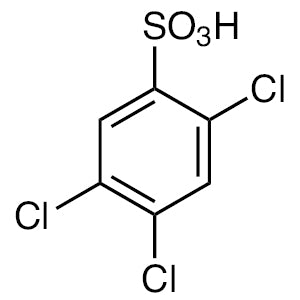
- TCI B0248 6378-25-2 2,4,5-Trichlorobenzenesulfonic Acid
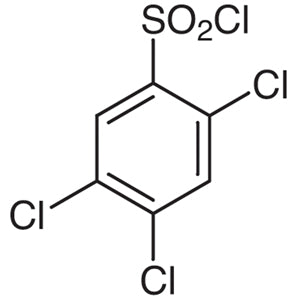
- TCI B0247 15945-07-0 2,4,5-Trichlorobenzenesulfonyl Chloride
- TCI T0628 62625-17-6 Potassium 2,4,5-Trichlorobenzenesulfonate
- TCI D4222 6579-54-0 2,6-Dichlorobenzenesulfonyl Chloride
- TCI D4037 16271-33-3 2,4-Dichlorobenzenesulfonyl Chloride
- Medicinal chemistry synthesis — the sulfonamide motif appears constantly in drug discovery work, so this compound gives research groups a pre-formed pharmacophore fragment they can elaborate directly.
- Preparation of secondary and tertiary sulfonamides — the weakly acidic sulfonamide nitrogen is easily deprotonated and then alkylated or acylated, giving straightforward access to substituted derivatives.
- Metal-catalysed cross-coupling studies — the two aryl chlorine substituents provide defined reaction points for coupling chemistry when researchers need to extend or diversify the aromatic ring.
- Structure–activity relationship exploration — the fixed 3,5-dichloro substitution pattern lets teams vary only the nitrogen substituents while holding the aromatic electronics constant across a compound series.
- Method development and reaction screening — as a stable crystalline solid with predictable behaviour, it is convenient as a model substrate when optimising sulfonamide functionalisation conditions.
| Brand | TCI |
|---|---|
| CAS number | 19797-32-1 |
| Molecular formula | — |
| Purity | — |
| Category | Chemistry > Building Blocks > Non-Heterocyclic Building Blocks |
| Pack sizes | available in standard TCI research-scale packaging; please confirm the size required when ordering |
| Physical form | crystalline solid |
| Storage | keep in the tightly closed original container, in a cool, dry, well-ventilated place |
- Chemical name: 3,5-Dichlorobenzenesulfonamide
Store 3,5-Dichlorobenzenesulfonamide in its tightly closed original container in a cool, dry and well-ventilated area, away from moisture, direct sunlight and sources of heat or ignition. Amber glass or the supplied chemical-resistant container is suitable; keep the closure sealed between uses to limit moisture uptake by the crystalline solid. Weigh and transfer the material in a fume hood using clean, dry spatulas, and avoid generating or inhaling dust. Wear safety glasses, a laboratory coat and chemical-resistant gloves, wash hands thoroughly after handling, and consult the manufacturer's safety data sheet before use. Segregate from strong oxidising agents and strong bases, label all secondary containers clearly, and dispose of residues and contaminated materials through the laboratory's chemical waste route.
—
Produk Terkait
-
2,4,6-TrichlorobenzenesulfonylChloride TCI T2035
Regular price From Rp 2.016.000,00Regular price -
2,4,5-TrichlorobenzenesulfonicAcid TCI B0248
Regular price From Rp 2.147.250,00Regular price -
2,4,5-TrichlorobenzenesulfonylChloride TCI B0247
Regular price From Rp 2.439.150,00Regular price -
Potassium2,4,5-Trichlorobenzenesulfonate TCI T0628
Regular price Rp 2.359.350,00Regular price -
2,6-DichlorobenzenesulfonylChloride TCI D4222
Regular price From Rp 505.050,00Regular price -
2,4-DichlorobenzenesulfonylChloride TCI D4037
Regular price From Rp 1.035.300,00Regular price -
2,3-DichlorobenzenesulfonylChloride TCI D3568
Regular price Rp 1.298.850,00Regular price -
3,5-DichlorobenzenesulfonylChloride TCI D3503
Regular price From Rp 1.273.650,00Regular price