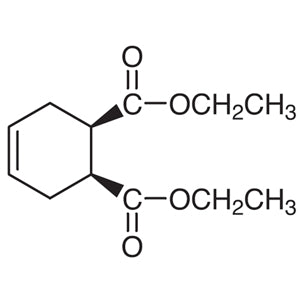
TCI D3714, also known as Diethyl cis-4-Cyclohexene-1,2-dicarboxylate, is the diethyl ester of a cyclohexene framework that carries one carbon-carbon double bond inside the ring together with two adjacent ester groups arranged in a cis configuration. In the laboratory it is recognised as a highly versatile non-heterocyclic building block, because it combines two different classes of reactive groups within a single molecule: an alkene and a pair of esters. That combination allows researchers to carry out selective, stepwise transformations without having to reassemble the ring skeleton from simpler starting materials.
The property that makes this compound an attractive choice is the double bond at position 4, which remains open to hydrogenation, epoxidation, dihydroxylation, hydroboration, and oxidative cleavage, while the two ester groups can be hydrolysed, reduced, or converted into amides. The cis configuration of the two ester groups provides a favourable geometry for intramolecular cyclisation reactions, for example the formation of anhydrides or bicyclic lactones. This framework is also, structurally speaking, a characteristic product of a Diels-Alder cycloaddition, which makes it familiar territory for synthetic organic chemists planning a route.
In Indonesian laboratories, this material is typically used in synthetic organic chemistry research at universities and research institutes, as well as in method development work where a well-defined, pre-built cyclohexene core saves several synthetic steps. It suits research groups that prepare functionalised carbocyclic intermediates, teaching laboratories demonstrating classical alkene and ester chemistry, and small-scale development work where a reliable, single-source building block keeps results reproducible between batches.
Related TCI products
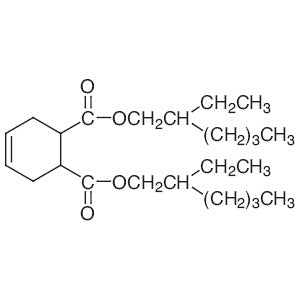
- TCI T0605 2915-49-3 Bis(2-ethylhexyl) 4-Cyclohexene-1,2-dicarboxylate
- TCI D5576 21544-03-6 Diglycidyl 4-Cyclohexene-1,2-dicarboxylate
- TCI D3703 4841-84-3 Dimethyl cis-4-Cyclohexene-1,2-dicarboxylate
- TCI D3692 17673-68-6 Dimethyl trans-4-Cyclohexene-1,2-dicarboxylate
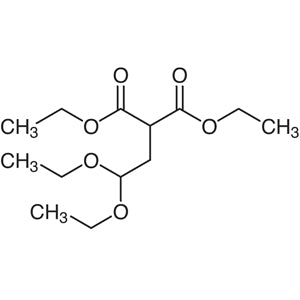
- TCI D2438 21339-47-9 Diethyl 3,3-Diethoxypropane-1,1-dicarboxylate
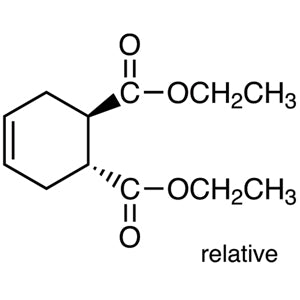
- TCI C1704 5048-50-0 Diethyl trans-4-Cyclohexene-1,2-dicarboxylate
- Alkene functionalisation studies — the position-4 double bond is available for hydrogenation, epoxidation, dihydroxylation, hydroboration, or oxidative cleavage, giving one substrate many possible downstream products.
- Ester transformation chemistry — both ester groups can be hydrolysed to acids, reduced to alcohols, or converted into amides, making the molecule useful for comparing selectivity between two equivalent sites.
- Intramolecular cyclisation work — the cis arrangement of the adjacent ester groups gives the geometry needed to close anhydrides or bicyclic lactones without additional conformational manipulation.
- Carbocyclic intermediate synthesis — as a non-heterocyclic building block it supplies a ready-made cyclohexene ring, letting researchers begin a route several steps further along than from simple acyclic precursors.
- Diels-Alder route development and teaching — because the framework is a characteristic cycloaddition product, it serves as a reference substrate for studying, verifying, or demonstrating downstream chemistry of Diels-Alder adducts.
| Brand | TCI (Tokyo Chemical Industry) |
|---|---|
| CAS number | 4841-85-4 |
| Molecular formula | — |
| Purity | — |
| Category | Chemistry > Building Blocks > Non-Heterocyclic Building Blocks |
| Pack sizes | available in standard TCI research pack sizes; please confirm the currently offered pack size when ordering |
| Physical form | — |
| Storage | keep in the tightly closed original container, in a cool, dry, well-ventilated place away from light and ignition sources |
- Chemical name: Diethyl cis-4-Cyclohexene-1,2-dicarboxylate (product code D3714)
Store the material in its tightly closed original container in a cool, dry, well-ventilated area, protected from direct sunlight and away from heat or ignition sources. Chemically resistant glass containers with well-sealing caps are suitable; keep containers clearly labelled and segregated from strong oxidising agents. Handle in a fume hood, and wear safety goggles, a laboratory coat, and chemically resistant gloves. Avoid inhalation of vapours and contact with skin and eyes, and avoid the generation of aerosols during transfer. Close the container immediately after use to limit exposure to air and moisture. Always consult the manufacturer's Safety Data Sheet before use, and follow your institution's procedures for waste collection and disposal of organic residues.
—
Produk Terkait
-
Bis(2-ethylhexyl)4-Cyclohexene-1,2-dicarboxylate TCI T0605
Regular price From Rp 477.750,00Regular price -
Diglycidyl4-Cyclohexene-1,2-dicarboxylate TCI D5576
Regular price Rp 848.400,00Regular price -
Dimethylcis-4-Cyclohexene-1,2-dicarboxylate TCI D3703
Regular price Rp 2.571.450,00Regular price -
Dimethyltrans-4-Cyclohexene-1,2-dicarboxylate TCI D3692
Regular price From Rp 1.565.550,00Regular price -
Diethyl3,3-Diethoxypropane-1,1-dicarboxylate TCI D2438
Regular price From Rp 1.803.900,00Regular price -
Diethyltrans-4-Cyclohexene-1,2-dicarboxylate TCI C1704
Regular price From Rp 557.550,00Regular price -
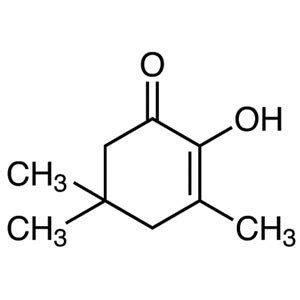
2-Hydroxy-3,5,5-trimethyl-2-cyclohexen-1-one TCI T2723
Regular price Rp 1.273.650,00Regular price -
3-Amino-2-cyclohexen-1-one TCI A1936
Regular price From Rp 1.510.950,00Regular price