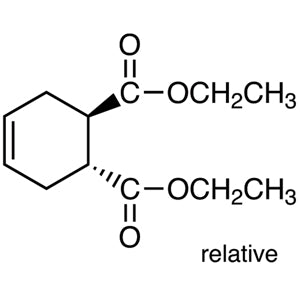
Bis(2-ethylhexyl) 4-cyclohexene-1,2-dicarboxylate is a chemical compound widely used as a building block in the synthesis of complex organic compounds. It plays a crucial role in laboratory settings where precise chemical reactions are required to produce materials with specific properties. This compound is valued for its versatility and stability, making it a reliable choice for researchers working in various fields of chemistry. Its molecular structure allows it to participate in a range of chemical transformations, contributing to the development of new materials and pharmaceutical compounds.
The compound's non-heterocyclic nature simplifies the synthesis process, reducing the complexity of reactions and improving the efficiency of laboratory workflows. Its chemical stability ensures that it remains inert under normal conditions, allowing for controlled reactions when needed. This characteristic makes it particularly suitable for applications where reproducibility and accuracy are essential. Additionally, its compatibility with various reagents enables it to be used in a wide array of chemical processes, enhancing its utility in both academic and industrial research.
In Indonesian laboratories, this compound is commonly used in organic chemistry research, especially in the development of industrial chemicals and pharmaceuticals. Its role in synthesizing materials with specific functional properties makes it a key component in the production of polymers, protective coatings, and active pharmaceutical ingredients. Researchers in Indonesia rely on this compound for its reliability and adaptability in diverse chemical applications, supporting innovation in both academic and industrial settings.
TCI brochures (PDF)
- Polymer Additives 2026-04-16 · p. 3
Related TCI products
- TCI A0163 103-23-1 Bis(2-ethylhexyl) Adipate
- TCI A1473 103-24-2 Bis(2-ethylhexyl) Azelate
- TCI A0653 103-24-2 Bis(2-ethylhexyl) Azelate
- TCI D5576 21544-03-6 Diglycidyl 4-Cyclohexene-1,2-dicarboxylate
- TCI D3714 4841-85-4 Diethyl cis-4-Cyclohexene-1,2-dicarboxylate
- TCI D3703 4841-84-3 Dimethyl cis-4-Cyclohexene-1,2-dicarboxylate
- Polymer synthesis for the development of new plastics and industrial chemicals due to its ability to form stable molecular structures.
- Organic chemistry research in the creation of functional compounds for pharmaceutical applications because of its reactivity and stability.
- Production of protective coatings and coatings for industrial applications due to its chemical inertness and compatibility with various reagents.
- Development of active pharmaceutical ingredients through controlled chemical reactions that benefit from its non-heterocyclic structure.
- Research in material science for the synthesis of advanced materials with specific physical and chemical properties.
| Brand | TCI |
|---|---|
| CAS number | 2915-49-3 |
| Molecular formula | — |
| Purity | — |
| Category | Chemistry > Building Blocks > Non-Heterocyclic Building Blocks |
| Pack sizes | Available in standard laboratory quantities as per supplier specifications |
| Physical form | Liquid or solid, depending on supplier packaging |
| Storage | Store in a cool, dry place away from direct sunlight and incompatible substances |
This compound should be stored in a cool, dry environment to maintain its chemical stability. It is recommended to use sealed containers to prevent exposure to moisture and air, which could affect its integrity. When handling, ensure that proper personal protective equipment is worn, including gloves and safety goggles, to minimize direct contact. The compound should be kept away from incompatible materials such as strong acids or bases to avoid potential chemical reactions. Regular monitoring of storage conditions is essential to ensure the compound remains in optimal condition for use in laboratory applications. Proper labeling of containers is also important for safety and traceability in the laboratory setting.
—
Produk Terkait
-
Bis(2-ethylhexyl)Adipate TCI A0163
Regular price Rp 452.550,00Regular priceRp 316.050,00Sale price Rp 452.550,00 -
Bis(2-ethylhexyl)Azelate TCI A1473
Regular price Rp 2.942.100,00Regular priceRp 2.072.700,00Sale price Rp 2.942.100,00 -
Bis(2-ethylhexyl)Azelate TCI A0653
Regular price From Rp 530.250,00Regular priceRp 386.400,00Sale price From Rp 530.250,00 -
Diglycidyl4-Cyclohexene-1,2-dicarboxylate TCI D5576
Regular price Rp 848.400,00Regular priceRp 593.250,00Sale price Rp 848.400,00 -
Diethylcis-4-Cyclohexene-1,2-dicarboxylate TCI D3714
Regular price Rp 2.837.100,00Regular priceRp 1.983.450,00Sale price Rp 2.837.100,00 -
Dimethylcis-4-Cyclohexene-1,2-dicarboxylate TCI D3703
Regular price Rp 2.571.450,00Regular priceRp 1.797.600,00Sale price Rp 2.571.450,00 -
Dimethyltrans-4-Cyclohexene-1,2-dicarboxylate TCI D3692
Regular price From Rp 1.565.550,00Regular priceRp 1.094.100,00Sale price From Rp 1.565.550,00 -
Diethyltrans-4-Cyclohexene-1,2-dicarboxylate TCI C1704
Regular price From Rp 557.550,00Regular priceRp 389.550,00Sale price From Rp 557.550,00