

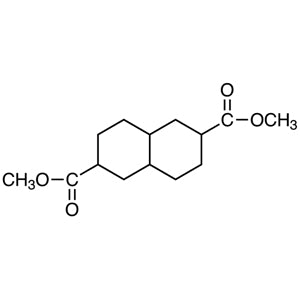
TCI D3745, also known as Dimethyl Decahydro-2,6-naphthalenedicarboxylate (mixture of isomers), is the dimethyl diester of a decahydronaphthalene framework — a naphthalene molecule that has been fully hydrogenated into two fused, saturated cyclohexane rings. In the laboratory, this compound serves as a non-heterocyclic building block and as a model monomer for research into high-performance polymers. The product is supplied as a mixture of isomers, a common and deliberately accepted form in many materials studies because it reflects hydrogenated material as it is actually obtained.
The property that makes this material attractive is the rigidity of its saturated bicyclic structure combined with the complete absence of aromatic rings. A framework of this kind provides stiffness approaching that of an aromatic unit, but without the ultraviolet light absorption that causes yellowing, so polyesters derived from it have the potential for good optical clarity and weathering resistance. Its two methyl ester groups are readily transesterified with a variety of diols, hydrolyzed to the corresponding diacid, or reduced to a bicyclic diol. The isomer mixture also opens up interesting avenues of study regarding the influence of stereochemistry on thermal properties.
In Indonesian laboratories, this reagent is typically used in university and institutional research groups working on polymer chemistry, coatings, and advanced materials, as well as in synthetic organic laboratories that require rigid alicyclic scaffolds. It is generally handled at the bench scale in fine chemical synthesis, monomer screening experiments, and structure–property investigations, where a well-defined commercial building block removes the need to prepare the hydrogenated framework in house.
Related TCI products
- TCI N0684 2549-47-5 Dimethyl 2,7-Naphthalenedicarboxylate
- TCI N0590 13728-34-2 Dimethyl 2,3-Naphthalenedicarboxylate
- TCI N0364 840-65-3 Dimethyl 2,6-Naphthalenedicarboxylate
- TCI D5743 68039-49-6 2,4-Dimethyl-3-cyclohexene-1-carboxaldehyde (mixture of isomers)
- TCI D4400 7487-15-2 Dimethyl 1,4-Naphthalenedicarboxylate
- TCI D4399 3068-03-9 Dimethyl Decahydro-1,4-naphthalenedicarboxylate (mixture of isomers)
- Polyester monomer research — the two methyl ester groups undergo transesterification with a wide range of diols, allowing systematic preparation of saturated alicyclic polyesters for property evaluation.
- Optically clear and weather-resistant coating studies — the absence of aromatic rings removes the ultraviolet absorption responsible for yellowing, making it suitable for work on non-yellowing polymer systems.
- Non-heterocyclic building block in organic synthesis — the fully saturated bicyclic core provides a rigid alicyclic scaffold for constructing more elaborate target molecules.
- Precursor to bicyclic diols and diacids — the ester groups can be reduced to the corresponding diol or hydrolyzed to the diacid, giving access to related difunctional intermediates.
- Stereochemistry and structure–property investigations — because the material is an isomer mixture, it supports studies of how stereochemical variation influences the thermal behaviour of derived polymers.
| Brand | TCI |
|---|---|
| CAS number | 3068-02-8 |
| Molecular formula | — |
| Purity | — |
| Category | Chemistry > Building Blocks > Non-Heterocyclic Building Blocks |
| Pack sizes | available in standard TCI research and laboratory pack sizes; please confirm the currently available packaging when ordering |
| Physical form | — |
| Storage | keep in a tightly closed original container in a cool, dry, well-ventilated place |
- Chemical name: Dimethyl Decahydro-2,6-naphthalenedicarboxylate (mixture of isomers)
- Isomeric composition: supplied as a mixture of isomers
Store the material in its original tightly closed container in a cool, dry, well-ventilated area, away from heat sources, direct sunlight, and incompatible chemicals such as strong oxidizing agents, strong acids, and strong bases. Chemically resistant, well-sealed glass containers with inert closures are suitable for both storage and dispensing, and containers should be kept closed when not in use to limit moisture uptake and vapour release. Handle in a fume hood using standard laboratory personal protective equipment, including safety glasses, chemically resistant gloves, and a laboratory coat. Avoid inhalation of vapours and contact with skin and eyes, and wash hands thoroughly after handling. Dispense with clean, dry equipment to avoid cross-contamination, label all secondary containers clearly, and dispose of residues and contaminated materials in accordance with the applicable institutional and local chemical waste regulations. Always consult the manufacturer's Safety Data Sheet before use.
—
Produk Terkait
-
Dimethyl2,7-Naphthalenedicarboxylate TCI N0684
Regular price From Rp 7.844.550,00Regular price -
Dimethyl2,3-Naphthalenedicarboxylate TCI N0590
Regular price From Rp 1.590.750,00Regular price -
Dimethyl2,6-Naphthalenedicarboxylate TCI N0364
Regular price From Rp 903.000,00Regular price -
2,4-Dimethyl-3-cyclohexene-1-carboxaldehyde(mixtureofisomers) TCI D5743
Regular price From Rp 1.035.300,00Regular price -
Dimethyl1,4-Naphthalenedicarboxylate TCI D4400
Regular price From Rp 2.625.000,00Regular price -
DimethylDecahydro-1,4-naphthalenedicarboxylate(mixtureofisomers) TCI D4399
Regular price Rp 3.605.700,00Regular price -
Tricyclo[5210~2,6~]decanedimethanolDiacrylate(mixtureofisomers)(stabilizedwithMEHQ) TCI T4002
Regular price From Rp 1.273.650,00Regular price -
Teprenone[mixtureof(5E,9E,13E)-and(5Z,9E,13E)-isomers] TCI T2701
Regular price From Rp 2.147.250,00Regular price


![42594-17-2 Tricyclo[5.2.1.0~2,6~]decanedimethanol Diacrylate (mixture of isomers) (stabilized with MEHQ) - AMI Scientific](http://amiscientific.com/cdn/shop/files/TCI2510T4002.jpg?v=1767144579&width=533)
![6809-52-5 Teprenone [mixture of (5E,9E,13E)- and (5Z,9E,13E)- isomers] - AMI Scientific](http://amiscientific.com/cdn/shop/files/TCI2510T2701.jpg?v=1767143256&width=533)