

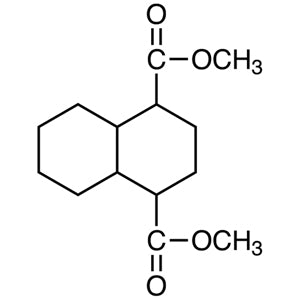
Dimethyl Decahydro-1,4-naphthalenedicarboxylate (mixture of isomers), with CAS number 3068-03-9, is a versatile chemical compound widely used in organic synthesis as a building block. This compound plays a crucial role in the development of complex organic molecules by facilitating the formation of carbon-carbon bonds and enabling the assembly of molecular structures. Its importance lies in its ability to participate in a variety of chemical reactions, making it a fundamental component in both academic and industrial research settings. Due to its stability and predictable chemical behavior, it is a reliable choice for researchers aiming to synthesize new compounds with specific functional groups or structural features.
One of the key attributes of this compound is its solubility in organic solvents, which simplifies the process of mixing and reacting with other reagents. This solubility, combined with its controlled reactivity, ensures that it can be effectively utilized in a wide range of synthetic pathways. Its molecular structure also allows for modifications that can lead to the creation of various derivatives, enhancing its utility in both laboratory and industrial applications. These properties make it a preferred material for chemists working on advanced synthetic projects.
In Indonesian laboratories, this compound is commonly used in organic chemistry research, particularly in educational institutions and research centers. It supports the development of pharmaceutical compounds, polymers, and other industrial chemicals. Its availability and reliability make it a valuable resource for scientists and students alike, contributing to the advancement of chemical research in the region.
Related TCI products
- TCI N0684 2549-47-5 Dimethyl 2,7-Naphthalenedicarboxylate
- TCI N0590 13728-34-2 Dimethyl 2,3-Naphthalenedicarboxylate
- TCI N0364 840-65-3 Dimethyl 2,6-Naphthalenedicarboxylate
- TCI D5743 68039-49-6 2,4-Dimethyl-3-cyclohexene-1-carboxaldehyde (mixture of isomers)
- TCI D4400 7487-15-2 Dimethyl 1,4-Naphthalenedicarboxylate
- TCI D3745 3068-02-8 Dimethyl Decahydro-2,6-naphthalenedicarboxylate (mixture of isomers)
- Organic synthesis is a primary application where this compound is used to build complex molecular structures through carbon-carbon bond formation.
- Pharmaceutical research benefits from its use in the development of new drug molecules due to its structural versatility and reactivity.
- Polymer science utilizes this compound as a building block for creating synthetic polymers with specific properties and functionalities.
- Industrial chemical production relies on its ability to participate in various chemical reactions, enabling the synthesis of a wide range of compounds.
- Academic research in chemical education and innovation uses this compound to teach and demonstrate synthetic methodologies and molecular design.
| Brand | TCI |
|---|---|
| CAS number | 3068-03-9 |
| Molecular formula | — |
| Purity | — |
| Category | Chemistry > Building Blocks > Non-Heterocyclic Building Blocks |
| Pack sizes | Available in various quantities as per supplier’s standard offerings |
| Physical form | Solid, crystalline or amorphous depending on the batch |
| Storage | Store in a cool, dry place away from direct light and moisture |
This compound should be stored in a cool, dry environment, away from direct sunlight and sources of heat to maintain its stability. It is recommended to use airtight containers made of materials such as glass or high-density polyethylene to prevent moisture absorption and contamination. Due to its chemical nature, it should be handled with appropriate personal protective equipment, including gloves and safety goggles, to ensure laboratory safety. Proper labeling of containers is essential to avoid mix-ups and ensure safe handling. Regular monitoring of storage conditions is advised to maintain the integrity of the compound and ensure its effectiveness in laboratory applications.
—
Produk Terkait
-
Dimethyl2,7-Naphthalenedicarboxylate TCI N0684
Regular price From Rp 7.844.550,00Regular price -
Dimethyl2,3-Naphthalenedicarboxylate TCI N0590
Regular price From Rp 1.590.750,00Regular price -
Dimethyl2,6-Naphthalenedicarboxylate TCI N0364
Regular price From Rp 903.000,00Regular price -
2,4-Dimethyl-3-cyclohexene-1-carboxaldehyde(mixtureofisomers) TCI D5743
Regular price From Rp 1.035.300,00Regular price -
Dimethyl1,4-Naphthalenedicarboxylate TCI D4400
Regular price From Rp 2.625.000,00Regular price -
DimethylDecahydro-2,6-naphthalenedicarboxylate(mixtureofisomers) TCI D3745
Regular price Rp 4.929.750,00Regular price -
Tricyclo[5210~2,6~]decanedimethanolDiacrylate(mixtureofisomers)(stabilizedwithMEHQ) TCI T4002
Regular price From Rp 1.273.650,00Regular price -
Teprenone[mixtureof(5E,9E,13E)-and(5Z,9E,13E)-isomers] TCI T2701
Regular price From Rp 2.147.250,00Regular price


![42594-17-2 Tricyclo[5.2.1.0~2,6~]decanedimethanol Diacrylate (mixture of isomers) (stabilized with MEHQ) - AMI Scientific](http://amiscientific.com/cdn/shop/files/TCI2510T4002.jpg?v=1767144579&width=533)
![6809-52-5 Teprenone [mixture of (5E,9E,13E)- and (5Z,9E,13E)- isomers] - AMI Scientific](http://amiscientific.com/cdn/shop/files/TCI2510T2701.jpg?v=1767143256&width=533)