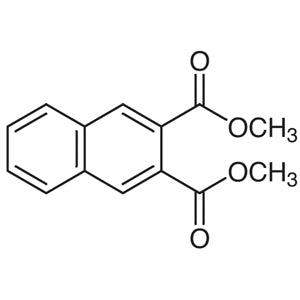
Dimethyl 2,3-Naphthalenedicarboxylate (CAS 13728-34-2) is the dimethyl diester of naphthalene-2,3-dicarboxylic acid. It is an aromatic compound built on a naphthalene framework, with two methyl ester groups on adjacent carbons at positions 2 and 3. In the laboratory it serves as a stable, easy-to-handle non-heterocyclic building block. It is also a protected form of naphthalene-2,3-dicarboxylic acid. Researchers use it as a starting material for symmetrical naphthalene derivatives needed in materials chemistry, coordination chemistry and general organic synthesis.
Its main strengths are its symmetry and the range of transformations it supports. The two ester groups can be hydrolysed to the diacid, reduced to the diol 2,3-bis(hydroxymethyl)naphthalene, or converted into amides and hydrazides. Because positions 2 and 3 sit next to each other, chemists can build new rings fused to the naphthalene core, such as imides and other heterocyclic systems. The diester is generally more soluble in organic solvents than the free diacid and easier to purify. This makes it a practical choice for multistep synthesis, where clean intermediates and reliable handling save time and material.
In Indonesian laboratories, this compound is useful for research groups in materials chemistry, metal-organic frameworks, coordination chemistry and synthetic organic chemistry. University research groups, graduate students and institutional laboratories can use it to prepare naphthalene-based ligands, fused-ring intermediates and symmetrical target molecules. Because it comes from TCI, labs can expect consistent material from batch to batch, so experiments can be repeated reliably across projects and teaching work.
Related TCI products
- TCI N0684 2549-47-5 Dimethyl 2,7-Naphthalenedicarboxylate
- TCI N0364 840-65-3 Dimethyl 2,6-Naphthalenedicarboxylate
- TCI D4400 7487-15-2 Dimethyl 1,4-Naphthalenedicarboxylate
- TCI D4399 3068-03-9 Dimethyl Decahydro-1,4-naphthalenedicarboxylate (mixture of isomers)
- TCI D3745 3068-02-8 Dimethyl Decahydro-2,6-naphthalenedicarboxylate (mixture of isomers)
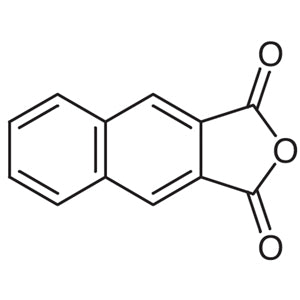
- TCI N0530 716-39-2 2,3-Naphthalenedicarboxylic Anhydride
- Preparation of naphthalene-2,3-dicarboxylic acid: Hydrolysing both methyl esters gives the free diacid, so the diester works as a convenient, easily purified protected precursor.
- Synthesis of 2,3-bis(hydroxymethyl)naphthalene: Reducing both ester groups gives the symmetrical diol, a useful intermediate for further functionalisation on the naphthalene framework.
- Construction of fused-ring systems: The adjacent 2,3-ester groups let researchers close new rings onto the naphthalene core, such as imides and related heterocyclic structures.
- Amide and hydrazide derivatives: The ester groups react readily to form amides and hydrazides, which gives access to symmetrical naphthalene compounds for organic and coordination chemistry studies.
- Ligand design for coordination chemistry and metal-organic frameworks: After conversion to the diacid or other derivatives, the rigid symmetrical naphthalene core suits studies of metal-binding building units and framework materials.
| Brand | TCI (product code N0590) |
|---|---|
| CAS number | 13728-34-2 |
| Molecular formula | — |
| Purity | — |
| Category | Chemistry > Building Blocks > Non-Heterocyclic Building Blocks |
| Pack sizes | TCI standard pack sizes; please confirm current options with AMI Scientific |
| Physical form | see the TCI product label and Certificate of Analysis |
| Storage | keep tightly closed in a cool, dry place, following the TCI label and Safety Data Sheet |
Store Dimethyl 2,3-Naphthalenedicarboxylate in its original, tightly sealed container. Keep it in a cool, dry, well-ventilated area away from direct sunlight, heat sources, moisture and strong oxidising agents. Moisture matters in particular because ester groups can hydrolyse slowly over time. After each use, close the container properly and label it clearly. Handle the material in a fume hood or a well-ventilated area, and wear suitable personal protective equipment, including safety glasses, laboratory gloves and a lab coat. Avoid creating dust, breathing it in, and contact with skin or eyes. Always read the TCI Safety Data Sheet before use, and dispose of residues and contaminated materials according to your institution's chemical waste procedures.
—
Produk Terkait
-
Dimethyl2,7-Naphthalenedicarboxylate TCI N0684
Regular price From Rp 7.844.550,00Regular price -
Dimethyl2,6-Naphthalenedicarboxylate TCI N0364
Regular price From Rp 903.000,00Regular price -
Dimethyl1,4-Naphthalenedicarboxylate TCI D4400
Regular price From Rp 2.625.000,00Regular price -
DimethylDecahydro-1,4-naphthalenedicarboxylate(mixtureofisomers) TCI D4399
Regular price Rp 3.605.700,00Regular price -
DimethylDecahydro-2,6-naphthalenedicarboxylate(mixtureofisomers) TCI D3745
Regular price Rp 4.929.750,00Regular price -
2,3-NaphthalenedicarboxylicAnhydride TCI N0530
Regular price Rp 4.559.100,00Regular price -
2,3-NaphthalenedicarboxylicAcid TCI N0526
Regular price From Rp 1.538.250,00Regular price -
2,6-NaphthalenedicarboxylicAcid TCI N0377
Regular price From Rp 743.400,00Regular price