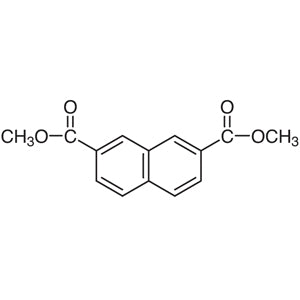
Dimethyl 2,7-Naphthalenedicarboxylate from TCI (product code N0684) is an aromatic diester with two methyl ester groups at the 2 and 7 positions of a naphthalene framework. In the laboratory it serves as a non-heterocyclic building block for synthesizing polymers, porous materials, and organic molecules with defined geometries. The 2,7 substitution pattern points its substituents at a different angle from the more common 2,6 isomer. That difference matters to researchers who want to control the shape and packing of molecules in the materials they make.
Researchers choose this compound for its rigid naphthalene backbone, its extended aromatic system, and two ester groups that are easy to modify further. Hydrolysis of the esters gives 2,7-naphthalenedicarboxylic acid, a linker ligand used in metal-organic framework (MOF) research. Reduction of the esters gives the corresponding diol, and transesterification lets the compound be built into polyester chains. The methyl ester form is generally more soluble in organic solvents and easier to purify than the free acid, which makes it a more practical starting material for multistep synthesis.
In Indonesia, Dimethyl 2,7-Naphthalenedicarboxylate is relevant to research groups in hybrid inorganic-organic materials, polymer science, and synthetic organic chemistry. University laboratories and research institutes can use it as a starting point for new ligands, rigid monomers, and model aromatic compounds. It suits projects that compare how different naphthalene substitution patterns affect material structure and properties, as well as graduate thesis work that needs a well-defined, versatile aromatic diester.
Related TCI products
- TCI N0590 13728-34-2 Dimethyl 2,3-Naphthalenedicarboxylate
- TCI N0364 840-65-3 Dimethyl 2,6-Naphthalenedicarboxylate
- TCI D4400 7487-15-2 Dimethyl 1,4-Naphthalenedicarboxylate
- TCI D4399 3068-03-9 Dimethyl Decahydro-1,4-naphthalenedicarboxylate (mixture of isomers)
- TCI D3745 3068-02-8 Dimethyl Decahydro-2,6-naphthalenedicarboxylate (mixture of isomers)
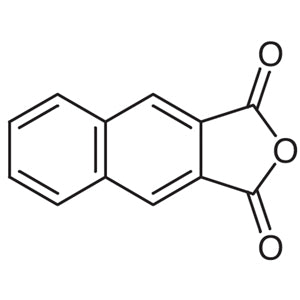
- TCI N0530 716-39-2 2,3-Naphthalenedicarboxylic Anhydride
- Metal-organic framework research: hydrolyzing this diester gives 2,7-naphthalenedicarboxylic acid, a rigid linker ligand whose angular geometry can produce framework structures different from those built with the 2,6 isomer.
- Polyester synthesis: the two methyl ester groups can take part in transesterification with diols, so the rigid naphthalene unit can be built directly into polyester backbones for materials research.
- Diol preparation by reduction: reducing both ester groups gives the corresponding naphthalene diol, a useful intermediate for further functionalization, cross-linking studies, and building larger organic architectures.
- Molecular geometry studies: the 2,7 substitution pattern gives a substituent angle distinct from the 2,6 isomer, so researchers can study how molecular shape affects packing and material behavior.
- Starting material for multistep synthesis: the methyl ester form is generally more soluble in organic solvents and easier to purify than the free acid, which makes handling practical in synthetic routes.
| Brand | TCI (product code N0684) |
|---|---|
| CAS number | 2549-47-5 |
| Molecular formula | — |
| Purity | — |
| Category | Chemistry > Building Blocks > Non-Heterocyclic Building Blocks |
| Pack sizes | see the product listing for available TCI pack sizes |
| Physical form | see the TCI product documentation for physical form and appearance |
| Storage | follow the storage conditions on the TCI label and Safety Data Sheet |
Store Dimethyl 2,7-Naphthalenedicarboxylate in its original, tightly closed TCI container, or in a clean, well-labeled glass container. Keep it in a cool, dry, well-ventilated place away from direct sunlight, moisture, heat sources, and incompatible materials such as strong oxidizers, acids, and bases, which can hydrolyze the ester groups. Always check the label and Safety Data Sheet for the recommended storage temperature. Wear standard personal protective equipment when handling it, including safety glasses, gloves, and a lab coat. Weigh and transfer the material in a fume hood or ventilated area to avoid breathing in dust, and dispose of waste according to institutional chemical waste procedures.
—
Produk Terkait
-
Dimethyl2,3-Naphthalenedicarboxylate TCI N0590
Regular price From Rp 1.590.750,00Regular price -
Dimethyl2,6-Naphthalenedicarboxylate TCI N0364
Regular price From Rp 903.000,00Regular price -
Dimethyl1,4-Naphthalenedicarboxylate TCI D4400
Regular price From Rp 2.625.000,00Regular price -
DimethylDecahydro-1,4-naphthalenedicarboxylate(mixtureofisomers) TCI D4399
Regular price Rp 3.605.700,00Regular price -
DimethylDecahydro-2,6-naphthalenedicarboxylate(mixtureofisomers) TCI D3745
Regular price Rp 4.929.750,00Regular price -
2,3-NaphthalenedicarboxylicAnhydride TCI N0530
Regular price Rp 4.559.100,00Regular price -
2,3-NaphthalenedicarboxylicAcid TCI N0526
Regular price From Rp 1.538.250,00Regular price -
2,6-NaphthalenedicarboxylicAcid TCI N0377
Regular price From Rp 743.400,00Regular price