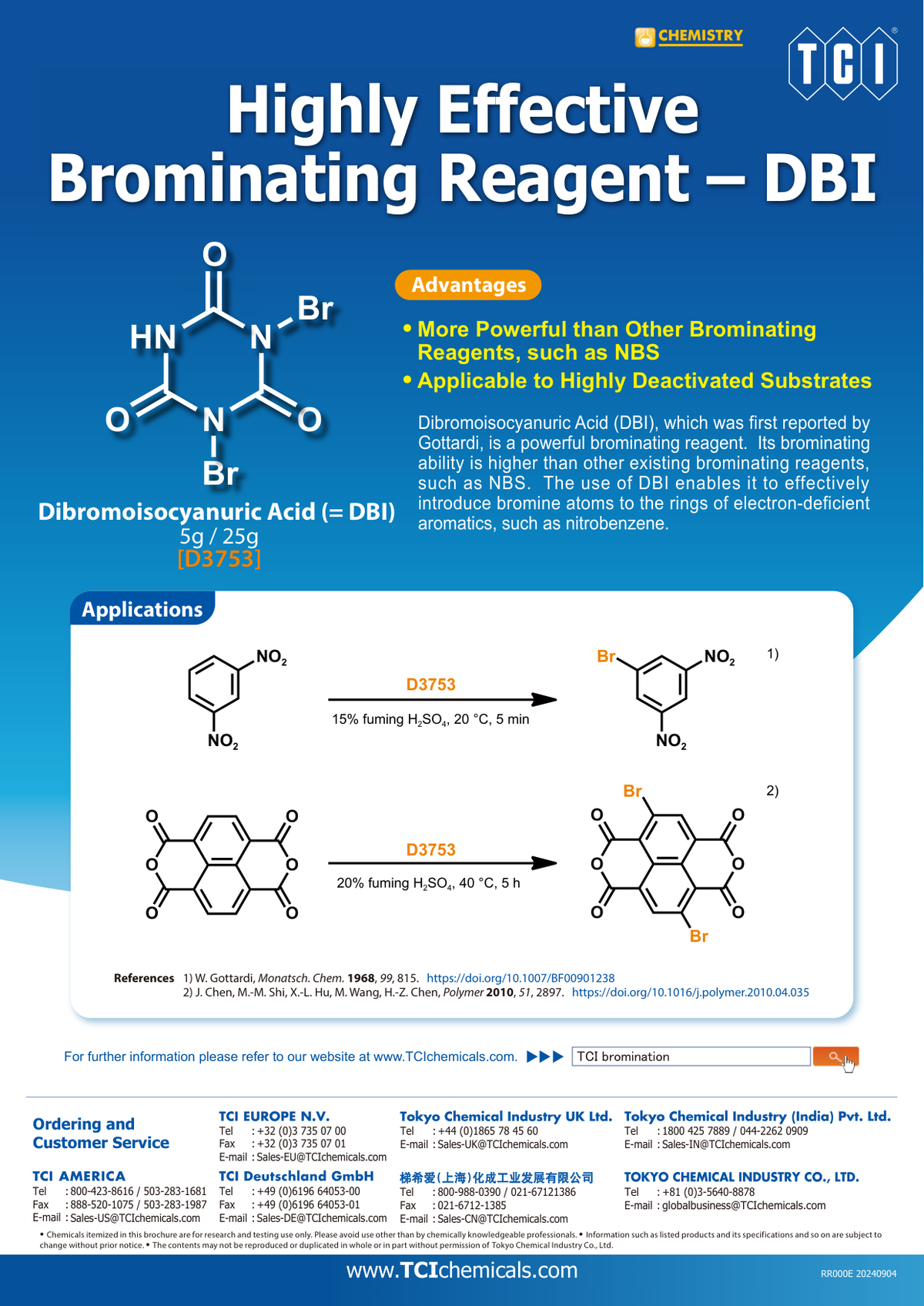
Dibromoisocyanuric Acid is a synthetic reagent that serves as a source of electrophilic bromine in an easily weighable solid form. The compound is a derivative of isocyanuric acid carrying two bromine atoms on the nitrogen atoms of the ring, so the bromine is stored in a bound state and released only when it encounters a suitable substrate and appropriate reaction conditions. In the laboratory, its role is to replace liquid bromine — which fumes, corrodes, and is difficult to measure accurately — with a solid reagent that is far more convenient to use for introducing bromine atoms into organic compounds in a controlled manner.
The main reason this reagent is selected is its electrophilic brominating power, which ranks among the strongest of the solid brominating reagents. In strongly acidic media, this reagent is capable of brominating deactivated aromatic rings, that is, substrates that often fail to react with milder brominating reagents. Its solid form makes accurate stoichiometric measurement straightforward, so researchers can control the amount of bromine introduced and suppress polybrominated side products. The by-product, an isocyanuric acid derivative, is generally a solid that is relatively easy to separate from the reaction mixture.
In Indonesian laboratories, this reagent is typically used in organic synthesis and research settings where a bromine atom must be installed on an organic framework without handling liquid bromine directly. Because it is a weighable solid, it fits laboratories that prefer to prepare reagents by mass rather than by volume, and its supply through the TCI catalogue allows synthesis, research, and teaching laboratories to obtain a consistent brominating reagent for planned experimental work.
Advantages (TCI brochure)
- More powerful than other brominating reagents, such as NBS
- Applicable to highly deactivated substrates
TCI brochures (PDF)
- Highly Effective Brominating Reagent-DBI 2024-09-04 · p. 1
- Halogenation Reagents 2026-04-03 · p. 3
Related TCI products
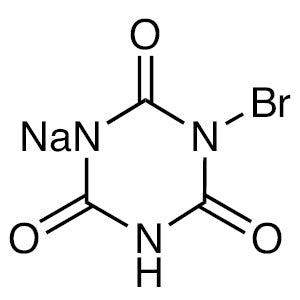
- TCI B2148 164918-61-0 Monosodium Bromoisocyanurate
- TCI T3592 15458-53-4 Trifluoromethanesulfonyl Bromide
- TCI T1382 111865-47-5 Benzyltrimethylammonium Tribromide [Brominating Reagent]
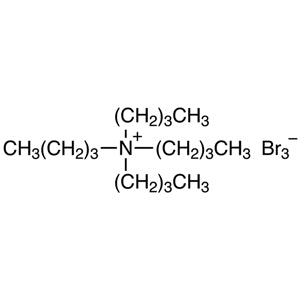
- TCI T1284 38932-80-8 Tetrabutylammonium Tribromide
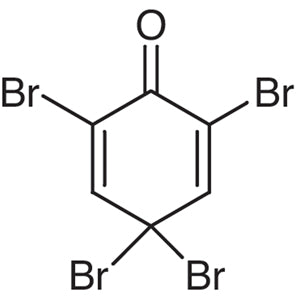
- TCI T1235 20244-61-5 2,4,4,6-Tetrabromo-2,5-cyclohexadienone
- TCI B3596 820965-08-0 1-Butyl-3-methylimidazolium Tribromide
- Bromination of deactivated aromatic rings — in strongly acidic media this reagent delivers electrophilic bromine powerful enough to react with substrates that milder brominating reagents leave untouched.
- Controlled monobromination in organic synthesis — the solid form allows precise stoichiometric weighing, so the amount of bromine introduced can be limited and polybrominated by-products suppressed.
- Replacement for liquid bromine in routine synthetic steps — it supplies the same brominating function without the fuming, corrosive, and hard-to-measure character of the liquid element.
- Formation of carbon–halogen bonds in research-scale preparations — as a C–X (halogen) bond formation reagent it introduces bromine atoms into organic compounds under conditions the chemist selects.
- Preparative work requiring simple product separation — the isocyanuric acid derivative left after bromine transfer is generally solid and relatively easy to remove from the reaction mixture.
From the TCI brochure
- Introducing bromine atoms to rings of electron-deficient aromatics, such as nitrobenzene
- 15% fuming H2SO4, 20 °C, 5 min
- 20% fuming H2SO4, 40 °C, 5 h
| Brand | TCI |
|---|---|
| CAS number | 15114-43-9 |
| Molecular formula | — |
| Purity | — |
| Category | Chemistry > Synthetic Reagents > C-X(Halogen) Bond Formation [Synthetic Reagents] |
| Pack sizes | available in TCI catalogue pack sizes — please confirm the packaging option required when ordering |
| Physical form | solid, weighable reagent |
| Storage | store according to the manufacturer's instructions on the product label and safety data sheet |
- Catalogue number: D3753
Store the reagent in its original tightly closed container, kept dry and away from moisture, heat, direct sunlight, and incompatible materials, in a cool and well-ventilated chemical store following the storage conditions stated on the manufacturer's label and safety data sheet. Because it is a reactive source of electrophilic bromine, keep it separated from reducing agents and organic materials that are not part of an intended reaction. Handle and weigh the solid in a fume hood, using safety glasses, chemical-resistant gloves, and a laboratory coat, and avoid raising dust or inhaling it. Use clean, dry spatulas and glassware so that no water or foreign residues are introduced into the container, close the container immediately after each use, and collect any residues and reaction waste as halogenated chemical waste in line with the applicable laboratory waste procedures.
References cited in the TCI brochure
- W. Gottardi. Über Bromierungen mit Dibromoisocyanursäure unter ionischen Bedingungen, 1. Mitt.: Monobromierungen Monatshefte für Chemie - Chemical Monthly, 1968. doi:10.1007/bf00901238
- Jian Chen. Conjugated polymers based on benzodithiophene and arylene imides: Extended absorptions and tunable electrochemical properties Polymer, 2010. doi:10.1016/j.polymer.2010.04.035
Produk Terkait
-
MonosodiumBromoisocyanurate TCI B2148
Regular price Rp 3.287.550,00Regular price -
TrifluoromethanesulfonylBromide TCI T3592
Regular price From Rp 1.565.550,00Regular price -
BenzyltrimethylammoniumTribromide[BrominatingReagent] TCI T1382
Regular price From Rp 823.200,00Regular price -
TetrabutylammoniumTribromide TCI T1284
Regular price From Rp 955.500,00Regular price -
2,4,4,6-Tetrabromo-2,5-cyclohexadienone TCI T1235
Regular price From Rp 1.405.950,00Regular price -
1-Butyl-3-methylimidazoliumTribromide TCI B3596
Regular price Rp 3.870.300,00Regular price -
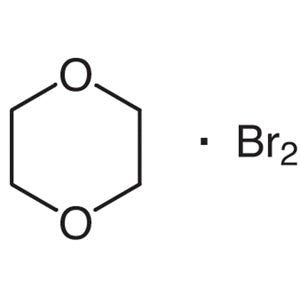
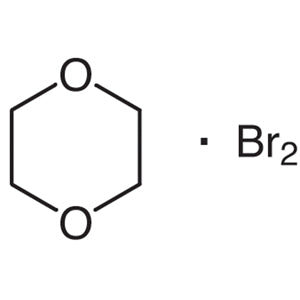
Bromine-1,4-DioxaneComplex TCI B2719
Regular price From Rp 2.995.650,00Regular price -
N-Bromosaccharin TCI B2152
Regular price From Rp 4.240.950,00Regular price

![111865-47-5 Benzyltrimethylammonium Tribromide [Brominating Reagent] - AMI Scientific](http://amiscientific.com/cdn/shop/files/TCI2510T1382.jpg?v=1769057884&width=533)