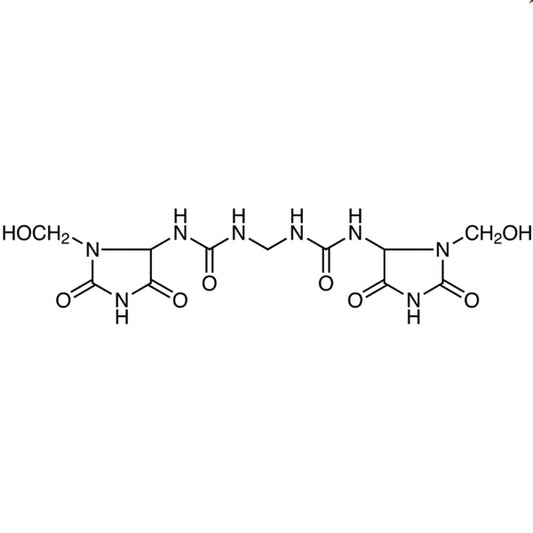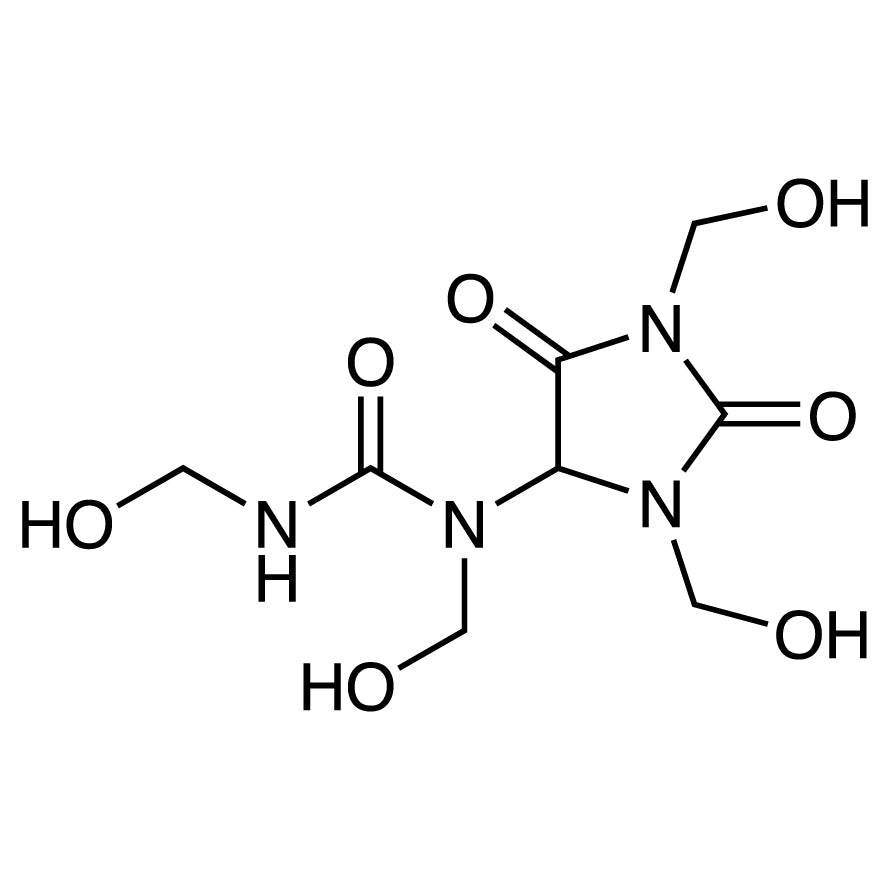
TCI D3769 Diazolidinyl Urea, with CAS number 78491-02-8, is a cyclic urea derivative widely recognized as an antimicrobial and preservative material. In the laboratory it is used as an active preservative agent that holds back the growth of bacteria and fungi in water-based systems, and equally as a test material in studies of preservative efficacy. Its role is important in research on personal care product formulations, aqueous media, and research materials that are vulnerable to microbial contamination during storage periods and repeated testing in the laboratory.
The properties that make diazolidinyl urea a preferred choice are its spectrum of activity, which covers Gram-positive bacteria, Gram-negative bacteria, and also yeasts and fungi, together with its good solubility in water, so that it is easily integrated into the aqueous phase of a formulation. This compound belongs to the formaldehyde-donor group, meaning a material that slowly releases small amounts of formaldehyde as its antimicrobial mechanism; that character explains its effectiveness at low concentrations and is at the same time the reason its handling needs care.
In Indonesian laboratories this material fits the routine work of formulation research and preservative evaluation, where aqueous preparations must remain free of microbial growth across storage and repeated testing. Because the compound is hygroscopic, control of container humidity becomes an important part of caring for this material, a point that matters especially in warm and humid working conditions where opened containers can pick up moisture between uses.
TCI brochures (PDF)
- Antimicrobials and Antitumor Agents for Research and Experimental Use 2025-04-24 · p. 7
- Pharmaceutical Ingredients for Research and Experimental Use 2026-03-09 · p. 8
- Preservation of aqueous media: the compound acts as an active preservative agent that holds back bacterial and fungal growth in water-based systems during storage and repeated handling.
- Preservative efficacy studies: it serves as a test material in evaluations of preservative performance, since its antimicrobial action is well characterized and effective at low concentrations.
- Personal care formulation research: its good water solubility allows straightforward integration into the aqueous phase of a formulation being developed and evaluated in the laboratory.
- Broad-spectrum microbial control work: activity covering Gram-positive bacteria, Gram-negative bacteria, yeasts, and fungi suits studies that require protection against several classes of organisms at once.
- Protection of contamination-prone research materials: it guards preparations that are vulnerable to microbial contamination across storage periods and repeated testing cycles in the laboratory.
| Brand | TCI |
|---|---|
| CAS number | 78491-02-8 |
| Molecular formula | — |
| Purity | — |
| Category | Life Science > Biochemicals and Reagents > Antibiotics |
| Pack sizes | — |
| Physical form | — |
| Storage | hygroscopic material; keep the container tightly closed with humidity controlled |
- Chemical name: Diazolidinyl Urea
- Catalog code: D3769
Store TCI D3769 Diazolidinyl Urea in its original tightly closed container, since the material is hygroscopic and moisture control inside the container is an essential part of maintaining it. Keep containers sealed between uses and return them promptly after weighing so that ambient humidity is not drawn in. Because the compound is a formaldehyde donor that slowly releases small amounts of formaldehyde as its antimicrobial mechanism, handle it with care: weigh and transfer in a well-ventilated area or fume hood, avoid inhaling dust, avoid direct skin and eye contact, and wear appropriate gloves, safety glasses, and a laboratory coat. Consult the manufacturer safety data sheet before use and follow local laboratory waste disposal procedures.
—
Product Categories
- Biochemicals and ReagentsAntibioticsAntibiotics (Chemical Structure Class)
- Biochemicals and ReagentsPharmaceutical Research Reagents (for Experimental Use)Antimicrobial Ingredients (for Research and Experimental Use)
- MicrobiologyAntibioticsAntibiotics (Chemical Structure Class)
- Pharmaceutical Development and Drug Discovery ResearchPharmaceutical Research Reagents (for Experimental Use)Antimicrobial Ingredients (for Research and Experimental Use)
- Pharmaceutical Development and Drug Discovery ResearchAntibioticsAntibiotics (Chemical Structure Class)
Produk Terkait
-
ImidazolidinylUrea TCI I0665
Regular price From Rp 1.326.150,00Regular priceRp 942.900,00Sale price From Rp 1.326.150,00 -
4-AminosalicylicAcid TCI A0420
Regular price From Rp 822.150,00Regular priceRp 590.100,00Sale price From Rp 822.150,00 -
Sodium4-AminosalicylateDihydrate TCI A0423
Regular price From Rp 928.200,00Regular priceRp 664.650,00Sale price From Rp 928.200,00 -
Wortmannin TCI W0007
Regular price Rp 11.632.950,00Regular priceRp 8.150.100,00Sale price Rp 11.632.950,00 -
ValganciclovirHydrochloride TCI V0158
Regular price From Rp 1.618.050,00Regular priceRp 1.146.600,00Sale price From Rp 1.618.050,00 -
ValnemulinHydrochloride TCI V0144
Regular price From Rp 4.982.250,00Regular priceRp 3.499.650,00Sale price From Rp 4.982.250,00 -
Sulfamerazine TCI U0176
Regular price From Rp 2.411.850,00Regular priceRp 1.702.050,00Sale price From Rp 2.411.850,00 -
SulfadiazineSodium TCI U0171
Regular price Rp 1.220.100,00Regular priceRp 868.350,00Sale price Rp 1.220.100,00