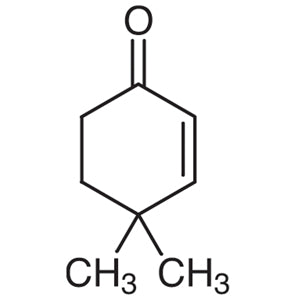
The 4,4-Dimethyl-2-cyclohexen-1-one supplied by TCI under catalog reference D3852, CAS number 1073-13-8, is a cyclic enone: a six-membered cyclic ketone carrying a carbon–carbon double bond conjugated with the carbonyl group, together with two methyl substituents at the fourth ring position. The compound belongs to the class of non-heterocyclic building blocks and serves in the laboratory as a versatile starting material for the construction of carbocyclic frameworks. Its conjugated enone system makes it a reactive Michael acceptor while simultaneously providing two distinct reactive centres, namely the carbonyl carbon and the beta carbon, so that a synthetic route can be directed according to the requirements of the target molecule.
The characteristics that lead chemists to select this material are the combination of reactivity and steric control that it offers. The conjugated carbonyl system permits conjugate addition, annulation reactions and selective reduction, while the quaternary gem-dimethyl centre at position four blocks one face of the ring and helps to direct the approach of incoming reagents. This gem-dimethyl motif is also frequently encountered in terpenoid skeletons, which makes the compound a shortcut towards natural-product structures without the need to install two methyl groups in separate steps. In addition, the cyclohexenone ring is comparatively straightforward to modify further.
In Indonesian laboratories, a building block of this type is typically used in synthetic organic chemistry groups at universities and research institutes, as well as in the development laboratories of the fine chemical and pharmaceutical sectors. It is normally ordered in small research quantities for method development, route scouting and the preparation of intermediates on a milligram-to-gram scale, then held in a chemical store alongside other reactive carbonyl reagents until required for a specific reaction sequence.
Related TCI products
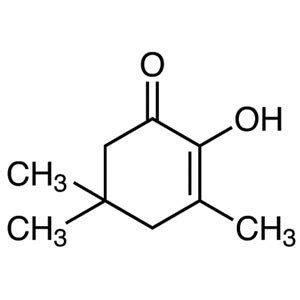
- TCI T2723 4883-60-7 2-Hydroxy-3,5,5-trimethyl-2-cyclohexen-1-one
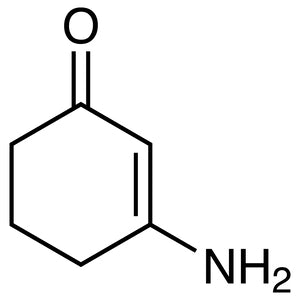
- TCI A1936 5220-49-5 3-Amino-2-cyclohexen-1-one
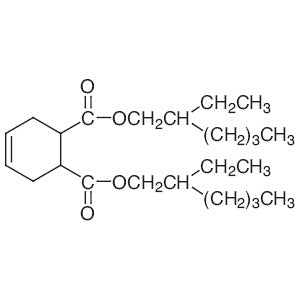
- TCI T0605 2915-49-3 Bis(2-ethylhexyl) 4-Cyclohexene-1,2-dicarboxylate
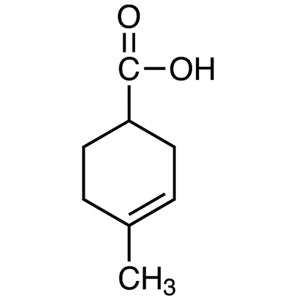
- TCI M2492 4342-60-3 4-Methyl-3-cyclohexene-1-carboxylic Acid
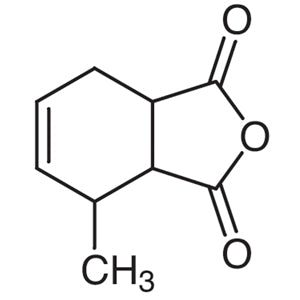
- TCI M1190 5333-84-6 3-Methyl-4-cyclohexene-1,2-dicarboxylic Anhydride
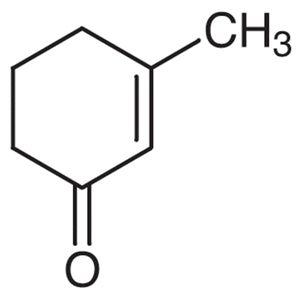
- TCI M1043 1193-18-6 3-Methyl-2-cyclohexen-1-one
- Michael addition chemistry: the conjugated enone acts as a reactive acceptor towards carbon and heteroatom nucleophiles, giving controlled bond formation at the beta carbon.
- Annulation and ring-construction sequences: the cyclohexenone core provides a ready-made six-membered carbocycle onto which additional rings can be fused in synthesis.
- Terpenoid-directed synthesis: the gem-dimethyl quaternary centre reproduces a motif common to terpenoid skeletons, removing the need for separate installation of two methyl groups.
- Selective reduction studies: the presence of both a carbonyl group and a conjugated double bond allows chemists to compare and optimise chemoselective reduction conditions.
- Regiochemical and stereochemical method development: two distinct reactive centres plus one sterically shielded ring face make this enone a useful substrate for probing reagent approach.
| Brand | TCI (catalog reference D3852) |
|---|---|
| CAS number | 1073-13-8 |
| Molecular formula | — |
| Purity | — |
| Category | Chemistry > Building Blocks > Non-Heterocyclic Building Blocks |
| Pack sizes | research-scale packaging as offered by the manufacturer for this catalog item; please confirm the available pack size when ordering |
| Physical form | — |
| Storage | keep in the tightly closed original container in a cool, well-ventilated chemical store, away from heat, ignition sources and incompatible reagents |
- Chemical name: 4,4-Dimethyl-2-cyclohexen-1-one
Store the material in its original tightly closed container in a cool, dry and well-ventilated chemical store, away from heat, open flames, ignition sources and direct sunlight, and separated from strong oxidising agents, strong bases and other incompatible reagents. Follow the specific storage temperature stated on the manufacturer's label and safety data sheet for this catalog item. Handle the compound inside a functioning fume hood, since reactive carbonyl compounds of this type can release irritating vapours. Wear safety glasses, chemical-resistant gloves and a laboratory coat, avoid inhalation and skin contact, and use compatible glass or otherwise chemically resistant containers and transfer equipment. Keep the container closed when not in use to limit exposure to air and moisture, label all working solutions clearly, and collect residues and contaminated materials as chemical waste in accordance with the laboratory's waste-handling procedures.
—
Produk Terkait
-
2-Hydroxy-3,5,5-trimethyl-2-cyclohexen-1-one TCI T2723
Regular price Rp 1.273.650,00Regular price -
3-Amino-2-cyclohexen-1-one TCI A1936
Regular price From Rp 1.510.950,00Regular price -
Bis(2-ethylhexyl)4-Cyclohexene-1,2-dicarboxylate TCI T0605
Regular price From Rp 477.750,00Regular price -
4-Methyl-3-cyclohexene-1-carboxylicAcid TCI M2492
Regular price From Rp 2.121.000,00Regular price -
3-Methyl-4-cyclohexene-1,2-dicarboxylicAnhydride TCI M1190
Regular price From Rp 4.877.250,00Regular price -
3-Methyl-2-cyclohexen-1-one TCI M1043
Regular price From Rp 928.200,00Regular price -
Methylcyclohexene-1,2-dicarboxylicAnhydride(mixtureofisomers) TCI M0683
Regular price From Rp 875.700,00Regular price -
Ethyl6-Methyl-2-oxo-3-cyclohexene-1-carboxylate(mixtureofisomers) TCI E0646
Regular price From Rp 743.400,00Regular price