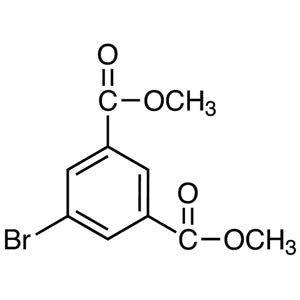
TCI D4068 Dimethyl 5-Bromoisophthalate is the dimethyl ester of 5-bromoisophthalic acid: a benzene framework carrying two ester groups at the 1 and 3 positions together with a single bromine atom at the 5 position. This symmetrical arrangement has made it a popular non-heterocyclic building block for constructing branched structures and three-dimensional networks. In the laboratory, the compound is widely used as a precursor to polycarboxylate ligands, as a connecting unit in dendritic macromolecules, and as a synthetic intermediate for multiply substituted aromatic compounds that demand strict positional control.
The characteristic that makes this material so frequently chosen is the presence of two distinct types of reactivity that can be addressed in sequence. The bromine atom at the 5 position is ready to undergo palladium-catalysed cross-coupling reactions or halogen–metal exchange, while the two ester groups can be hydrolysed to the dicarboxylic acid, converted into amides, or reduced to alcohols. The ester form also makes the compound more soluble in organic solvents and easier to purify by chromatography or recrystallisation than the free acid form, so handling during the synthetic sequence becomes considerably more straightforward.
In Indonesian laboratories, this building block is typically encountered in university research groups and institutional laboratories working on organic synthesis, coordination chemistry, and materials chemistry. It is generally ordered in research quantities for multi-step synthetic routes, ligand preparation, and method development work, where a symmetrical, dual-reactivity aromatic scaffold from an established supplier such as TCI supports reproducible results across repeated experimental runs.
- Polycarboxylate ligand synthesis — hydrolysis of the two symmetric ester groups gives a rigid dicarboxylic acid scaffold suitable for preparing coordination ligands and framework-forming linkers.
- Palladium-catalysed cross-coupling chemistry — the bromine at the 5 position provides a clean, well-defined site for coupling reactions that extend the aromatic core in a controlled direction.
- Dendritic macromolecule construction — the symmetrical 1,3-diester with a single 5-substituent serves as a branching unit for building generation-by-generation dendritic architectures.
- Multiply substituted aromatic intermediates — researchers use it when a synthetic route requires strict positional control over three substituents on a single benzene ring.
- Halogen–metal exchange transformations — the carbon–bromine bond permits metalation chemistry, opening access to further functionalisation that the ester groups alone would not provide.
| Brand | TCI |
|---|---|
| CAS number | 51760-21-5 |
| Molecular formula | — |
| Purity | — |
| Category | Chemistry > Building Blocks > Non-Heterocyclic Building Blocks |
| Pack sizes | available in standard research-scale packaging; please confirm the currently offered pack size when ordering |
| Physical form | — |
| Storage | store in a closed original container under the conditions stated on the manufacturer's label and safety data sheet |
- Chemical class: dimethyl ester of 5-bromoisophthalic acid (non-heterocyclic aromatic building block)
Store the container tightly closed in a cool, dry, well-ventilated area away from direct sunlight, moisture, and sources of ignition, following the storage conditions given on the manufacturer's label and safety data sheet. Keep the material in its original supplier container, or in a clean, chemically compatible and clearly labelled amber glass container if transferred. Handle in a fume hood using appropriate personal protective equipment, including safety glasses, chemically resistant gloves, and a laboratory coat. Avoid inhalation of dust and contact with skin and eyes. Reseal the container promptly after use to limit moisture uptake, keep it separated from strong bases and strong oxidising agents, and dispose of residues and contaminated materials in accordance with applicable laboratory chemical waste procedures.
—
Produk Terkait
-
Di-tert-butyl5-Bromoisophthalate TCI D6526
Regular price Rp 5.539.800,00Regular price -
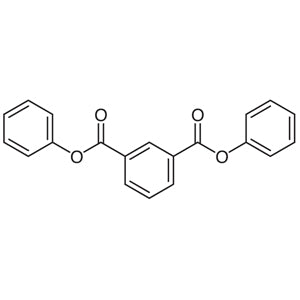
DiphenylIsophthalate TCI I0416
Regular price From Rp 1.298.850,00Regular price -
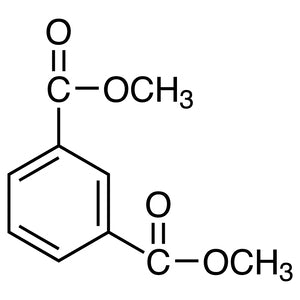
DimethylIsophthalate TCI I0157
Regular price From Rp 452.550,00Regular price -
5-BromoisophthalicAcid TCI B4232
Regular price From Rp 1.193.850,00Regular price -
4-BromoisophthalicAcid TCI B1260
Regular price From Rp 3.710.700,00Regular price -
2-Bromoisophthalaldehyde TCI B3568
Regular price From Rp 1.220.100,00Regular price -
MonomethylIsophthalate TCI M2327
Regular price From Rp 637.350,00Regular price -
IsophthalicAcid TCI I0155
Regular price From Rp 477.750,00Regular price