

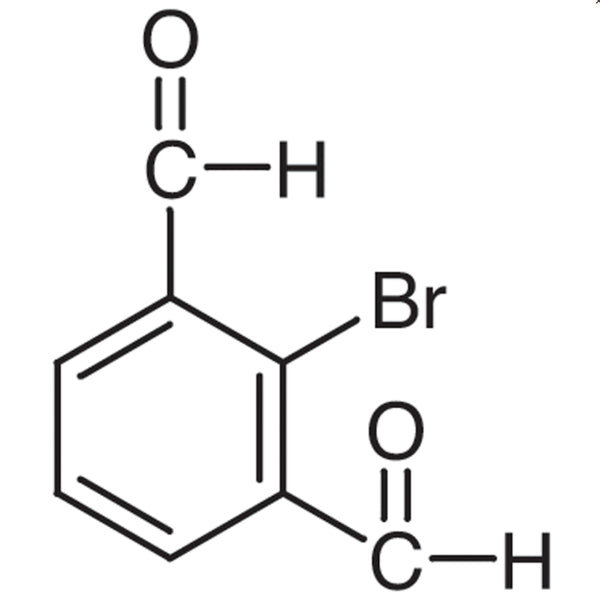
2-Bromoisophthalaldehyde is a chemical compound widely used in organic synthesis reactions within laboratory settings. It serves as a versatile building block in the development of complex organic molecules, playing a crucial role in various chemical transformations. Its aldehyde functional group enables participation in nucleophilic reactions, substitution reactions, and oxidation processes, making it a valuable reagent for chemists. This compound is particularly favored for its ability to undergo multiple reaction pathways, which enhances its utility in synthetic chemistry.
The chemical properties of 2-Bromoisophthalaldehyde, including its reactivity and molecular structure, make it a preferred choice in laboratory environments. The presence of a bromo group and an aldehyde group allows for a wide range of chemical modifications, making it suitable for substitution and catalytic reactions. Its stability under controlled conditions ensures reliable performance in synthetic processes. Additionally, its relatively high melting and boiling points facilitate handling during heating and cooling procedures commonly used in laboratory experiments.
In Indonesian laboratories, 2-Bromoisophthalaldehyde is extensively used in organic chemistry research, especially in the pharmaceutical and food chemistry industries. It is commonly employed by research institutions and universities to develop new compounds or improve existing synthesis methods. Its versatility and reactivity make it an essential component in various chemical processes within the scientific community.
- Organic synthesis applications benefit from its reactivity and ability to participate in nucleophilic and substitution reactions.
- Pharmaceutical research utilizes it for the development of new drug compounds due to its structural versatility.
- Food chemistry applications leverage its chemical properties for the synthesis of flavor and aroma compounds.
- Catalytic reactions often use this compound as a substrate due to its functional group reactivity.
- Research institutions use it for the modification of complex molecules in synthetic chemistry projects.
| Brand | TCI |
|---|---|
| CAS number | 79839-49-9 |
| Molecular formula | — |
| Purity | — |
| Category | Chemistry > Building Blocks > Non-Heterocyclic Building Blocks |
| Pack sizes | Available in standard laboratory quantities |
| Physical form | Solid |
| Storage | Store in a cool, dry place away from light and moisture |
This compound should be stored in a cool, dry environment, away from direct light and moisture to maintain its chemical integrity. It is recommended to use airtight containers to prevent exposure to air and moisture, which could affect its reactivity. Due to its reactive nature, it should be handled with appropriate personal protective equipment, such as gloves and safety goggles, to ensure laboratory safety. Proper ventilation is essential when working with this compound to minimize inhalation risks. It should not be stored near incompatible substances to avoid potential chemical interactions. Regular monitoring of storage conditions ensures the compound remains stable and suitable for use in laboratory applications.
—
Produk Terkait
-
Isophthalaldehyde TCI I0153
Regular price From Rp 1.298.850,00Regular priceRp 908.250,00Sale price From Rp 1.298.850,00 -
5-BromoisophthalicAcid TCI B4232
Regular price From Rp 1.193.850,00Regular priceRp 834.750,00Sale price From Rp 1.193.850,00 -
4-BromoisophthalicAcid TCI B1260
Regular price From Rp 3.710.700,00Regular priceRp 2.594.550,00Sale price From Rp 3.710.700,00 -
IsophthalaldehydicAcid TCI I0851
Regular price From Rp 1.378.650,00Regular priceRp 979.650,00Sale price From Rp 1.378.650,00 -
Di-tert-butyl5-Bromoisophthalate TCI D6526
Regular price Rp 5.539.800,00Regular priceRp 3.873.450,00Sale price Rp 5.539.800,00 -
Dimethyl5-Bromoisophthalate TCI D4068
Regular price From Rp 1.590.750,00Regular priceRp 1.111.950,00Sale price From Rp 1.590.750,00 -
PhthalaldehydicAcid TCI P0281
Regular price From Rp 1.431.150,00Regular priceRp 1.016.400,00Sale price From Rp 1.431.150,00 -
IsophthalicAcid TCI I0155
Regular price From Rp 477.750,00Regular priceRp 333.900,00Sale price From Rp 477.750,00


