


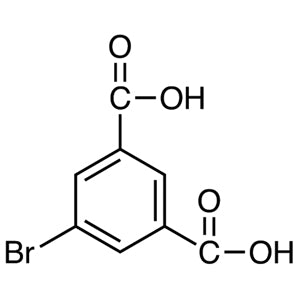
5-Bromoisophthalic Acid is a chemical compound widely used as a building block in the synthesis of complex organic compounds. It plays a crucial role in laboratory settings where organic reactions involving bromo substitution on isophthalic acid structures are required. This compound is essential for chemists working on the development of new materials, pharmaceuticals, and industrial chemicals. Its presence in various chemical reactions helps in the formation of more complex molecular structures, making it a versatile tool in synthetic chemistry.
The compound is valued for its stable chemical properties and controlled reactivity, which make it a preferred choice for organic and heterocyclic synthesis. Its molecular structure consists of two carboxyl groups connected by a benzene ring, with a bromine atom attached to one of the carbon atoms. This structure provides the necessary stability for predictable chemical reactions, including esterification, hydrolysis, and electrophilic substitution. Its predictable behavior under different reaction conditions ensures reliable results in laboratory experiments.
In Indonesian laboratories, 5-Bromoisophthalic Acid is extensively used in both fundamental and applied chemical research. It is commonly found in academic institutions and research centers where new compounds, including drugs and industrial chemicals, are being developed. Its application in heterocyclic synthesis makes it an important reagent for advancing chemical innovation in the region.
TCI brochures (PDF)
- Organic Linker Molecules for Metal Organic Frameworks (MOFs) 2026-05-11 · p. 3
- Heterocyclic Synthesis: This compound is ideal for creating heterocyclic structures due to its stable molecular framework and predictable reactivity.
- Organic Compound Development: Its role in substitution reactions makes it a key reagent in the synthesis of new organic compounds.
- Esterification Reactions: The carboxyl groups allow it to participate in esterification, contributing to the formation of ester derivatives.
- Hydrolysis Studies: It is used in hydrolysis experiments to study the breakdown of organic compounds under different conditions.
- Industrial Chemical Production: Its versatility supports the development of various industrial chemicals and pharmaceutical intermediates.
| Brand | TCI |
|---|---|
| CAS number | 23351-91-9 |
| Molecular formula | — |
| Purity | — |
| Category | Chemistry > Building Blocks > Non-Heterocyclic Building Blocks |
| Pack sizes | Available in standard laboratory quantities |
| Physical form | Solid |
| Storage | Store in a cool, dry place away from moisture and direct sunlight |
This compound should be stored in a cool, dry environment to maintain its chemical stability. It is recommended to keep it in a sealed container to prevent exposure to moisture and air. Due to its bromine content, it should be handled with care, using appropriate personal protective equipment. Avoid direct contact with skin and inhalation of vapors. Ensure proper ventilation in the laboratory when working with this material. Storage should be in a location that is inaccessible to children and unauthorized personnel. Always follow standard laboratory safety protocols when handling and storing chemical substances.
—
Product Categories
- Organic-Inorganic Hybrid MaterialsMetal Organic Frameworks (MOF) and Their Raw MaterialsOrganic Linker Molecules [Metal Organic Frameworks (MOFs) Precursors]
- Polymer/Macromolecule ReagentsMetal Organic Frameworks (MOF) and Their Raw MaterialsOrganic Linker Molecules [Metal Organic Frameworks (MOFs) Precursors]
Produk Terkait
-
IsophthalicAcid TCI I0155
Regular price From Rp 477.750,00Regular priceRp 333.900,00Sale price From Rp 477.750,00 -
4-BromoisophthalicAcid TCI B1260
Regular price From Rp 3.710.700,00Regular priceRp 2.594.550,00Sale price From Rp 3.710.700,00 -
5-NitroisophthalicAcid TCI N0520
Regular price From Rp 903.000,00Regular priceRp 631.050,00Sale price From Rp 903.000,00 -
5-MethoxyisophthalicAcid TCI M1835
Regular price Rp 4.001.550,00Regular priceRp 2.814.000,00Sale price Rp 4.001.550,00 -
5-HydroxyisophthalicAcid TCI H0794
Regular price From Rp 1.298.850,00Regular priceRp 924.000,00Sale price From Rp 1.298.850,00 -
2-Bromoisophthalaldehyde TCI B3568
Regular price From Rp 1.220.100,00Regular priceRp 852.600,00Sale price From Rp 1.220.100,00 -
Di-tert-butyl5-Bromoisophthalate TCI D6526
Regular price Rp 5.539.800,00Regular priceRp 3.873.450,00Sale price Rp 5.539.800,00 -
Dimethyl5-Bromoisophthalate TCI D4068
Regular price From Rp 1.590.750,00Regular priceRp 1.111.950,00Sale price From Rp 1.590.750,00


