

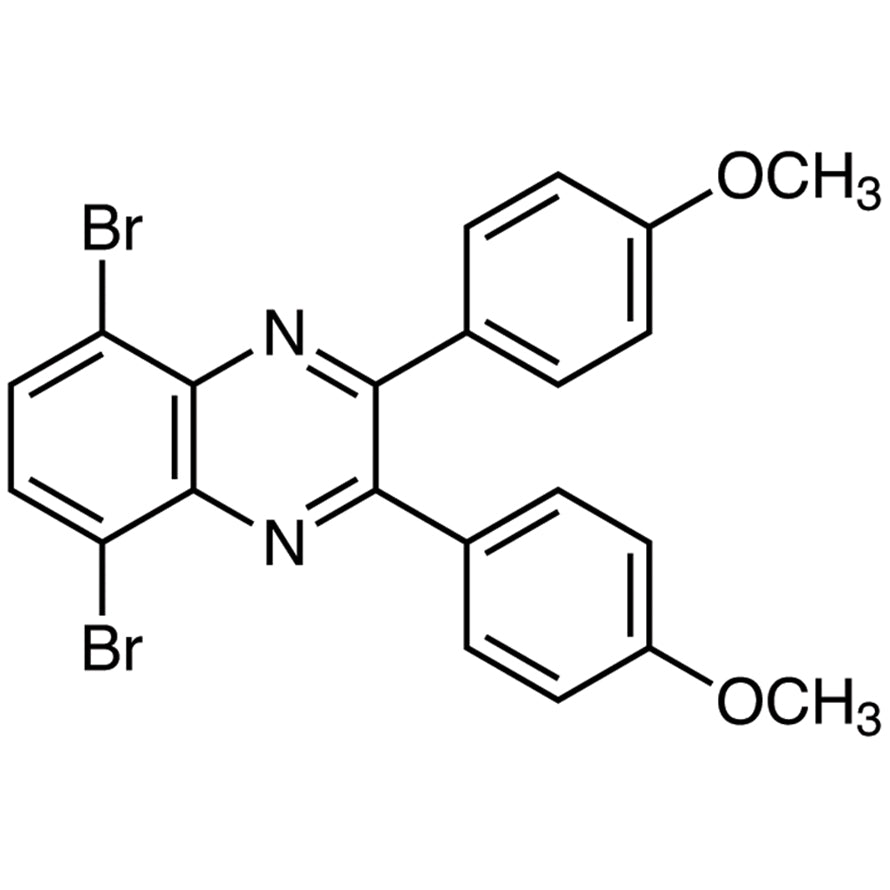
5,8-Dibromo-2,3-bis(4-methoxyphenyl)quinoxaline is a complex chemical compound widely used in scientific material research, particularly in the development of semiconductor and polymer materials. This compound plays a crucial role in laboratories where researchers aim to modify the optical and electronic properties of materials through chemical substitution. Its unique molecular structure makes it a valuable tool for creating advanced materials with tailored functionalities. Due to its versatility, it is frequently used in synthetic processes that lead to the production of compounds with applications in display technologies, optical devices, and sensor systems.
The compound is preferred for its chemical stability under controlled conditions, which allows for consistent results in experimental settings. Its sensitivity to light and moisture requires careful handling, but this also makes it ideal for applications where precise control over reaction conditions is essential. The ability to interact with various reagents enhances its utility in high-precision material research. Its molecular complexity enables researchers to fine-tune electronic and optical properties, making it a key component in the development of next-generation materials.
In Indonesian laboratories, this compound is commonly used in academic and research institutions focused on material science and technology. It supports studies in semiconductor development, optical material synthesis, and advanced polymer engineering. Its relevance in these fields aligns with the growing demand for innovative materials in Indonesia’s scientific community. Researchers rely on this compound to explore new applications and improve existing technologies in the region.
TCI brochures (PDF)
- Building Blocks for Organic Semiconductor 2026-03-24 · p. 39
Related TCI products
- TCI D4461 94544-77-1 5,8-Dibromo-2,3-diphenylquinoxaline
- TCI D5340 746651-52-5 3,6-Dibromo-9-(4-methoxyphenyl)-9H-carbazole
- TCI E1040 1237479-38-7 2-Ethylhexyl 4,6-Dibromo-3-fluorothieno[3,4-b]thiophene-2-carboxylate
- TCI D5766 1147124-23-9 6,6'-Dibromo-1,1'-bis(2-exylhexyl)isoindigo
- TCI D5742 1334295-79-2 6,6'-Dibromo-1,1'-di(n-octyl)isoindigo
- TCI D5740 1801592-76-6 6,6'-Dibromo-1,1'-bis(2-decyltetradecyl)isoindigo
- Semiconductor material development, as it enables precise tuning of electronic properties through chemical modification.
- Optical device fabrication, due to its ability to influence light interaction and absorption characteristics.
- Polymer synthesis for advanced materials, as its molecular structure supports cross-linking and functional group integration.
- Sensor technology research, where its chemical reactivity allows for the creation of responsive and sensitive detection systems.
- Display technology innovation, as it contributes to the development of materials with tailored optical and electronic behaviors.
| Brand | TCI |
|---|---|
| CAS number | 162967-90-0 |
| Molecular formula | — |
| Purity | — |
| Category | Materials Science > Material Building Blocks > Polymer/Macromolecule Semiconductor Building Blocks |
| Pack sizes | Available in standard laboratory quantities as per supplier specifications |
| Physical form | Solid, typically in crystalline or powder form |
| Storage | Store in a cool, dark place away from light and moisture |
This compound should be stored in a cool, dark environment to prevent degradation due to light exposure. It is recommended to use airtight containers made of materials that are chemically inert, such as glass or high-density polyethylene, to minimize moisture absorption. Due to its sensitivity to humidity, it is important to maintain a controlled storage environment with low relative humidity. Researchers should handle the compound with appropriate personal protective equipment, including gloves and safety goggles, to ensure safety during handling. In laboratory settings, it should be kept away from incompatible substances to prevent unwanted reactions. Proper labeling and storage conditions are essential to maintain its chemical integrity and ensure safe usage in research applications.
—
Produk Terkait
-
5,8-Dibromo-2,3-diphenylquinoxaline TCI D4461
Regular price Rp 2.411.850,00Regular priceRp 1.702.050,00Sale price Rp 2.411.850,00 -
3,6-Dibromo-9-(4-methoxyphenyl)-9H-carbazole TCI D5340
Regular price From Rp 2.199.750,00Regular priceRp 1.554.000,00Sale price From Rp 2.199.750,00 -
2-Ethylhexyl4,6-Dibromo-3-fluorothieno[3,4-b]thiophene-2-carboxylate TCI E1040
Regular price Rp 4.266.150,00Regular priceRp 2.998.800,00Sale price Rp 4.266.150,00 -
6,6'-Dibromo-1,1'-bis(2-exylhexyl)isoindigo TCI D5766
Regular price From Rp 2.914.800,00Regular priceRp 2.053.800,00Sale price From Rp 2.914.800,00 -
6,6'-Dibromo-1,1'-di(n-octyl)isoindigo TCI D5742
Regular price Rp 3.922.800,00Regular priceRp 2.758.350,00Sale price Rp 3.922.800,00 -
6,6'-Dibromo-1,1'-bis(2-decyltetradecyl)isoindigo TCI D5740
Regular price Rp 4.664.100,00Regular priceRp 3.277.050,00Sale price Rp 4.664.100,00 -
2,5-Dibromo-N-(2-ethylhexyl)-3,4-thiophenedicarboximide TCI D5021
Regular price From Rp 2.013.900,00Regular priceRp 1.423.800,00Sale price From Rp 2.013.900,00 -
4,7-Dibromo-5,6-dinitro-2,1,3-benzothiadiazole TCI D4985
Regular price From Rp 1.961.400,00Regular priceRp 1.387.050,00Sale price From Rp 1.961.400,00


