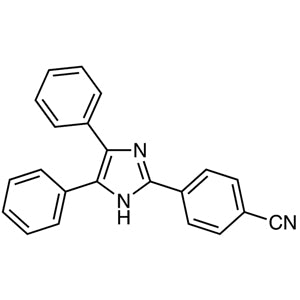
TCI D4655 4-(4,5-Diphenyl-1H-imidazol-2-yl)benzonitrile is a heterocyclic intermediate that combines an imidazole core bearing two phenyl substituents with a benzonitrile ring at the 2-position. Structurally, it belongs to the family of triphenylimidazole or lophine derivatives, a group of compounds widely recognised in chemiluminescence studies and fluorescent materials research. In the laboratory, this compound serves as a molecular building block for further synthesis and, at the same time, as a chromophore whose optical properties can be studied directly in work on sensors and functional materials.
Several properties make this material a preferred choice. The imidazole core provides donor nitrogen atoms and an N–H proton that can participate in hydrogen bonding as well as metal ion binding, while the two phenyl groups extend the conjugated system and therefore support light-emitting behaviour. The nitrile group on the phenyl ring acts both as an electron-withdrawing substituent and as a synthetic handle that can be converted into an amide, a carboxylic acid, an amine, a tetrazole, or other heterocycles. Donor–acceptor combinations of this kind are widely used by researchers to tune the electronic properties and optical response of a molecule.
In Indonesian laboratories, a compound of this type is typically handled in university and institutional research groups working on organic synthesis, photophysics, and functional materials. It is normally used at small research scale, weighed out for exploratory synthesis, derivatisation studies, or spectroscopic characterisation rather than for routine bulk work. Because it functions as both an intermediate and a chromophore, it fits naturally into projects that move from synthesis through to optical measurement within the same laboratory.
Related TCI products
- TCI D4178 1752-94-9 4-(4,5-Diphenyl-1H-imidazol-2-yl)phenol [for Biochemical Research]
- TCI H1380 13599-84-3 6-Hydroxybenzothiazole
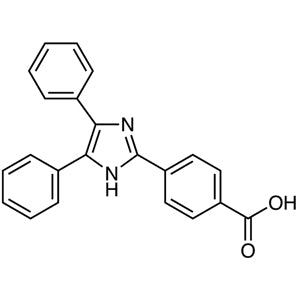
- TCI D2816 5496-35-5 4-(4,5-Diphenyl-1H-imidazol-2-yl)benzoic Acid
- TCI P2450 25699-83-6 4-(1-Pyrazolyl)benzonitrile
- TCI P2449 68104-63-2 4-(1-Piperazinyl)benzonitrile
- TCI P2448 111373-03-6 2-(1-Piperazinyl)benzonitrile
- Heterocyclic building block synthesis — the reactive nitrile group and substituted imidazole core allow controlled elaboration into amides, carboxylic acids, amines, tetrazoles, and further heterocyclic systems.
- Chemiluminescence research — as a member of the triphenylimidazole or lophine family, it belongs to a compound class long established in the study of light-emitting chemical reactions.
- Fluorescent materials development — the extended conjugation contributed by the two phenyl rings supports emissive behaviour, making the molecule useful for preparing and evaluating fluorescent compounds.
- Chemical sensor studies — the imidazole N–H proton and donor nitrogen atoms can participate in hydrogen bonding and metal ion binding, giving a recognition site for analyte-responsive systems.
- Donor–acceptor molecular design — pairing the electron-rich imidazole with the electron-withdrawing nitrile lets researchers systematically tune electronic structure and optical response in functional molecules.
| Brand | TCI |
|---|---|
| CAS number | 29898-72-4 |
| Molecular formula | — |
| Purity | — |
| Category | Chemistry > Building Blocks > Heterocyclic Building Blocks |
| Pack sizes | — |
| Physical form | — |
| Storage | store in the original, tightly closed container as indicated on the manufacturer's label |
- Chemical name: 4-(4,5-Diphenyl-1H-imidazol-2-yl)benzonitrile
- Catalogue code: D4655
Keep the product in its original, tightly closed container and store it in a cool, dry, well-ventilated place away from direct sunlight, moisture, and incompatible chemicals. Amber glass or the supplied container is suitable, and containers should be resealed promptly after each use to limit exposure to air and humidity. Handle the solid in a fume hood or a well-ventilated area, using safety glasses, gloves, and a laboratory coat, and avoid generating or inhaling dust during weighing and transfer. Label all working solutions clearly, keep the manufacturer's safety data sheet accessible, and follow institutional procedures for chemical waste disposal.
—
Product Categories
Produk Terkait
-
4-(4,5-Diphenyl-1H-imidazol-2-yl)phenol[forBiochemicalResearch] TCI D4178
Regular price Rp 1.803.900,00Regular price -
6-Hydroxybenzothiazole TCI H1380
Regular price Rp 2.809.800,00Regular price -
4-(4,5-Diphenyl-1H-imidazol-2-yl)benzoicAcid TCI D2816
Regular price From Rp 1.353.450,00Regular price -
4-(1-Pyrazolyl)benzonitrile TCI P2450
Regular price From Rp 1.087.800,00Regular price -
4-(1-Piperazinyl)benzonitrile TCI P2449
Regular price From Rp 2.597.700,00Regular price -
2-(1-Piperazinyl)benzonitrile TCI P2448
Regular price Rp 2.068.500,00Regular price -
4-(1-Pyrrolidinyl)benzonitrile TCI P2428
Regular price From Rp 1.220.100,00Regular price -
4-Methoxy-2-(1H-pyrazol-1-yl)benzonitrile TCI M3412
Regular price Rp 5.194.350,00Regular price
![4-(4,5-Diphenyl-1H-imidazol-2-yl)phenol [for Biochemical Research] (CAS 1752-94-9) - TCI D4178 - AMI Scientific](http://amiscientific.com/cdn/shop/files/TCI2510D4178.jpg?v=1767107168&width=533)