4-(1-Pyrrolidinyl)benzonitrile from TCI is a heterocyclic building block made of a benzene ring with an electron-donating pyrrolidine group on one side and an electron-accepting nitrile group in the para position. This donor–acceptor, or "push-pull", structure makes the compound useful in two ways: as a synthetic intermediate and as a model molecule in photophysics. In the laboratory, chemists use it to build more complex molecules and to study intramolecular charge transfer in the excited state.
Researchers choose this compound for its clear electronic polarisation. The pyrrolidine nitrogen pushes electron density into the aromatic ring, while the nitrile group pulls it away. Related molecules such as 4-(dimethylamino)benzonitrile are well known in studies of dual fluorescence and twisted intramolecular charge transfer (TICT). The pyrrolidinyl variant gives researchers a useful structural comparison in that work. For synthesis, the nitrile group can be converted into amines, amides, carboxylic acids, or heterocycles such as tetrazoles, which makes the compound a flexible intermediate.
In Indonesia, this compound is relevant to university and research institute laboratories working in organic synthesis, medicinal chemistry, and physical chemistry. Synthesis groups can use it as a starting material for nitrogen-containing target molecules. Spectroscopy and photochemistry groups can use it as a reference push-pull chromophore when they study solvent effects and charge transfer. It also suits postgraduate projects that compare substituted benzonitriles, where a well-defined donor–acceptor structure helps when interpreting experimental results.
Related TCI products
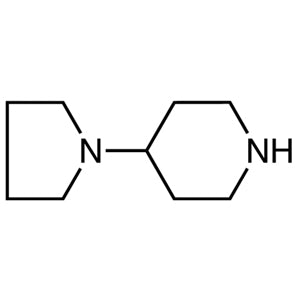
- TCI P1932 5004-07-9 4-(1-Pyrrolidinyl)piperidine
- TCI P2148 334981-10-1 4-[(1-Pyrrolidinylsulfonyl)methyl]aniline
- TCI P2450 25699-83-6 4-(1-Pyrazolyl)benzonitrile
- TCI P2449 68104-63-2 4-(1-Piperazinyl)benzonitrile
- TCI P2448 111373-03-6 2-(1-Piperazinyl)benzonitrile
- TCI M3412 1200536-22-6 4-Methoxy-2-(1H-pyrazol-1-yl)benzonitrile
- Organic synthesis intermediate: the nitrile group can be converted into amines, amides, carboxylic acids, or tetrazoles, so one starting material can lead to several product classes.
- Intramolecular charge transfer studies: the pyrrolidine donor and the para-nitrile acceptor give a clear push-pull system for studying how charge redistributes in the excited state.
- Comparative fluorescence research: it is a structural analogue of 4-(dimethylamino)benzonitrile, so it is useful for comparing dual fluorescence and TICT behaviour across related donor groups.
- Heterocyclic building block chemistry: it already contains a saturated nitrogen heterocycle on an aromatic core, which makes it convenient for assembling more complex nitrogen-containing molecules in discovery-stage work.
- Solvatochromism and solvent-effect experiments: its polarised electronic structure makes it a suitable model compound for observing how solvent polarity affects absorption and emission behaviour.
| Brand | TCI (product code P2428) |
|---|---|
| CAS number | 10282-30-1 |
| Molecular formula | — |
| Purity | — |
| Category | Chemistry > Building Blocks > Heterocyclic Building Blocks |
| Pack sizes | TCI standard pack sizes; please confirm the available packaging when ordering |
| Physical form | refer to the TCI specification sheet for this lot |
| Storage | keep in a tightly closed container according to the TCI label and Safety Data Sheet |
Store this compound in its original, tightly sealed container in a cool, dry, well-ventilated place, away from direct sunlight, heat sources, and incompatible materials such as strong oxidising agents and strong acids. If you transfer it to another container, use clean, dry glass or another chemically compatible container with clear labelling. Handle it in a fume hood or a well-ventilated area, and wear safety glasses, laboratory gloves, and a lab coat. Avoid creating dust and avoid contact with skin, eyes, and clothing. Before use, always read the TCI Safety Data Sheet for specific hazard information, first-aid measures, and disposal requirements, and follow your institution's chemical safety procedures.
—
Produk Terkait
-
4-(1-Pyrrolidinyl)piperidine TCI P1932
Regular price From Rp 4.664.100,00Regular price -
4-[(1-Pyrrolidinylsulfonyl)methyl]aniline TCI P2148
Regular price From Rp 637.350,00Regular price -
4-(1-Pyrazolyl)benzonitrile TCI P2450
Regular price From Rp 1.087.800,00Regular price -
4-(1-Piperazinyl)benzonitrile TCI P2449
Regular price From Rp 2.597.700,00Regular price -
2-(1-Piperazinyl)benzonitrile TCI P2448
Regular price Rp 2.068.500,00Regular price -
4-Methoxy-2-(1H-pyrazol-1-yl)benzonitrile TCI M3412
Regular price Rp 5.194.350,00Regular price -
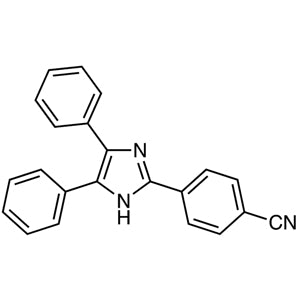
4-(4,5-Diphenyl-1H-imidazol-2-yl)benzonitrile TCI D4655
Regular price Rp 3.710.700,00Regular price -
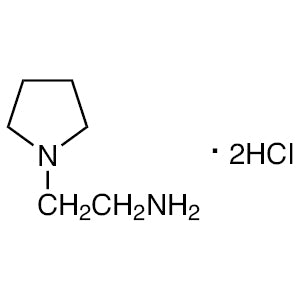
2-(1-Pyrrolidinyl)ethanamineDihydrochloride TCI A3393
Regular price Rp 1.881.600,00Regular price
![334981-10-1 4-[(1-Pyrrolidinylsulfonyl)methyl]aniline - AMI Scientific](http://amiscientific.com/cdn/shop/files/TCI2510P2148.jpg?v=1767135798&width=533)