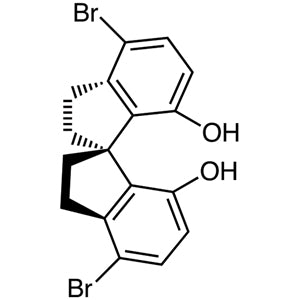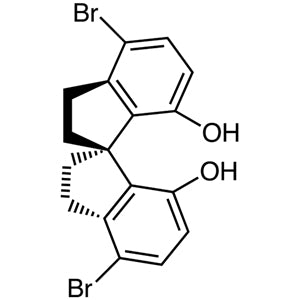
TCI D4717 (R)-4,4'-Dibromo-1,1'-spirobiindane-7,7'-diol is a chiral compound built on a spirobiindane framework, carrying two hydroxyl groups at the 7 and 7' positions and two bromine atoms at the 4 and 4' positions. The spirobiindanediol skeleton, commonly known as SPINOL, is one of the important backbones in modern asymmetric synthesis. Its chirality originates from the spiro center that joins two indane rings in a perpendicular arrangement, producing a rigid chiral cavity. The product is supplied as a single (R) enantiomer, so it is ready to be used for directing the formation of products with a defined configuration.
The property that makes this material highly valued is its conformational rigidity. Unlike biphenyl or binaphthyl ligands, whose chirality is axial in nature and able to rotate, the spiro framework is structurally locked, so the chiral environment around the reaction center is more well defined and frequently delivers good selectivity. The two phenolic hydroxyl groups act as attachment points for a wide range of functional groups, for example to form chiral phosphoric acids, phosphites, or phosphoramidites. The presence of the two bromine atoms adds further value because those positions can be modified.
In Indonesian laboratories, this compound is typically encountered in university and institutional research groups working on asymmetric synthesis, organocatalysis, and chiral ligand design, as well as in industrial R&D units developing enantioselective routes. It generally serves as a starting building block rather than a bulk reagent: a research chemist converts it into the catalyst or ligand needed for a particular transformation. Because it is delivered as a defined single enantiomer, it fits well into method development work where the stereochemical outcome must be controlled and reproducible.
TCI brochures (PDF)
- Asymmetric Synthesis 2026-03-18 · p. 4
Related TCI products
- TCI D4718 636601-27-9 (S)-4,4'-Dibromo-1,1'-spirobiindane-7,7'-diol
- TCI D4332 681481-91-4 4,4'-Dibromo-1,1'-spirobiindane-7,7'-diol
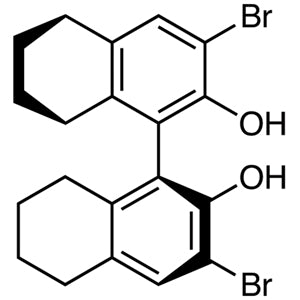
- TCI D5107 765278-73-7 (S)-(-)-3,3'-Dibromo-5,5',6,6',7,7',8,8'-octahydro-1,1'-bi-2-naphthol
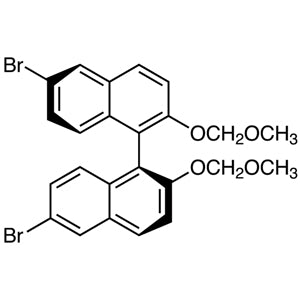
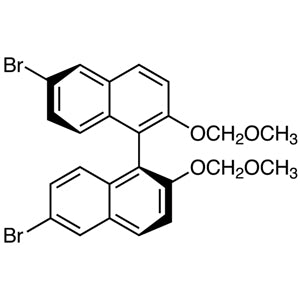
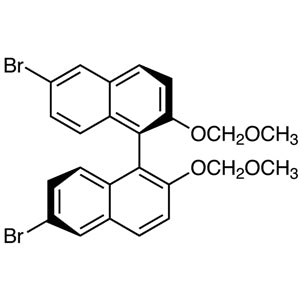
- TCI D4883 211560-97-3 (S)-6,6'-Dibromo-2,2'-bis(methoxymethoxy)-1,1'-binaphthyl
- TCI D4882 179866-74-1 (R)-6,6'-Dibromo-2,2'-bis(methoxymethoxy)-1,1'-binaphthyl
- TCI D4418 65355-08-0 (R)-(+)-3,3'-Dibromo-5,5',6,6',7,7',8,8'-octahydro-1,1'-bi-2-naphthol
- Chiral phosphoric acid catalyst preparation: the two phenolic hydroxyl groups at the 7 and 7' positions provide the attachment points needed to install the phosphate bridge across the rigid spiro backbone.
- Chiral phosphite and phosphoramidite ligand synthesis: the same diol functionality allows conversion into phosphorus-based ligands whose chiral pocket is held fixed by the spiro center.
- Asymmetric catalysis method development: supplied as a single (R) enantiomer, it lets researchers direct a reaction toward one product configuration without a separate resolution step.
- Structural modification through the bromine positions: the two bromine atoms at the 4 and 4' positions serve as handles for introducing further substituents and tuning the catalyst framework.
- Comparative selectivity studies against binaphthyl systems: because the spiro skeleton is conformationally locked rather than rotationally flexible, it is useful for evaluating how ligand rigidity influences enantioselectivity.
| Brand | TCI (Tokyo Chemical Industry) |
|---|---|
| CAS number | 681481-94-7 |
| Molecular formula | — |
| Purity | — |
| Category | Chemistry > Asymmetric Synthesis > Chiral Catalysts, Chiral Ligands, Chiral Reagents |
| Pack sizes | available in the research-scale pack sizes offered by TCI for this catalogue item; storage per the manufacturer's product documentation |
| Physical form | — |
| Storage | — |
- Chemical name: (R)-4,4'-Dibromo-1,1'-spirobiindane-7,7'-diol
- Stereochemistry: supplied as the single (R) enantiomer
Store the container tightly closed in a cool, dry place, protected from light and moisture, and follow the storage conditions stated on the manufacturer's label and Safety Data Sheet for this catalogue item. Keep the material in its original supplier container or in an equivalent tightly sealed glass or amber vial, and avoid prolonged exposure to open air when weighing. Handle in a fume hood using gloves, safety glasses, and a laboratory coat, and use clean, dry spatulas to prevent contamination of the remaining stock. Allow refrigerated containers to reach room temperature before opening to reduce condensation, and record each withdrawal so material integrity can be traced during method development work.
—
Produk Terkait
-
(S)-4,4'-Dibromo-1,1'-spirobiindane-7,7'-diol TCI D4718
Regular price Rp 10.467.450,00Regular price -
4,4'-Dibromo-1,1'-spirobiindane-7,7'-diol TCI D4332
Regular price From Rp 2.995.650,00Regular price -
(S)-(-)-3,3'-Dibromo-5,5',6,6',7,7',8,8'-octahydro-1,1'-bi-2-naphthol TCI D5107
Regular price Rp 2.466.450,00Regular price -
(S)-6,6'-Dibromo-2,2'-bis(methoxymethoxy)-1,1'-binaphthyl TCI D4883
Regular price From Rp 2.625.000,00Regular price -
(R)-6,6'-Dibromo-2,2'-bis(methoxymethoxy)-1,1'-binaphthyl TCI D4882
Regular price From Rp 3.551.100,00Regular price -
(R)-(+)-3,3'-Dibromo-5,5',6,6',7,7',8,8'-octahydro-1,1'-bi-2-naphthol TCI D4418
Regular price From Rp 3.260.250,00Regular price -
(S)-3,3'-Dibromo-1,1'-bi-2-naphthol TCI D2811
Regular price From Rp 4.213.650,00Regular price -
(R)-3,3'-Dibromo-1,1'-bi-2-naphthol TCI D2810
Regular price From Rp 4.849.950,00Regular price