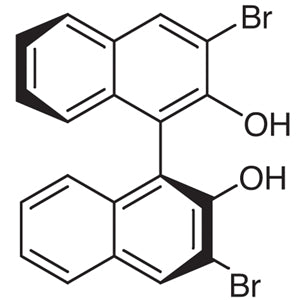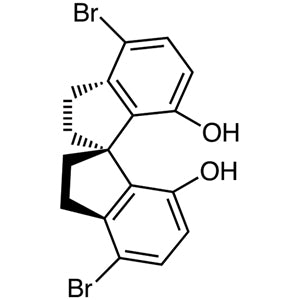
TCI D4718 (S)-4,4'-Dibromo-1,1'-spirobiindane-7,7'-diol is the (S) enantiomer of the brominated spirobiindanediol framework commonly known as a SPINOL derivative. The molecule consists of two indane rings joined through a single spiro carbon atom, bearing two hydroxyl groups at the 7 and 7' positions and two bromine atoms at the 4 and 4' positions. In asymmetric synthesis, the availability of both enantiomers matters a great deal, because researchers frequently need to prepare products of the opposite configuration, or to compare the outcomes obtained with each form in order to confirm that the observed selectivity genuinely originates from the catalyst rather than from some other factor in the system.
The most notable characteristic of this compound is the rigidity of the spiro framework, which locks the orientation of the two aromatic units relative to one another. This produces a stable chiral pocket that does not readily change conformation while a reaction is in progress, and that structural stability frequently translates into high levels of asymmetric induction. The phenolic diol groups serve as attachment points for building chiral phosphoric acid catalysts and phosphorus-based ligands, while the two bromine atoms open the door to further tuning through cross-coupling reactions or halogen–metal exchange. A single framework therefore supports a broad range of downstream structural modifications.
In Indonesian laboratories, this material is typically used within university and institutional research groups working on asymmetric catalysis, organic methodology development, and the preparation of enantiomerically enriched intermediates. It is usually handled at small scale on the bench, where a modest quantity is sufficient for the synthesis of a catalyst or ligand that is then applied across many trial reactions. Groups that maintain both enantiomers are able to run matched-pair experiments and verify stereochemical outcomes with confidence.
TCI brochures (PDF)
- Asymmetric Synthesis 2026-03-18 · p. 4
Related TCI products
- TCI D4717 681481-94-7 (R)-4,4'-Dibromo-1,1'-spirobiindane-7,7'-diol
- TCI D4332 681481-91-4 4,4'-Dibromo-1,1'-spirobiindane-7,7'-diol
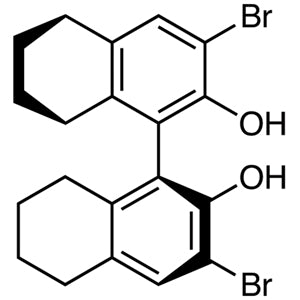
- TCI D5107 765278-73-7 (S)-(-)-3,3'-Dibromo-5,5',6,6',7,7',8,8'-octahydro-1,1'-bi-2-naphthol
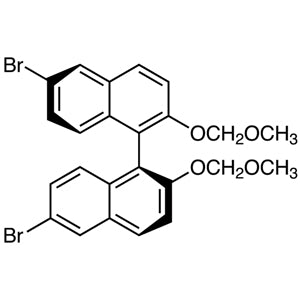
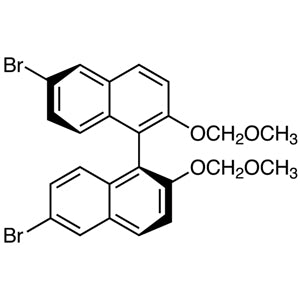
- TCI D4883 211560-97-3 (S)-6,6'-Dibromo-2,2'-bis(methoxymethoxy)-1,1'-binaphthyl
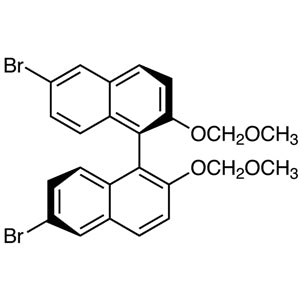
- TCI D4882 179866-74-1 (R)-6,6'-Dibromo-2,2'-bis(methoxymethoxy)-1,1'-binaphthyl
- TCI D4418 65355-08-0 (R)-(+)-3,3'-Dibromo-5,5',6,6',7,7',8,8'-octahydro-1,1'-bi-2-naphthol
- Chiral phosphoric acid catalyst preparation — the phenolic diol at the 7 and 7' positions provides the two oxygen attachment points required to construct SPINOL-derived phosphoric acid catalysts on a rigid backbone.
- Chiral ligand synthesis for asymmetric catalysis — the spiro diol framework serves as a starting scaffold for phosphorus-based ligands whose locked geometry transmits stereochemical information effectively to a metal centre.
- Cross-coupling and structural tuning studies — the bromine atoms at the 4 and 4' positions act as handles for coupling reactions, allowing researchers to install substituents that modify steric and electronic properties.
- Halogen–metal exchange chemistry — the two aryl bromide sites permit metalation and subsequent functionalization, giving synthetic groups a direct route to further derivatives from a single common intermediate.
- Enantiomer comparison and control experiments — pairing this (S) form against the opposite configuration lets researchers confirm that the selectivity observed in a reaction genuinely arises from the catalyst framework.
| Brand | TCI |
|---|---|
| CAS number | 636601-27-9 |
| Molecular formula | — |
| Purity | — |
| Category | Chemistry > Asymmetric Synthesis > Chiral Catalysts, Chiral Ligands, Chiral Reagents |
| Pack sizes | available in the standard research-scale pack sizes supplied by TCI; please confirm the currently available option when ordering |
| Physical form | — |
| Storage | store in a cool, dry place in a tightly closed container, protected from light |
- Chemical name: (S)-4,4'-Dibromo-1,1'-spirobiindane-7,7'-diol
Store the container tightly closed in a cool, dry, and well-ventilated area, away from direct sunlight and sources of heat or ignition. The original manufacturer packaging is the most suitable container; if the material is transferred, use a clean, chemically compatible amber glass vial with a secure cap, and label it clearly with the compound name, CAS number, and date of transfer. Handle the solid inside a fume hood to avoid dust formation, and wear a laboratory coat, safety glasses, and chemically resistant gloves. Avoid contact with skin and eyes and avoid inhaling dust. Keep the compound away from strong oxidizing agents, and consult the manufacturer's safety data sheet before use and before any disposal of residues.
—
Produk Terkait
-
(R)-4,4'-Dibromo-1,1'-spirobiindane-7,7'-diol TCI D4717
Regular price Rp 9.514.050,00Regular price -
4,4'-Dibromo-1,1'-spirobiindane-7,7'-diol TCI D4332
Regular price From Rp 2.995.650,00Regular price -
(S)-(-)-3,3'-Dibromo-5,5',6,6',7,7',8,8'-octahydro-1,1'-bi-2-naphthol TCI D5107
Regular price Rp 2.466.450,00Regular price -
(S)-6,6'-Dibromo-2,2'-bis(methoxymethoxy)-1,1'-binaphthyl TCI D4883
Regular price From Rp 2.625.000,00Regular price -
(R)-6,6'-Dibromo-2,2'-bis(methoxymethoxy)-1,1'-binaphthyl TCI D4882
Regular price From Rp 3.551.100,00Regular price -
(R)-(+)-3,3'-Dibromo-5,5',6,6',7,7',8,8'-octahydro-1,1'-bi-2-naphthol TCI D4418
Regular price From Rp 3.260.250,00Regular price -
(S)-3,3'-Dibromo-1,1'-bi-2-naphthol TCI D2811
Regular price From Rp 4.213.650,00Regular price -
(R)-3,3'-Dibromo-1,1'-bi-2-naphthol TCI D2810
Regular price From Rp 4.849.950,00Regular price