

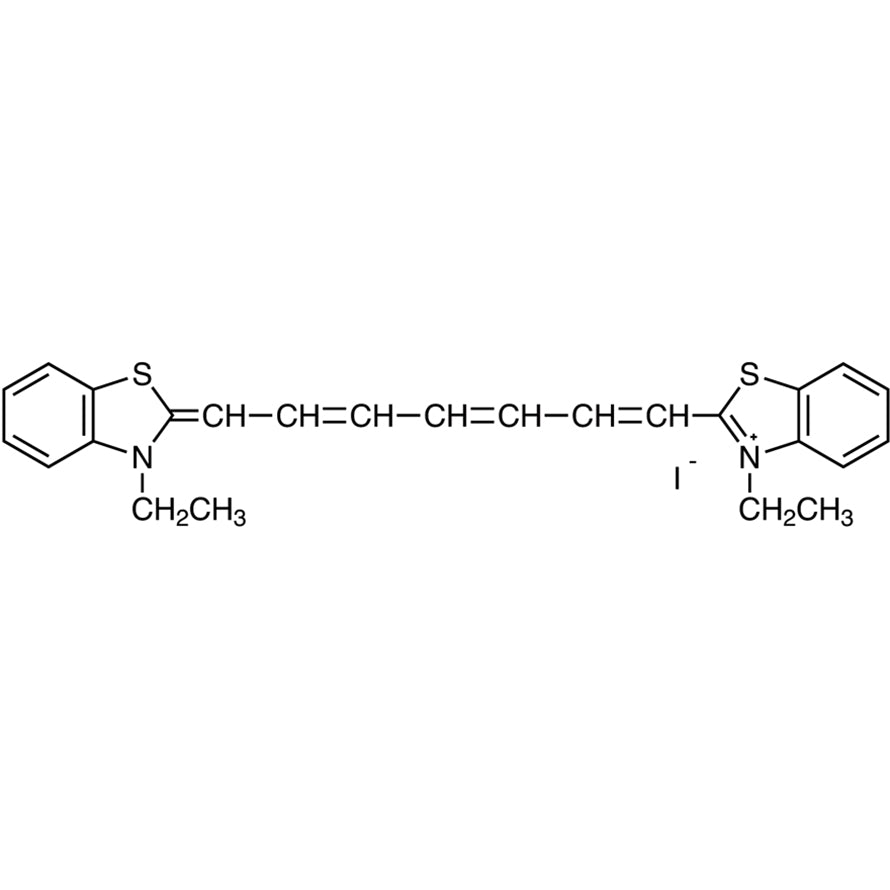
3,3'-Diethylthiatricarbocyanine Iodide is a chemical compound widely utilized in material science, particularly in optical and photonic research. This dye is essential for developing optical materials that interact with light in specific ways, such as absorbing and emitting light across various wavelengths. Its role in the laboratory is critical for creating pigments and materials with tailored optical properties, making it a key component in advanced material synthesis and characterization. Due to its unique chemical structure, it is also used in studies related to light-matter interactions and electronic transitions, contributing to the advancement of photonic technologies.
The compound is preferred for its strong fluorescence and sensitivity to light, which allows it to be used in applications requiring precise optical responses. Its ability to absorb light in specific wavelength ranges makes it ideal for applications where controlled light interaction is necessary. The complex molecular structure ensures stability and consistent performance, which is vital for reproducible experimental results. These properties make it a reliable choice for researchers working on optical characterization and material development.
In Indonesian laboratories, 3,3'-Diethylthiatricarbocyanine Iodide is commonly used in optical research, photonic material development, and the creation of light-sensitive sensors. Scientists at universities and research institutions rely on this compound for experiments involving material characterization and optical property testing. Its versatility and performance make it an essential tool in the pursuit of innovative optical technologies and applications.
Related TCI products
- TCI T4273 25470-94-4 1,3,3-Trimethyl-2-[3-(1,3,3-trimethylindolin-2-ylidene)prop-1-en-1-yl]-3H-indol-1-ium Iodide
- TCI T4272 19764-96-6 1,3,3-Trimethyl-2-[7-(1,3,3-trimethylindolin-2-ylidene)hepta-1,3,5-trien-1-yl]-3H-indol-1-ium Iodide
- TCI A2684 14696-39-0 1,1'-Diethyl-3,3,3',3'-tetramethylindocarbocyanine Iodide
- TCI P0436 605-91-4 Pinacyanol Iodide
- TCI I1216 56289-67-9 IR-786 Iodide
- TCI D6672 14806-50-9 3,3'-Diethyloxadicarbocyanine Iodide
- Optical Material Development: This compound is ideal for creating advanced optical materials that require precise light absorption and emission properties.
- Fluorescence Spectroscopy Studies: Its strong fluorescence makes it suitable for experiments that analyze light interaction and emission characteristics.
- Photonic Sensor Fabrication: The compound's sensitivity to light allows it to be used in the development of light-sensitive sensors for various applications.
- Electronic Transition Research: Its molecular structure enables it to be used in studies focused on electronic transitions and light-matter interactions.
- Material Characterization Experiments: It is frequently used in experiments that assess the optical properties of new materials and their behavior under different light conditions.
| Brand | TCI |
|---|---|
| CAS number | 3071-70-3 |
| Molecular formula | — |
| Purity | — |
| Category | Materials Science > Photonic Materials and Optical Materials > Cyanine Dyes, Squarylium Dyes |
| Pack sizes | Available in standard laboratory quantities |
| Physical form | Solid powder |
| Storage | Store in a cool, dark place away from light and moisture |
This compound should be stored in a cool, dark environment to maintain its stability and optical properties. It is recommended to keep it in a sealed container to prevent exposure to moisture and air. Due to its sensitivity to light, it should be handled in a controlled laboratory setting with appropriate protective measures. Avoid direct sunlight and ensure storage conditions are consistent to preserve its integrity. Proper labeling and safe handling practices are essential to ensure the safety of laboratory personnel and the accuracy of experimental results.
—
Produk Terkait
-
1,3,3-Trimethyl-2-[3-(1,3,3-trimethylindolin-2-ylidene)prop-1-en-1-yl]-3H-indol-1-iumIodide TCI T4273
Regular price From Rp 980.700,00Regular price -
1,3,3-Trimethyl-2-[7-(1,3,3-trimethylindolin-2-ylidene)hepta-1,3,5-trien-1-yl]-3H-indol-1-iumIodide TCI T4272
Regular price From Rp 980.700,00Regular price -
1,1'-Diethyl-3,3,3',3'-tetramethylindocarbocyanineIodide TCI A2684
Regular price From Rp 2.597.700,00Regular price -
PinacyanolIodide TCI P0436
Regular price From Rp 2.121.000,00Regular price -
IR-786Iodide TCI I1216
Regular price Rp 4.823.700,00Regular price -
3,3'-DiethyloxadicarbocyanineIodide TCI D6672
Regular price Rp 1.326.150,00Regular price -
3,3'-DipropylthiadicarbocyanineIodide TCI D4456
Regular price From Rp 2.597.700,00Regular price -
3,3'-DiethylthiacarbocyanineIodide TCI D4454
Regular price Rp 3.949.050,00Regular price
![25470-94-4 1,3,3-Trimethyl-2-[3-(1,3,3-trimethylindolin-2-ylidene)prop-1-en-1-yl]-3H-indol-1-ium Iodide - AMI Scientific](http://amiscientific.com/cdn/shop/files/TCI2510T4273.jpg?v=1771058870&width=533)
![19764-96-6 1,3,3-Trimethyl-2-[7-(1,3,3-trimethylindolin-2-ylidene)hepta-1,3,5-trien-1-yl]-3H-indol-1-ium Iodide - AMI Scientific](http://amiscientific.com/cdn/shop/files/TCI2510T4272.jpg?v=1769143805&width=533)


