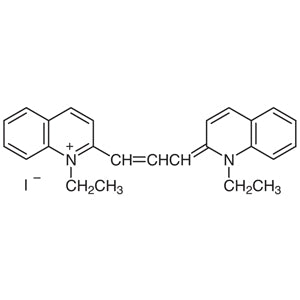
Pinacyanol Iodide (TCI P0436), with CAS number 605-91-4, is a chemical compound widely used in scientific and technical applications within laboratory settings. This compound belongs to the cyanine dye family, known for its unique optical properties that make it essential in the development of optical materials and photonic applications. It is commonly utilized in research fields such as photophysics, optical sensing, and material science due to its ability to interact with light in specific ways. Its role in laboratory experiments is critical, especially in studies involving light absorption, fluorescence, and optical signal processing.
The compound is valued for its stable chemical structure and controlled reactivity, which make it a reliable choice for various experimental setups. Its optical properties allow for precise tuning of light absorption and emission wavelengths, making it suitable for applications that require specific spectral responses. Additionally, Pinacyanol Iodide exhibits resistance to certain chemical reactions, ensuring consistency in experimental results over time. These characteristics make it a preferred material for researchers working on advanced optical technologies and photonic devices.
In Indonesian laboratories, Pinacyanol Iodide is frequently used in optical research, analytical chemistry, and material development projects. Its availability supports local institutions engaged in photonics, sensor technology, and composite material research. The compound's relevance in these areas highlights its importance in advancing scientific innovation within the region. Its use is particularly prominent in academic and industrial settings where optical properties are critical to experimental success.
- Optical Sensor Development: Pinacyanol Iodide is ideal for creating optical sensors due to its unique light absorption and emission characteristics, enabling precise detection of specific wavelengths.
- Photonic Material Research: Its role in photonic materials allows for the study of light-matter interactions, supporting advancements in optical communication and data transmission technologies.
- Fluorescence Spectroscopy Studies: The compound’s fluorescence properties make it a key component in fluorescence spectroscopy, aiding in the analysis of molecular structures and interactions.
- Composite Material Fabrication: It is used in the development of composite materials that require optical responsiveness, enhancing the functionality of engineered materials.
- Analytical Chemistry Applications: Its optical behavior supports analytical techniques such as spectroscopy, providing accurate data for chemical analysis and identification.
| Brand | TCI |
|---|---|
| CAS number | 605-91-4 |
| Molecular formula | — |
| Purity | — |
| Category | Materials Science > Photonic Materials and Optical Materials > Cyanine Dyes, Squarylium Dyes |
| Pack sizes | Available in various quantities as per supplier specifications |
| Physical form | Solid (as per standard product description) |
| Storage | Store in a cool, dry place away from light and moisture |
Pinacyanol Iodide should be stored in a cool, dry environment, away from direct light and moisture to maintain its chemical stability. It is recommended to use airtight containers made of glass or inert plastic to prevent contamination and degradation. Due to its optical properties, exposure to light may affect its performance, so proper storage conditions are crucial for maintaining its integrity. In laboratory settings, it should be handled with care, using appropriate personal protective equipment to ensure safety. Regular monitoring of storage conditions is advised to ensure the material remains suitable for its intended applications. Proper labeling and storage practices help prevent accidental exposure and ensure the compound remains effective for research purposes.
—
Produk Terkait
-
TCI B5774 5,10-Bis(4,4,5,5-tetramethyl-1,3,2-dioxaborolan-2-yl)naphtho[1,2-c:5,6-c']bis([1,2,5]oxadiazole)
Regular price Rp 10.255.350,00Regular price -
Dihydroiodide TCI B6569
Regular price From Rp 1.936.200,00Regular price -
Trifluoromethanesulfonate TCI B7003
Regular price From Rp 1.936.200,00Regular price
![5,10-Bis(4,4,5,5-tetramethyl-1,3,2-dioxaborolan-2-yl)naphtho[1,2-c:5,6-c']bis([1,2,5]oxadiazole) - TCI B5774 - AMI Scientific](http://amiscientific.com/cdn/shop/files/TCI2510B5774.jpg?v=1769180228&width=533)