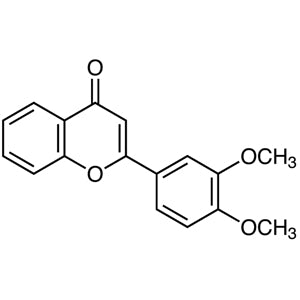
TCI D4794 3',4'-Dimethoxyflavone is a flavone derivative built on the 2-phenyl-4H-chromen-4-one skeleton, carrying two methoxy groups at the 3' and 4' positions of its B ring. In the laboratory it serves a dual role: as a heterocyclic building block for synthesis, and as a reference compound for the methylated flavonoid class. Natural product chemists use it to explore structure–activity relationships within the flavone group, while medicinal chemists employ it as a starting point for further modification toward new and more complex analogues.
The characteristics that make this compound a preferred choice begin with its rigid, fully conjugated chromone framework, which gives a distinctive ultraviolet absorption profile that is easy to monitor by HPLC with a UV detector or by spectrophotometer. The two methoxy groups on the B ring increase lipophilicity compared with the corresponding hydroxy analogues, so the compound dissolves more readily in organic solvents such as DMSO, methanol, or dichloromethane and shows greater stability toward oxidation. Those same methoxy groups can be demethylated to hydroxy groups whenever a more polar derivative is required.
In Indonesian laboratories, this material fits naturally into natural product chemistry and medicinal chemistry programmes at universities and research institutes, where flavonoid work is well established. It is typically handled at small synthetic and analytical scale: as a reference standard alongside plant extract profiling, as an intermediate in stepwise derivative synthesis, and as a teaching or method-development material in graduate research groups working on heterocyclic chemistry.
- Heterocyclic synthesis building block — the chromone core provides a stable, reactive scaffold from which more complex flavone analogues can be assembled through stepwise chemical modification.
- Structure–activity relationship studies — as a defined methylated flavone, it lets natural product researchers compare substitution patterns systematically across the wider flavone series.
- Medicinal chemistry lead modification — its methoxy groups offer clear handles for demethylation or further functionalisation when designing new candidate analogues from a known framework.
- HPLC and UV spectrophotometric reference work — the conjugated framework gives a characteristic ultraviolet absorption profile, making the compound straightforward to detect, track, and quantify.
- Preparation of more polar derivatives — the 3' and 4' methoxy groups can be converted to hydroxy groups when a research programme requires increased polarity or hydrogen-bonding capability.
| Brand | TCI (Tokyo Chemical Industry) |
|---|---|
| CAS number | 4143-62-8 |
| Molecular formula | — |
| Purity | — |
| Category | Chemistry > Building Blocks > Heterocyclic Building Blocks |
| Pack sizes | available in standard research-scale TCI catalogue pack sizes; please confirm the required size when ordering |
| Physical form | — |
| Storage | keep in the tightly closed original container, protected from light and moisture, in accordance with the manufacturer's product documentation |
- Catalogue number: D4794
Store the compound in its original tightly closed container, kept dry and protected from light, and follow the storage conditions stated in the manufacturer's product documentation and safety data sheet. Amber glass vials or the supplied container are suitable; avoid repeated opening that allows moisture ingress. Handle the powder in a fume hood or well-ventilated area using gloves, safety glasses, and a laboratory coat, and avoid generating or inhaling dust. Weigh out only the quantity needed, close the container promptly afterward, and prepare stock solutions in organic solvents such as DMSO or methanol shortly before use. Dispose of residues and contaminated consumables through the institution's chemical waste procedures.
—
Produk Terkait
-
4'-Methoxyflavone TCI M2887
Regular price Rp 8.825.250,00Regular price -
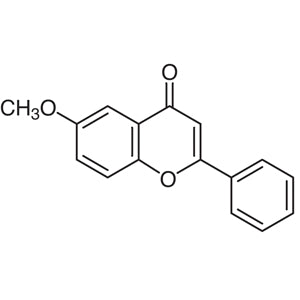
6-Methoxyflavone TCI M1346
Regular price From Rp 1.220.100,00Regular price -
3-Hydroxy-6-methoxyflavone TCI H1522
Regular price From Rp 2.199.750,00Regular price -
O~6~-Benzylguanine TCI B4208
Regular price From Rp 1.167.600,00Regular price -
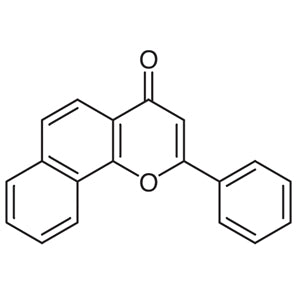
alpha-Naphthoflavone TCI B0056
Regular price From Rp 743.400,00Regular price -
1-Aminobenzotriazole TCI A1464
Regular price From Rp 6.015.450,00Regular price -
1,10-Phenanthroline-5,6-dione TCI P1973
Regular price From Rp 3.419.850,00Regular price -
2-Methyl-4(1H)-quinazolinone TCI M2709
Regular price Rp 2.625.000,00Regular price