TCI D4855 N,N'-Di-1-naphthyl-N,N'-di-2-naphthylbenzidine is a functional organic material belonging to the diamine family built on a biphenyl (benzidine) backbone, in which all four nitrogen positions carry naphthyl groups, combining substitution at both the 1- and 2-positions of naphthalene. TCI classifies it as an organic light-emitting diode (OLED) material within the scope of materials science and electronic materials. In the laboratory, triarylamine-type compounds of this kind serve as hole-transport materials, that is, thin layers that convey positive charge carriers from the electrode toward the light-emitting layer in OLED devices and other optoelectronic components.
The properties that make this compound a preferred choice are the combination of electronic and morphological characteristics typical of tetraarylbenzidine derivatives. The electron-rich nitrogen centres provide a highest occupied molecular orbital energy level well suited to hole injection and transport, while the bulky, angular naphthyl groups enlarge the molecular volume so that the amorphous thin films formed from it tend to be more resistant to crystallisation. Mixing 1-naphthyl and 2-naphthyl groups within a single molecule reduces symmetry and is commonly exploited to suppress the tendency toward ordered packing, which supports more uniform and more stable deposited layers.
In Indonesian laboratories, materials of this class are typically found in university and institutional research groups working on organic electronics, thin-film physics, and materials chemistry, as well as in device fabrication facilities that prepare multilayer stacks by vacuum deposition. They are usually handled in small quantities during the preparation of experimental device architectures, in comparative studies of hole-transport layers, and in the characterisation of film morphology and charge-transport behaviour, where reproducible material quality from a recognised supplier is important for comparing results between runs.
- Hole-transport layer fabrication in OLED test devices, where the electron-rich triarylamine nitrogen centres carry positive charge carriers from the anode side toward the emissive layer.
- Multilayer organic device stack development, where the compound is deposited as a discrete thin film and evaluated for its contribution to overall device architecture and layer compatibility.
- Amorphous thin-film morphology studies, since the bulky angular naphthyl substituents and reduced molecular symmetry give films that resist crystallisation over time.
- Comparative screening of hole-transport materials, in which this mixed 1-naphthyl and 2-naphthyl benzidine derivative serves as a structurally defined reference point against other tetraarylbenzidine analogues.
- General optoelectronic device research beyond OLEDs, where triarylamine derivatives are applied as hole-conducting components in experimental thin-film charge-transport structures.
| Brand | TCI |
|---|---|
| CAS number | 374592-88-8 |
| Molecular formula | — |
| Purity | — |
| Category | Materials Science > Electronic Materials > Organic Light-Emitting Diode (OLED) Materials |
| Pack sizes | available in the manufacturer's standard research-scale packaging; please confirm the required size when ordering |
| Physical form | — |
| Storage | keep in the closed original container under the conditions stated on the manufacturer's label |
- Catalogue code: D4855
- Chemical name: N,N'-Di-1-naphthyl-N,N'-di-2-naphthylbenzidine
Store the material in its tightly closed original container in a cool, dry, and well-ventilated area, protected from direct light and away from heat sources or oxidising agents. Amber glass bottles or the manufacturer's supplied packaging are suitable containers, and the container should be reclosed promptly after each use to limit exposure to moisture and air. Handle the powder in a fume hood or a well-ventilated workspace, wearing a laboratory coat, safety glasses, and chemical-resistant gloves, and avoid raising dust when weighing. Use clean, dry spatulas and glassware to prevent contamination that could affect thin-film quality. Always consult the manufacturer's safety data sheet before use, and dispose of residues and contaminated materials in accordance with applicable laboratory chemical waste procedures.
—
Produk Terkait
-
N,N'-Bis[4-di(m-tolyl)aminophenyl]-N,N'-diphenylbenzidine TCI B5634
Regular price From Rp 2.677.500,00Regular price -
N,N-Bis(4'-diphenylamino-4-biphenylyl)amine TCI B5676
Regular price From Rp 1.590.750,00Regular price -
1,4-Bis[4-(N,N-diphenylamino)styryl]benzene TCI B5820
Regular price Rp 2.889.600,00Regular price -
(1R,2R)-1,2-Bis(2,4,6-trimethylphenyl)ethylenediamineDihydrochloride TCI B5914
Regular price Rp 2.199.750,00Regular price -
(1R,2R)-1,2-Bis(4-methylphenyl)ethylenediamineDihydrochloride TCI B6240
Regular price Rp 2.174.550,00Regular price -
(1S,2S)-N~1~,N~2~-Dibenzylcyclohexane-1,2-diamineDihydrochloride TCI B6390
Regular price From Rp 3.605.700,00Regular price -
(1R,2R)-N1,N2-Dibenzylcyclohexane-1,2-diamineDihydrochloride TCI B6393
Regular price From Rp 3.605.700,00Regular price -
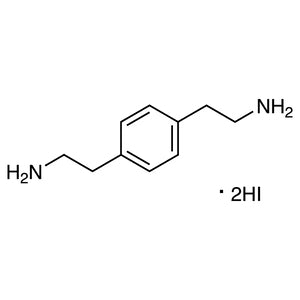
1,4-BenzenediethanamineDihydroiodide TCI B6570
Regular price From Rp 2.068.500,00Regular price
![N,N'-Bis[4-di(m-tolyl)aminophenyl]-N,N'-diphenylbenzidine (CAS 199121-98-7) - TCI B5634 - AMI Scientific](http://amiscientific.com/cdn/shop/files/TCI2510B5634.jpg?v=1771058153&width=533)

![1,4-Bis[4-(N,N-diphenylamino)styryl]benzene (CAS 55035-42-2) - TCI B5820 - AMI Scientific](http://amiscientific.com/cdn/shop/files/TCI2510B5820.jpg?v=1771057994&width=533)