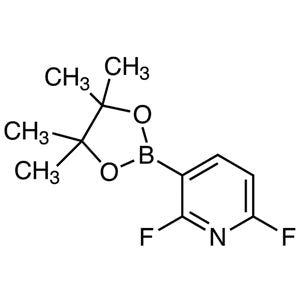
2,6-Difluoro-3-(4,4,5,5-tetramethyl-1,3,2-dioxaborolan-2-yl)pyridine is a specialized chemical compound used in advanced organic chemistry applications, particularly in the field of organoboron reagents. This compound plays a crucial role in laboratory settings where complex molecular structures are being synthesized. Its unique molecular structure includes a boron-containing group, which is essential for facilitating various coupling reactions. As a key component in modern synthetic chemistry, it supports the development of new materials and pharmaceutical compounds.
The compound is favored for its reactivity and compatibility with transition metals such as palladium, making it ideal for reactions like Suzuki-Miyaura and other coupling processes. Its ability to efficiently participate in these reactions contributes to the synthesis of aromatic compounds with halogen substituents. The presence of the boron group allows for high reactivity and versatility, enabling chemists to achieve precise and controlled outcomes in their experiments. This reagent is particularly valuable in laboratories that require high precision and reproducibility.
In Indonesian laboratories, this compound is commonly used in organic chemistry research, especially in the synthesis of complex heterocyclic compounds and new materials. Its stability under specific conditions makes it a reliable choice for applications that demand consistency and accuracy. Researchers in Indonesia often rely on this reagent for advancing their work in chemical synthesis and material development.
TCI brochures (PDF)
- Suzuki-Miyaura Cross Coupling Reaction 2025-12-01 · p. 19
Related TCI products
- TCI T4400 942919-26-8 4-(4,4,5,5-Tetramethyl-1,3,2-dioxaborolan-2-yl)-1H-pyrrolo[2,3-b]pyridine
- TCI T3400 1009033-87-7 4-[4-(4,4,5,5-Tetramethyl-1,3,2-dioxaborolan-2-yl)phenyl]pyridine
- TCI T3399 1009033-83-3 4-[3-(4,4,5,5-Tetramethyl-1,3,2-dioxaborolan-2-yl)phenyl]pyridine
- TCI T3313 939430-30-5 3-[3-(4,4,5,5-Tetramethyl-1,3,2-dioxaborolan-2-yl)phenyl]pyridine
- TCI T2345 329214-79-1 3-(4,4,5,5-Tetramethyl-1,3,2-dioxaborolan-2-yl)pyridine
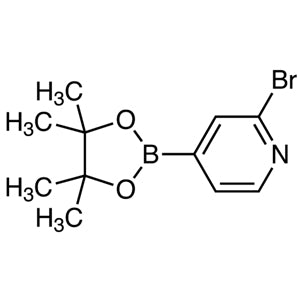
- TCI B5238 458532-82-6 2-Bromo-4-(4,4,5,5-tetramethyl-1,3,2-dioxaborolan-2-yl)pyridine
- Organic synthesis of complex heterocyclic compounds due to its reactivity and compatibility with transition metals.
- Facilitation of Suzuki-Miyaura coupling reactions for the efficient formation of aromatic compounds with halogen substituents.
- Development of new materials in chemical research through its role in coupling reactions and structural modifications.
- Use in pharmaceutical research for the synthesis of compounds with specific functional groups and molecular structures.
- Support for advanced chemical processes requiring high precision and controlled reaction conditions in laboratory settings.
| Brand | TCI |
|---|---|
| CAS number | 1072945-00-6 |
| Molecular formula | — |
| Purity | — |
| Category | Chemistry > Organometallic Reagents > Organoboron [Organometallic Reagents] |
| Pack sizes | — |
| Physical form | — |
| Storage | Store in a cool, dry place away from moisture and direct sunlight |
This compound should be stored in a cool, dry environment to maintain its stability and reactivity. It is recommended to use airtight containers to prevent exposure to moisture and air, which can affect its chemical integrity. Due to its reactivity with transition metals, it should be handled with care in laboratory settings, ensuring proper ventilation and protective equipment. Avoid contact with incompatible substances and keep it away from sources of heat. Regular monitoring of storage conditions is essential to ensure the compound remains effective for its intended applications. Proper labeling and secure storage are also important to prevent accidental exposure or misuse.
—
Produk Terkait
-
4-(4,4,5,5-Tetramethyl-1,3,2-dioxaborolan-2-yl)-1H-pyrrolo[2,3-b]pyridine TCI T4400
Regular price From Rp 3.630.900,00Regular price -
4-[4-(4,4,5,5-Tetramethyl-1,3,2-dioxaborolan-2-yl)phenyl]pyridine TCI T3400
Regular price From Rp 1.565.550,00Regular price -
4-[3-(4,4,5,5-Tetramethyl-1,3,2-dioxaborolan-2-yl)phenyl]pyridine TCI T3399
Regular price From Rp 1.908.900,00Regular price -
3-[3-(4,4,5,5-Tetramethyl-1,3,2-dioxaborolan-2-yl)phenyl]pyridine TCI T3313
Regular price From Rp 4.982.250,00Regular price -
3-(4,4,5,5-Tetramethyl-1,3,2-dioxaborolan-2-yl)pyridine TCI T2345
Regular price From Rp 1.485.750,00Regular price -
2-Bromo-4-(4,4,5,5-tetramethyl-1,3,2-dioxaborolan-2-yl)pyridine TCI B5238
Regular price Rp 2.411.850,00Regular price -
2-Bromo-6-(4,4,5,5-tetramethyl-1,3,2-dioxaborolan-2-yl)pyridine TCI B5077
Regular price From Rp 2.306.850,00Regular price -
1-(tert-Butoxycarbonyl)-1,2,3,6-tetrahydro-4-(4,4,5,5-tetramethyl-1,3,2-dioxaborolan-2-yl)pyridine TCI B4051
Regular price Rp 2.279.550,00Regular price
![942919-26-8 4-(4,4,5,5-Tetramethyl-1,3,2-dioxaborolan-2-yl)-1H-pyrrolo[2,3-b]pyridine - AMI Scientific](http://amiscientific.com/cdn/shop/files/TCI2510T4400.jpg?v=1767145178&width=533)
![1009033-87-7 4-[4-(4,4,5,5-Tetramethyl-1,3,2-dioxaborolan-2-yl)phenyl]pyridine - AMI Scientific](http://amiscientific.com/cdn/shop/files/TCI2510T3400.jpg?v=1769143727&width=533)
![1009033-83-3 4-[3-(4,4,5,5-Tetramethyl-1,3,2-dioxaborolan-2-yl)phenyl]pyridine - AMI Scientific](http://amiscientific.com/cdn/shop/files/TCI2510T3399.jpg?v=1769058221&width=533)
![939430-30-5 3-[3-(4,4,5,5-Tetramethyl-1,3,2-dioxaborolan-2-yl)phenyl]pyridine - AMI Scientific](http://amiscientific.com/cdn/shop/files/TCI2510T3313.jpg?v=1769058203&width=533)