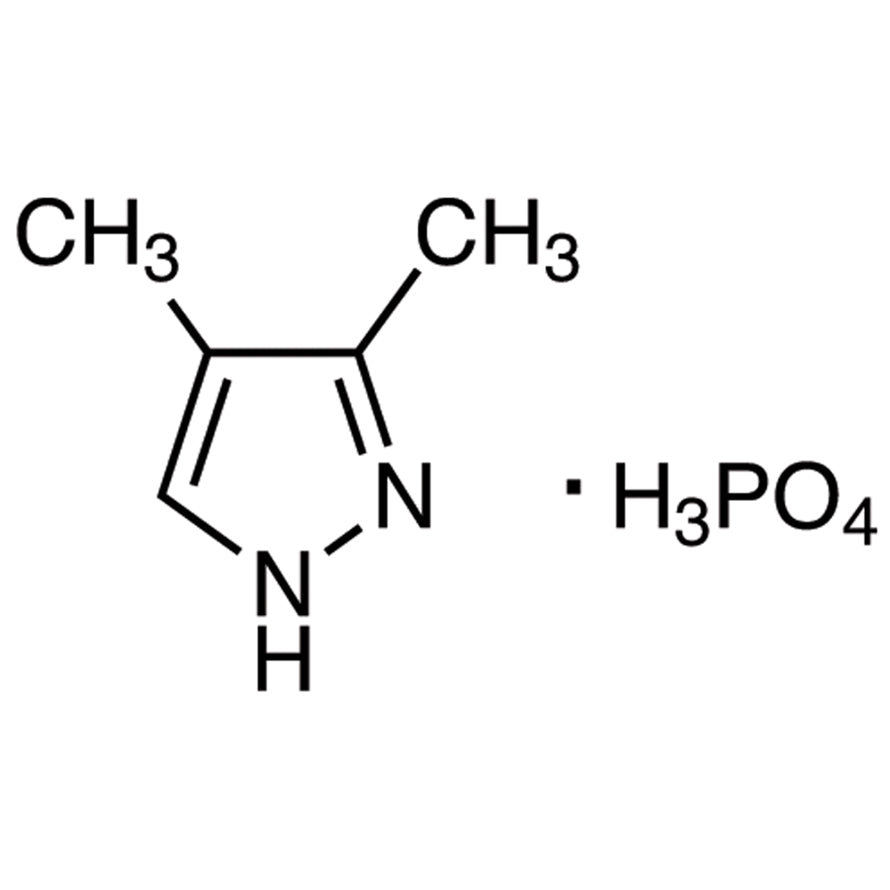
TCI D5668 3,4-Dimethyl-1H-pyrazole Phosphate is the phosphate salt of 3,4-dimethylpyrazole, a nitrogen-containing heterocyclic compound widely known among researchers as a nitrification inhibitor material. The phosphate salt form is chosen because it yields a solid that is considerably easier to handle, weigh, and distribute than the corresponding free base. In the laboratory, this material serves as a test substance and reference material in research on soil fertility, nitrogen fertilizer efficiency, and nutrient dynamics, as well as a starting material or ligand in heterocyclic chemistry work that exploits the pyrazole ring as a metal-binding framework.
The defining characteristic of this compound is its pyrazole ring bearing two adjacent nitrogen atoms, which are able to interact strongly with metal centres and with ammonia-oxidising enzyme systems. Added to this are the two methyl groups, which raise solubility in organic solvents while also modulating the basicity of the ring. As a phosphate salt, the compound offers good storage stability, is not as readily volatile as the free pyrazole, and dissolves more easily in the aqueous media required for soil incubation experiments. Together, these properties explain why the phosphate form is the preferred laboratory presentation of this molecule.
In Indonesian laboratories, this material is typically encountered in agricultural and soil science research settings, in fertiliser efficiency studies, and in analytical or synthetic chemistry work involving heterocyclic building blocks. The availability of 5 g and 25 g pack sizes gives laboratories flexibility between small-scale exploratory work and larger or repeated experimental programmes, allowing a group to match the quantity ordered to the scale of the study rather than committing to more material than a project requires.
Related TCI products
- TCI D6559 1047644-76-7 1,4-Dimethyl-5-(4,4,5,5-tetramethyl-1,3,2-dioxaborolan-2-yl)-1H-pyrazole
- TCI D5759 5744-59-2 1,5-Dimethyl-1H-pyrazole-3-carboxylic Acid
- TCI D5575 1036991-40-8 1,5-Dimethyl-4-(4,4,5,5-tetramethyl-1,3,2-dioxaborolan-2-yl)-1H-pyrazole
- TCI D5468 5744-56-9 1,3-Dimethyl-1H-pyrazole-5-carboxylic Acid
- TCI D5184 1046832-21-6 1,3-Dimethyl-4-(4,4,5,5-tetramethyl-1,3,2-dioxaborolan-2-yl)pyrazole
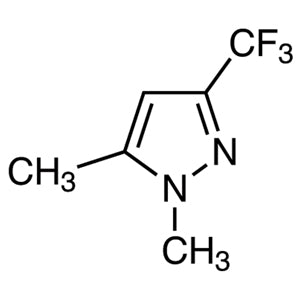
- TCI D5071 79080-31-2 1,5-Dimethyl-3-(trifluoromethyl)pyrazole
- Nitrification inhibition studies — the compound is a recognised nitrification inhibitor material, making it the direct test substance for experiments examining how ammonium conversion in soil can be slowed.
- Nitrogen fertiliser efficiency research — its role as a test and comparison substance allows researchers to evaluate how inhibitor addition affects the performance and retention of applied nitrogen fertilisers.
- Soil fertility and nutrient dynamics work — good aqueous solubility as a phosphate salt suits the incubation-type experiments used to follow nutrient transformation and movement in soil systems.
- Heterocyclic synthesis — the pyrazole ring serves as a starting material or building block in synthetic chemistry programmes that construct or modify nitrogen-containing heterocyclic structures.
- Coordination chemistry and ligand studies — the two adjacent ring nitrogen atoms interact strongly with metal centres, making the compound useful as a ligand or metal-binding framework in complexation work.
| Brand | TCI |
|---|---|
| CAS number | 202842-98-6 |
| Molecular formula | — |
| Purity | — |
| Category | TCI |
| Pack sizes | 5 g and 25 g |
| Physical form | solid (phosphate salt, easier to handle and weigh than the free base) |
| Storage | good storage stability as the phosphate salt; store in a closed container under normal laboratory reagent storage conditions |
Store the material in its original tightly closed container, kept dry and protected from moisture, in a cool and well-ventilated area away from incompatible materials. Amber glass or the manufacturer's supplied packaging is suitable, and containers should be resealed promptly after each weighing to preserve the good storage stability characteristic of the phosphate salt. Handle the solid in a fume hood or a well-ventilated weighing area to limit dust generation, and use standard personal protective equipment including a laboratory coat, safety glasses, and chemical-resistant gloves. Avoid contact with skin and eyes and avoid inhalation of dust. Label all working solutions clearly, and consult the manufacturer's safety data sheet before first use and before disposal.
—
Produk Terkait
-
1,4-Dimethyl-5-(4,4,5,5-tetramethyl-1,3,2-dioxaborolan-2-yl)-1H-pyrazole TCI D6559
Regular price Rp 2.121.000,00Regular price -
1,5-Dimethyl-1H-pyrazole-3-carboxylicAcid TCI D5759
Regular price From Rp 2.041.200,00Regular price -
1,5-Dimethyl-4-(4,4,5,5-tetramethyl-1,3,2-dioxaborolan-2-yl)-1H-pyrazole TCI D5575
Regular price From Rp 1.590.750,00Regular price -
1,3-Dimethyl-1H-pyrazole-5-carboxylicAcid TCI D5468
Regular price From Rp 2.518.950,00Regular price -
1,3-Dimethyl-4-(4,4,5,5-tetramethyl-1,3,2-dioxaborolan-2-yl)pyrazole TCI D5184
Regular price Rp 2.041.200,00Regular price -
1,5-Dimethyl-3-(trifluoromethyl)pyrazole TCI D5071
Regular price From Rp 795.900,00Regular price -
1-(tert-Butoxycarbonyl)-3,5-dimethyl-4-(4,4,5,5-tetramethyl-1,3,2-dioxaborolan-2-yl)pyrazole TCI B6026
Regular price From Rp 1.220.100,00Regular price -
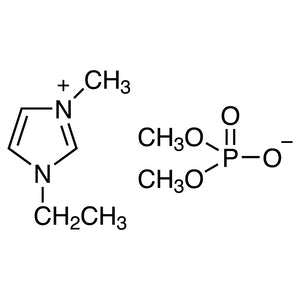
3-Ethyl-1-methyl-1H-imidazol-3-iumDimethylPhosphate TCI E1520
Regular price From Rp 1.510.950,00Regular price