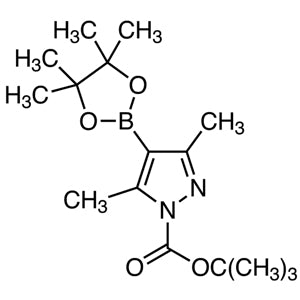
1-(tert-Butoxycarbonyl)-3,5-dimethyl-4-(4,4,5,5-tetramethyl-1,3,2-dioxaborolan-2-yl)pyrazole is a complex organic compound widely used in laboratory settings for its unique reactivity and structural versatility. This reagent plays a crucial role in organic synthesis, particularly in the development of heterocyclic compounds and boron-containing molecules. Its application spans various synthetic pathways, making it an essential tool for researchers working in advanced chemical processes. Due to its functional groups, it is especially valuable in metal-catalyzed reactions, contributing to the efficiency and selectivity of synthetic protocols.
The compound's structure includes both a boron-containing group and a tert-butoxycarbonyl moiety, which together provide stability and reactivity in a range of chemical environments. These properties make it a preferred choice for synthetic chemists seeking reliable and controllable reagents. The presence of the boron group allows it to participate in important coupling reactions, such as Suzuki-Miyaura and Kumada-Corriu, which are fundamental in the synthesis of complex organic molecules. Its chemical specificity ensures that it can be tailored for various synthetic applications without unwanted side reactions.
In Indonesian laboratories, this compound is commonly used by chemists and researchers in the fields of organic synthesis, pharmacology, and materials science. Its role in producing precise and controlled chemical outcomes makes it a valuable asset in both academic and industrial research settings. Its application is particularly relevant in projects requiring high levels of chemical accuracy and synthetic efficiency.
TCI brochures (PDF)
- Suzuki-Miyaura Cross Coupling Reaction 2025-12-01 · p. 18
- Boron Compounds 2025-10-07 · p. 19
Related TCI products
- TCI T3829 844501-71-9 3-(4,4,5,5-Tetramethyl-1,3,2-dioxaborolan-2-yl)-1H-pyrazole
- TCI T3668 1040377-03-4 1-(Tetrahydro-2H-pyran-4-yl)-4-(4,4,5,5-tetramethyl-1,3,2-dioxaborolan-2-yl)-1H-pyrazole
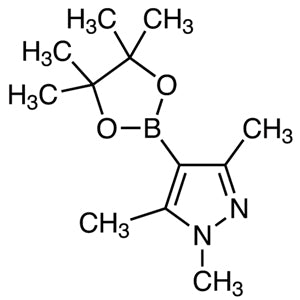
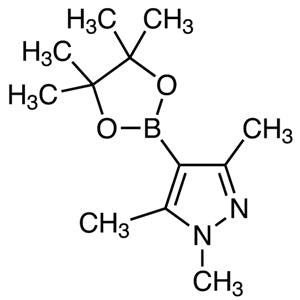
- TCI T3409 844891-04-9 1,3,5-Trimethyl-4-(4,4,5,5-tetramethyl-1,3,2-dioxaborolan-2-yl)pyrazole
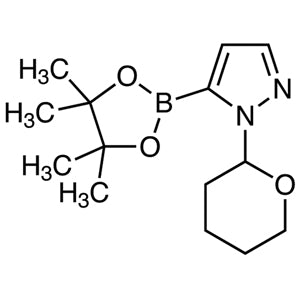
- TCI T3215 903550-26-5 1-(Tetrahydropyran-2-yl)-5-(4,4,5,5-tetramethyl-1,3,2-dioxaborolan-2-yl)pyrazole
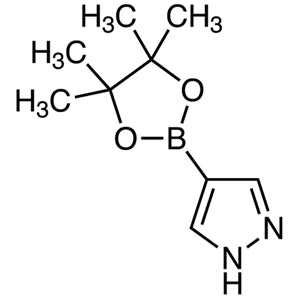
- TCI T2756 269410-08-4 4-(4,4,5,5-Tetramethyl-1,3,2-dioxaborolan-2-yl)pyrazole
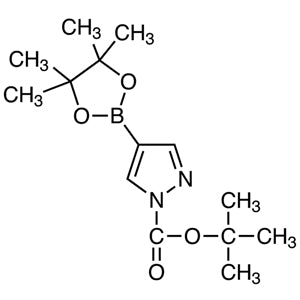
- TCI B5203 552846-17-0 1-(tert-Butoxycarbonyl)-4-(4,4,5,5-tetramethyl-1,3,2-dioxaborolan-2-yl)pyrazole
- Organic synthesis: This compound is ideal for creating complex heterocyclic structures due to its boron functionality and reactivity.
- Pharmaceutical research: It is used in the development of new drug compounds, especially those involving boron-containing moieties.
- Materials science: It contributes to the synthesis of advanced materials with specific chemical properties and structural features.
- Metal-catalyzed coupling reactions: Its ability to participate in Suzuki-Miyaura and Kumada-Corriu reactions makes it suitable for these specialized synthetic methods.
- Custom compound preparation: It is a key reagent in the synthesis of tailored organic compounds for specific research needs.
| Brand | TCI |
|---|---|
| CAS number | 1073354-70-7 |
| Molecular formula | — |
| Purity | — |
| Category | Chemistry > Organometallic Reagents > Organoboron [Organometallic Reagents] |
| Pack sizes | As per supplier specifications |
| Physical form | Solid (as per standard product description) |
| Storage | Store in a cool, dry place away from moisture and direct sunlight |
This compound should be stored in a cool, dry environment, away from moisture and direct sunlight to maintain its chemical integrity. It is recommended to use airtight containers to prevent exposure to air and humidity, which could affect its stability. Due to its reactivity, it should be handled with appropriate laboratory safety measures, including the use of personal protective equipment. Proper ventilation is essential when working with this material to minimize inhalation risks. It is important to follow standard chemical handling protocols to ensure the safety of laboratory personnel and the integrity of the compound during storage and use.
—
Produk Terkait
-
3-(4,4,5,5-Tetramethyl-1,3,2-dioxaborolan-2-yl)-1H-pyrazole TCI T3829
Regular price From Rp 1.936.200,00Regular price -
1-(Tetrahydro-2H-pyran-4-yl)-4-(4,4,5,5-tetramethyl-1,3,2-dioxaborolan-2-yl)-1H-pyrazole TCI T3668
Regular price From Rp 769.650,00Regular price -
1,3,5-Trimethyl-4-(4,4,5,5-tetramethyl-1,3,2-dioxaborolan-2-yl)pyrazole TCI T3409
Regular price From Rp 955.500,00Regular price -
1-(Tetrahydropyran-2-yl)-5-(4,4,5,5-tetramethyl-1,3,2-dioxaborolan-2-yl)pyrazole TCI T3215
Regular price From Rp 928.200,00Regular price -
4-(4,4,5,5-Tetramethyl-1,3,2-dioxaborolan-2-yl)pyrazole TCI T2756
Regular price From Rp 1.776.600,00Regular price -
1-(tert-Butoxycarbonyl)-4-(4,4,5,5-tetramethyl-1,3,2-dioxaborolan-2-yl)pyrazole TCI B5203
Regular price From Rp 1.273.650,00Regular price -
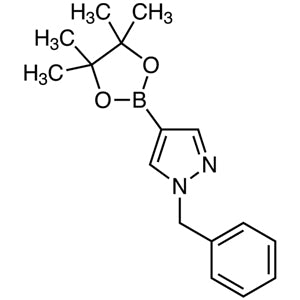
1-Benzyl-4-(4,4,5,5-tetramethyl-1,3,2-dioxaborolan-2-yl)pyrazole TCI B4364
Regular price From Rp 1.670.550,00Regular price -
1-(tert-Butoxycarbonyl)-1,2,3,6-tetrahydro-4-(4,4,5,5-tetramethyl-1,3,2-dioxaborolan-2-yl)pyridine TCI B4051
Regular price Rp 2.279.550,00Regular price