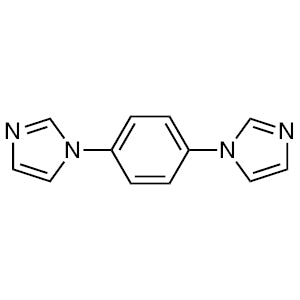
1,4-Di(1H-imidazol-1-yl)benzene is a chemical compound widely used in catalytic reactions and organic synthesis within laboratory settings. This compound features a benzene ring substituted with two imidazole groups at the 1,4 positions, forming a complex molecular structure. Its role as a nitrogen-donor ligand makes it essential in the formation of transition metal complexes, which are fundamental in catalytic processes. Due to its structural stability and reactivity, it is a valuable tool for researchers aiming to control reaction pathways and enhance catalytic efficiency.
The compound's chemical properties, including its high stability and controlled reactivity, make it a preferred choice for laboratory applications. It exhibits resistance to degradation under typical experimental conditions, ensuring consistent performance in various synthetic protocols. Its ability to coordinate with transition metals allows for the design of efficient catalysts, particularly in reactions requiring electronic activation or structural modulation. These attributes contribute to its reliability and effectiveness in both academic and industrial research environments.
In Indonesian laboratories, 1,4-Di(1H-imidazol-1-yl)benzene is commonly used in organic chemistry and catalysis research. It plays a crucial role in the synthesis of complex compounds and is frequently employed in academic institutions and research centers. Its versatility and chemical stability make it an essential component in the development of new chemical processes and materials. Its presence in these laboratories supports ongoing scientific investigations and innovation in the field of chemistry.
Related TCI products
- TCI T3479 147951-02-8 1,3,5-Tris[(1H-imidazol-1-yl)methyl]benzene
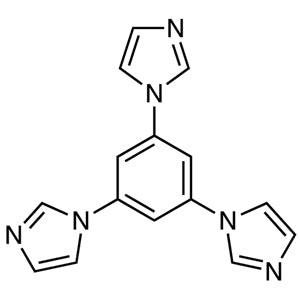
- TCI T3903 528543-96-6 1,3,5-Tri(1H-imidazol-1-yl)benzene
- TCI B4023 56643-83-5 1,4-Bis[(1H-imidazol-1-yl)methyl]benzene
- TCI B1511 34052-90-9 1,3-Bis(4,5-dihydro-2-oxazolyl)benzene
- TCI D6240 N1-[3',5'-Di-tert-butyl-[1,1'-biphenyl]-2-yl]-N2-[2-(3,5-di-tert-butylphenyl)naphthalen-1-yl]benzene-1,2-diamine
- TCI B6606 2897656-97-0 N1-([1,1'-Biphenyl]-2-yl)-N2-(2-phenylnaphthalen-1-yl)benzene-1,2-diamine
- Organic synthesis applications benefit from its role as a nitrogen-donor ligand, enabling the formation of stable transition metal complexes that enhance reaction efficiency.
- Catalytic processes in transition metal-based reactions rely on its ability to activate substrates and modulate reaction pathways, making it ideal for industrial and academic research.
- Ligand design in coordination chemistry utilizes its structural features to create custom ligands for specific catalytic or analytical purposes.
- Research in molecular electronics and materials science employs its stable chemical properties to develop new compounds with unique electronic behaviors.
- Analytical chemistry applications leverage its reactivity and stability for the development of sensitive detection methods and chemical sensors.
| Brand | TCI |
|---|---|
| CAS number | 25372-07-0 |
| Molecular formula | — |
| Purity | — |
| Category | Chemistry > Catalysis and Inorganic Chemistry > Nitrogen-Donor Ligands [Catalysis] |
| Pack sizes | — |
| Physical form | — |
| Storage | Store in a cool, dry place away from moisture and direct sunlight |
This compound should be stored in a cool, dry environment to maintain its chemical stability and prevent degradation. It is recommended to use airtight containers to minimize exposure to moisture and air, which can affect its reactivity. Proper labeling of storage containers is essential for safe handling and identification. Laboratory personnel should wear appropriate personal protective equipment, such as gloves and safety goggles, when handling this material. The compound should be kept away from incompatible substances to avoid any potential chemical interactions. Regular monitoring of storage conditions ensures the material remains suitable for use in experimental procedures.
—
Produk Terkait
-
1,3,5-Tris[(1H-imidazol-1-yl)methyl]benzene TCI T3479
Regular price From Rp 2.545.200,00Regular price -
1,3,5-Tri(1H-imidazol-1-yl)benzene TCI T3903
Regular price Rp 3.155.250,00Regular price -
1,4-Bis[(1H-imidazol-1-yl)methyl]benzene TCI B4023
Regular price From Rp 1.696.800,00Regular price -
1,3-Bis(4,5-dihydro-2-oxazolyl)benzene TCI B1511
Regular price From Rp 903.000,00Regular price -
N1-[3',5'-Di-tert-butyl-[1,1'-biphenyl]-2-yl]-N2-[2-(3,5-di-tert-butylphenyl)naphthalen-1-yl]benzene-1,2-diamine TCI D6240
Regular price From Rp 2.411.850,00Regular price -
N1-([1,1'-Biphenyl]-2-yl)-N2-(2-phenylnaphthalen-1-yl)benzene-1,2-diamine TCI B6606
Regular price From Rp 2.041.200,00Regular price -
3-Ethyl-1-vinyl-1H-imidazol-3-iumBromide TCI V0183
Regular price From Rp 980.700,00Regular price -
1-Butyl-3-methyl-1H-imidazol-3-iumNitrate TCI B5103
Regular price From Rp 1.378.650,00Regular price
![147951-02-8 1,3,5-Tris[(1H-imidazol-1-yl)methyl]benzene - AMI Scientific](http://amiscientific.com/cdn/shop/files/TCI2510T3479.jpg?v=1767144149&width=533)
![56643-83-5 1,4-Bis[(1H-imidazol-1-yl)methyl]benzene - AMI Scientific](http://amiscientific.com/cdn/shop/files/TCI2510B4023.jpg?v=1768815555&width=533)
![56643-83-5 1,4-Bis[(1H-imidazol-1-yl)methyl]benzene - AMI Scientific](http://amiscientific.com/cdn/shop/files/TCI2510B4023_57deab68-ab37-4d54-9bdc-438e660abd2f.jpg?v=1769055692&width=533)

![N1-[3',5'-Di-tert-butyl-[1,1'-biphenyl]-2-yl]-N2-[2-(3,5-di-tert-butylphenyl)naphthalen-1-yl]benzene-1,2-diamine (CAS 2897657-05-3) - TCI D6240 - AMI Scientific](http://amiscientific.com/cdn/shop/files/TCI2510D6240.jpg?v=1767109945&width=533)
![N1-([1,1'-Biphenyl]-2-yl)-N2-(2-phenylnaphthalen-1-yl)benzene-1,2-diamine (CAS 2897656-97-0) - TCI B6606 - AMI Scientific](http://amiscientific.com/cdn/shop/files/TCI2510B6606.jpg?v=1767094008&width=533)