1,4-Bis[(1H-imidazol-1-yl)methyl]benzene is a complex organic compound that plays a significant role in laboratory research, particularly in the development of advanced materials. This compound is widely used as a building block in the synthesis of organic-inorganic hybrid materials, especially in the creation of Metal Organic Frameworks (MOFs). Due to its unique molecular structure, it enables the formation of porous, high-surface-area materials with tailored properties. Its versatility makes it a key component in various scientific applications, supporting innovation in material science and chemical engineering.
The compound's high reactivity and molecular complexity make it a preferred choice for researchers. Its imidazole groups, attached to a benzene ring, provide functional sites that can interact with metal ions, facilitating the formation of stable MOF structures. These properties allow for the design of materials with specific adsorption capacities and chemical selectivity. Additionally, its chemical stability under certain conditions ensures reliable performance in laboratory settings, making it a reliable reagent for synthetic processes.
In Indonesian laboratories, this compound is commonly used in academic and industrial research focused on material development. It is a staple in chemical synthesis labs, where it supports the creation of advanced materials for applications such as gas storage, catalysis, and drug delivery. Its role in MOF synthesis is particularly prominent, contributing to the advancement of nanotechnology and sustainable chemical processes.
TCI brochures (PDF)
- Organic Linker Molecules for Metal Organic Frameworks (MOFs) 2026-05-11 · p. 6
Related TCI products
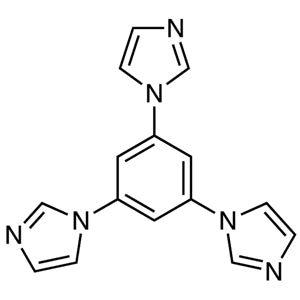
- TCI T3903 528543-96-6 1,3,5-Tri(1H-imidazol-1-yl)benzene
- TCI T3479 147951-02-8 1,3,5-Tris[(1H-imidazol-1-yl)methyl]benzene
- TCI D5777 855766-92-6 4,4'-Di(1H-imidazol-1-yl)-1,1'-biphenyl
- TCI B6458 69506-86-1 1,4-Di(1H-imidazol-1-yl)butane
- TCI T3894 1078153-58-8 1,2,4,5-Tetrakis(4-carboxyphenyl)benzene
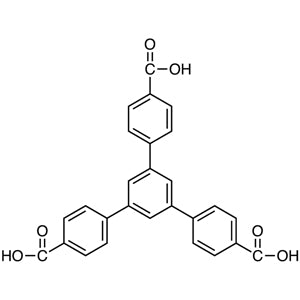
- TCI T2647 50446-44-1 1,3,5-Tris(4-carboxyphenyl)benzene
- Metal Organic Frameworks (MOF) synthesis: This compound is ideal for creating MOFs due to its ability to coordinate with metal ions, forming porous structures with high surface area and tunable properties.
- Organic-inorganic hybrid material development: Its molecular structure allows for the integration of organic and inorganic components, enabling the design of materials with enhanced functional properties.
- Catalytic reaction research: The compound’s reactivity makes it suitable for catalytic processes, where it can act as a ligand or support for catalysts in various chemical transformations.
- Adsorption and separation studies: The porous nature of MOFs formed from this compound makes it useful for studying molecular adsorption and selective separation of gases or solutes.
- Pharmaceutical and chemical synthesis: It is used as a reagent in the synthesis of complex organic molecules, supporting the development of new drugs and chemical compounds.
| Brand | TCI |
|---|---|
| CAS number | 56643-83-5 |
| Molecular formula | — |
| Purity | — |
| Category | Materials Science > Organic-Inorganic Hybrid Materials > Metal Organic Frameworks (MOF) and Their Raw Materials |
| Pack sizes | Available in various quantities as per standard laboratory supply |
| Physical form | Solid |
| Storage | Store in a cool, dry place away from moisture and direct sunlight |
This compound should be stored in a cool, dry environment to maintain its chemical stability and prevent degradation. It is recommended to use airtight containers to protect it from moisture and air exposure. Due to its reactivity, it should be handled in a well-ventilated laboratory setting, ideally with appropriate personal protective equipment such as gloves and safety goggles. Avoid contact with incompatible substances and ensure proper waste disposal procedures are followed. Regular monitoring of storage conditions is advised to ensure the material remains suitable for use in laboratory applications.
—
Product Categories
- Organic-Inorganic Hybrid MaterialsMetal Organic Frameworks (MOF) and Their Raw MaterialsOrganic Linker Molecules [Metal Organic Frameworks (MOFs) Precursors]
- Polymer/Macromolecule ReagentsMetal Organic Frameworks (MOF) and Their Raw MaterialsOrganic Linker Molecules [Metal Organic Frameworks (MOFs) Precursors]
Produk Terkait
-
1,3,5-Tri(1H-imidazol-1-yl)benzene TCI T3903
Regular price Rp 3.207.750,00Regular priceRp 2.258.550,00Sale price Rp 3.207.750,00 -
1,3,5-Tris[(1H-imidazol-1-yl)methyl]benzene TCI T3479
Regular price From Rp 2.597.700,00Regular priceRp 1.832.250,00Sale price From Rp 2.597.700,00 -
4,4'-Di(1H-imidazol-1-yl)-1,1'-biphenyl TCI D5777
Regular price From Rp 3.285.450,00Regular priceRp 2.313.150,00Sale price From Rp 3.285.450,00 -
1,4-Di(1H-imidazol-1-yl)butane TCI B6458
Regular price Rp 2.359.350,00Regular priceRp 1.665.300,00Sale price Rp 2.359.350,00 -
1,2,4,5-Tetrakis(4-carboxyphenyl)benzene TCI T3894
Regular price From Rp 2.837.100,00Regular priceRp 1.983.450,00Sale price From Rp 2.837.100,00 -
1,3,5-Tris(4-carboxyphenyl)benzene TCI T2647
Regular price From Rp 3.683.400,00Regular priceRp 2.575.650,00Sale price From Rp 3.683.400,00 -
1,4-Di(1H-imidazol-1-yl)benzene TCI D5767
Regular price Rp 3.870.300,00Regular priceRp 2.721.600,00Sale price Rp 3.870.300,00 -
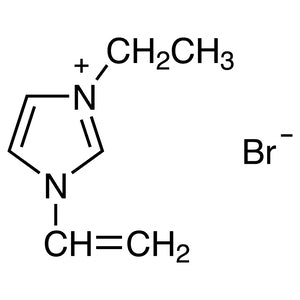
3-Ethyl-1-vinyl-1H-imidazol-3-iumBromide TCI V0183
Regular price From Rp 1.033.200,00Regular priceRp 738.150,00Sale price From Rp 1.033.200,00