


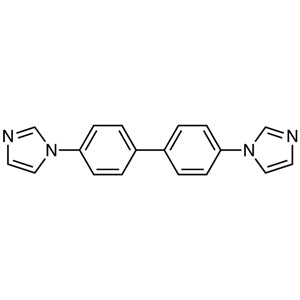
4,4'-Di(1H-imidazol-1-yl)-1,1'-biphenyl (TCI D5777) is a heterocyclic building block and nitrogen-donor linker built from a biphenyl core carrying an imidazole group at each end. Compared with linkers based on a single benzene ring, the presence of two connected aromatic rings makes the distance between the two coordination sites considerably longer. In materials chemistry and inorganic chemistry laboratories, this property is used to assemble metal-organic frameworks and coordination polymers with more spacious cavities, which makes the compound useful for research on porous materials and on the storage of guest molecules.
The characteristics that lead researchers to select this linker are the combination of linker length, structural rigidity, and reliable coordination behaviour. The biphenyl core is rigid, even though the two rings can rotate relative to one another, and that limited rotation actually gives the resulting framework some freedom to adjust its geometry as it crystallises. The imidazole nitrogen atoms provide strong coordination to a wide range of transition metal ions, while the neutral character of the ligand makes it easier to control the overall charge of the framework. As a stable solid, the compound is practical to weigh out and handle on the bench.
In Indonesian laboratories, this building block is typically used in university and institutional research groups working on porous materials, coordination polymers, and metal-organic frameworks. It is normally weighed out in small quantities for solvothermal or solution-phase framework syntheses, in which the linker is combined with a transition metal salt and allowed to crystallise. Because it is supplied as a stable solid, it fits well into routine synthetic work where reproducible weighing and straightforward storage between experiments are important.
TCI brochures (PDF)
- Organic Linker Molecules for Metal Organic Frameworks (MOFs) 2026-05-11 · p. 6
Related TCI products
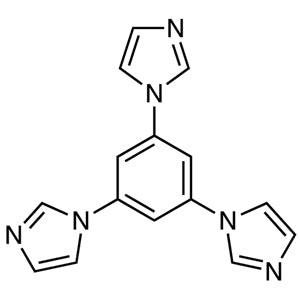
- TCI T3903 528543-96-6 1,3,5-Tri(1H-imidazol-1-yl)benzene
- TCI T3479 147951-02-8 1,3,5-Tris[(1H-imidazol-1-yl)methyl]benzene
- TCI B4023 56643-83-5 1,4-Bis[(1H-imidazol-1-yl)methyl]benzene
- TCI M3886 31349-48-1 4-(1-Methyl-5-nitro-1H-benzo[d]imidazol-2-yl)butanoic Acid
- TCI I1294 1074-59-5 3-(1H-Imidazol-5-yl)propanoic Acid
- TCI I1288 2221-00-3 4-(1H-Imidazol-1-yl)aniline
- Metal-organic framework synthesis — the long, rigid biphenyl spacer separates the two imidazole coordination sites, producing frameworks with more open cavities than single-ring nitrogen donor linkers.
- Coordination polymer construction — the two terminal imidazole nitrogen atoms bridge transition metal centres reliably, allowing extended one-, two-, or three-dimensional networks to be assembled reproducibly.
- Porous materials research — the spacious cavities generated by this extended linker make it a useful component when studying pore architecture, framework topology, and accessible internal volume.
- Guest molecule storage studies — frameworks built with this longer linker offer roomier channels, which suits investigations into the uptake and release of guest species within the host lattice.
- Heterocyclic building block for coordination chemistry — as a neutral bis-imidazole ligand, it simplifies charge balancing in the target structure while providing strong, predictable metal-nitrogen coordination.
| Brand | TCI |
|---|---|
| CAS number | 855766-92-6 |
| Molecular formula | — |
| Purity | — |
| Category | Chemistry > Building Blocks > Heterocyclic Building Blocks |
| Pack sizes | available in standard TCI research-scale packaging; please refer to the packaging options listed for this item |
| Physical form | stable solid |
| Storage | keep in a closed container under the conditions stated on the manufacturer's label |
- Product code: D5777
Store the container tightly closed in a cool, dry place away from moisture, direct sunlight, and sources of heat or ignition, following the conditions given on the manufacturer's label. The original supplier container is the most suitable primary packaging; if the material must be subdivided, use clean, dry, well-sealed glass or chemically compatible plastic containers and label them clearly with the compound name and CAS number. Handle the solid in a well-ventilated area or fume hood to avoid generating and inhaling dust, and wear standard laboratory personal protective equipment, including a lab coat, safety goggles, and suitable gloves. Weigh the material carefully to limit airborne particles, close the container immediately after use, and consult the manufacturer's safety data sheet before first handling and for waste disposal guidance.
—
Product Categories
- Organic-Inorganic Hybrid MaterialsMetal Organic Frameworks (MOF) and Their Raw MaterialsOrganic Linker Molecules [Metal Organic Frameworks (MOFs) Precursors]
- Polymer/Macromolecule ReagentsMetal Organic Frameworks (MOF) and Their Raw MaterialsOrganic Linker Molecules [Metal Organic Frameworks (MOFs) Precursors]
Produk Terkait
-
1,3,5-Tri(1H-imidazol-1-yl)benzene TCI T3903
Regular price Rp 3.207.750,00Regular priceRp 2.258.550,00Sale price Rp 3.207.750,00 -
1,3,5-Tris[(1H-imidazol-1-yl)methyl]benzene TCI T3479
Regular price From Rp 2.597.700,00Regular priceRp 1.832.250,00Sale price From Rp 2.597.700,00 -
1,4-Bis[(1H-imidazol-1-yl)methyl]benzene TCI B4023
Regular price From Rp 1.749.300,00Regular priceRp 1.239.000,00Sale price From Rp 1.749.300,00 -
4-(1-Methyl-5-nitro-1H-benzo[d]imidazol-2-yl)butanoicAcid TCI M3886
Regular price Rp 4.028.850,00Regular priceRp 2.832.900,00Sale price Rp 4.028.850,00 -
3-(1H-Imidazol-5-yl)propanoicAcid TCI I1294
Regular price Rp 3.551.100,00Regular priceRp 2.499.000,00Sale price Rp 3.551.100,00 -
4-(1H-Imidazol-1-yl)aniline TCI I1288
Regular price From Rp 900.900,00Regular priceRp 645.750,00Sale price From Rp 900.900,00 -
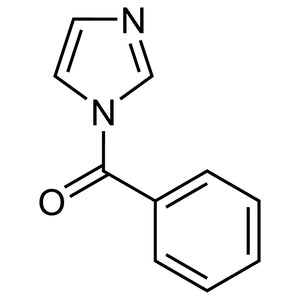
(1H-Imidazol-1-yl)(phenyl)methanone TCI I1276
Regular price From Rp 2.439.150,00Regular priceRp 1.720.950,00Sale price From Rp 2.439.150,00 -
1-[4-(1H-Imidazol-1-yl)phenyl]ethan-1-one TCI I1252
Regular price Rp 2.359.350,00Regular priceRp 1.665.300,00Sale price Rp 2.359.350,00

![TCI T3479 147951-02-8 1,3,5-Tris[(1H-imidazol-1-yl)methyl]benzene](http://amiscientific.com/cdn/shop/files/TCI2510T3479_07fa0f8c-a369-4f86-9ca8-f3f869050edd.jpg?v=1792664146&width=533)
![147951-02-8 1,3,5-Tris[(1H-imidazol-1-yl)methyl]benzene - AMI Scientific](http://amiscientific.com/cdn/shop/files/TCI2510T3479.jpg?v=1767144149&width=533)
![56643-83-5 1,4-Bis[(1H-imidazol-1-yl)methyl]benzene - AMI Scientific](http://amiscientific.com/cdn/shop/files/TCI2510B4023.jpg?v=1768815555&width=533)
![56643-83-5 1,4-Bis[(1H-imidazol-1-yl)methyl]benzene - AMI Scientific](http://amiscientific.com/cdn/shop/files/TCI2510B4023_57deab68-ab37-4d54-9bdc-438e660abd2f.jpg?v=1769055692&width=533)
![31349-48-1 4-(1-Methyl-5-nitro-1H-benzo[d]imidazol-2-yl)butanoic Acid - AMI Scientific](http://amiscientific.com/cdn/shop/files/TCI2510M3886.jpg?v=1769181080&width=533)


![TCI I1252 10041-06-2 1-[4-(1H-Imidazol-1-yl)phenyl]ethan-1-one](http://amiscientific.com/cdn/shop/files/TCI2510I1252_0731852d-25a1-46f4-b976-cd78f3959896.jpg?v=1792646076&width=533)
![10041-06-2 1-[4-(1H-Imidazol-1-yl)phenyl]ethan-1-one - AMI Scientific](http://amiscientific.com/cdn/shop/files/TCI2510I1252.jpg?v=1767120996&width=533)