![(4,4'-Di-tert-butyl-2,2'-bipyridine)bis[3,5-difluoro-2-[5-trifluoromethyl-2-pyridinyl-kappaN)phenyl-kappaC]iridium(III) Hexafluorophosphate (CAS 870987-63-6) - TCI D5817 - AMI Scientific](http://amiscientific.com/cdn/shop/files/TCI2510D5817.jpg?v=1767109244&width=1946)
![(4,4'-Di-tert-butyl-2,2'-bipyridine)bis[3,5-difluoro-2-[5-trifluoromethyl-2-pyridinyl-kappaN)phenyl-kappaC]iridium(III) Hexafluorophosphate (CAS 870987-63-6) - TCI D5817 - AMI Scientific](http://amiscientific.com/cdn/shop/files/TCI2510D5817.jpg?v=1767109244&width=1445)
TCI D5817, (4,4'-Di-tert-butyl-2,2'-bipyridine)bis[3,5-difluoro-2-[5-trifluoromethyl-2-pyridinyl-kappaN)phenyl-kappaC]iridium(III) Hexafluorophosphate, CAS 870987-63-6, is a cyclometalated iridium(III) complex that functions as a photocatalyst. The complex is built from two cyclometalated phenylpyridine ligands bearing fluorine and trifluoromethyl substituents, together with one 4,4'-di-tert-butyl-2,2'-bipyridine ancillary ligand, with hexafluorophosphate acting as the counter anion. In the laboratory, this compound serves as a visible-light-activated catalyst that drives electron transfer and energy transfer reactions, including work in the field of C–H bond activation.
The key characteristic that makes this complex a preferred choice is its electronic behaviour, which has been deliberately tuned through its substituents. The fluorine groups on the phenyl rings and the trifluoromethyl groups on the pyridine rings are strongly electron-withdrawing, so the excited state of this complex becomes far more oxidizing than that of conventional iridium photocatalysts. This makes it possible to oxidize substrates that are otherwise difficult to oxidize. At the same time, the di-tert-butyl groups on the bipyridine ligand improve solubility in organic solvents, which supports homogeneous reaction conditions and reproducible catalyst loading in synthetic work.
In Indonesian laboratories, this material is typically used in university research groups, synthetic organic chemistry laboratories, and catalysis-focused research centres that carry out photoredox reactions under visible-light irradiation. It is normally handled at small scale on the benchtop or in a photoreactor setup, where a low catalyst loading is dissolved together with the substrate before irradiation. Researchers working on methodology development, late-stage functionalization, and C–H activation studies select this catalyst when a strongly oxidizing excited state is required.
TCI brochures (PDF)
- TIPS-NSO for the Synthesis of Sulfinamides 2026-03-26 · p. 1
- NHC Reagent for Redox Activation of Alcohols Deoxazole 2025-09-18 · p. 2
- Iridium Photoredox Catalyst with Highly Oxidizing Excited State 2023-07-21 · p. 2
- Visible Light Photoredox Catalysts 2026-04-28 · p. 3
- Organic Photoreaction Reagents 2025-02-13 · p. 4
- Transition Metal Catalysts 2026-04-10 · p. 11
Related TCI products
- TCI B4944 864163-80-4 (2,2'-Bipyridine)bis[2-(2,4-difluorophenyl)pyridine]iridium(III) Hexafluorophosphate
- TCI B4893 106294-60-4 (2,2'-Bipyridine)bis(2-phenylpyridinato)iridium(III) Hexafluorophosphate
- TCI D4887 676525-77-2 (4,4'-Di-tert-butyl-2,2'-bipyridine)bis[(2-pyridinyl)phenyl]iridium(III) Hexafluorophosphate
- TCI B6451 1973375-72-2 [5,5'-Bis(trifluoromethyl)-2,2'-bipyridine-kappa~2~N~1~,N~1'~][bis[3,5-difluoro-2-[5-(trifluoromethyl)-2-pyridinyl-kappaN]phenyl-kappaC~1~]]iridium Hexafluorophosphate
- TCI B6258 808142-88-3 (4,4'-Di-tert-butyl-2,2'-bipyridine-kappa~2~N~1~,N~1'~)[bis[5-fluoro-2-(5-methyl-2-pyridinyl-kappaN)phenyl-kappaC~1~]]iridium Hexafluorophosphate
- TCI B6254 1335047-34-1 (4,4'-Di-tert-butyl-2,2'-bipyridine-kappa~2~N~1~,N~1'~)[bis[3,5-difluoro-2-(5-methyl-2-pyridinyl-kappaN)phenyl-kappaC~1~]]iridium Hexafluorophosphate
- Visible-light photoredox catalysis: the complex absorbs visible light and enters a long-lived excited state that drives single-electron transfer steps without requiring high-energy ultraviolet sources or specialised irradiation equipment.
- C–H bond activation research: the strongly oxidizing excited state generated by the fluorinated and trifluoromethylated ligands allows direct engagement of relatively inert C–H bonds within catalytic functionalization sequences under mild laboratory conditions.
- Oxidation of difficult substrates: because the electron-withdrawing substituents raise the oxidizing power of the excited complex, researchers apply it to substrates that conventional iridium photocatalysts cannot oxidize efficiently.
- Energy transfer reactions: the complex can act as a triplet sensitizer, transferring excitation energy to acceptor molecules and enabling transformations that proceed through triplet excited states rather than electron transfer.
- Homogeneous catalytic methodology development: the di-tert-butyl bipyridine ligand improves solubility in organic solvents, so the catalyst dissolves fully and gives consistent, reproducible results during reaction screening and optimization.
From the TCI brochure
- Catalyst option for visible-light-catalyzed [2+2] cycloaddition with U0182, CH2Cl2, 450 nm light
| Brand | TCI |
|---|---|
| CAS number | 870987-63-6 |
| Molecular formula | — |
| Purity | — |
| Category | Chemistry > Catalysis and Inorganic Chemistry > C-H Activation [Catalysis] |
| Pack sizes | available in standard TCI catalogue research-scale packaging; please confirm the required size when ordering |
| Physical form | — |
| Storage | keep in the sealed original container, protected from light |
- Chemical class: cyclometalated iridium(III) complex with hexafluorophosphate counter anion
Data from the TCI brochure
| Kemasan | 200mg / 1g |
|---|
Source: TCI brochure RR237 (2026-03-26)
Store the product in its original tightly sealed container, protected from light and moisture, and keep it in a cool, dry, well-ventilated storage area away from incompatible chemicals. Amber glass vials or the supplied container are suitable for storage, and the container should be closed immediately after each use to limit exposure to air and humidity. Handle the compound inside a fume hood using appropriate personal protective equipment, including gloves, safety glasses, and a laboratory coat. Weigh and transfer the solid carefully to avoid generating dust, and use clean, dry spatulas to prevent contamination. Always consult the manufacturer's safety data sheet before use, and follow institutional procedures for waste collection and disposal of chemical residues.
References cited in the TCI brochure
- Di Zhai. Access to four-membered cyclic sulfinamides by energy transfer catalysis Science, 2026. doi:10.1126/science.aec3158
Product Categories
Produk Terkait
-
(2,2'-Bipyridine)bis[2-(2,4-difluorophenyl)pyridine]iridium(III)Hexafluorophosphate TCI B4944
Regular price Rp 8.931.300,00Regular price -
(2,2'-Bipyridine)bis(2-phenylpyridinato)iridium(III)Hexafluorophosphate TCI B4893
Regular price Rp 6.308.400,00Regular price -
(4,4'-Di-tert-butyl-2,2'-bipyridine)bis[(2-pyridinyl)phenyl]iridium(III)Hexafluorophosphate TCI D4887
Regular price Rp 6.465.900,00Regular price -
[5,5'-Bis(trifluoromethyl)-2,2'-bipyridine-kappa~2~N~1~,N~1'~][bis[3,5-difluoro-2-[5-(trifluoromethyl)-2-pyridinyl-kappaN]phenyl-kappaC~1~]]iridiumHexafluorophosphate TCI B6451
Regular price From Rp 4.506.600,00Regular price -
(4,4'-Di-tert-butyl-2,2'-bipyridine-kappa~2~N~1~,N~1'~)[bis[5-fluoro-2-(5-methyl-2-pyridinyl-kappaN)phenyl-kappaC~1~]]iridiumHexafluorophosphate TCI B6258
Regular price From Rp 3.287.550,00Regular price -
(4,4'-Di-tert-butyl-2,2'-bipyridine-kappa~2~N~1~,N~1'~)[bis[3,5-difluoro-2-(5-methyl-2-pyridinyl-kappaN)phenyl-kappaC~1~]]iridiumHexafluorophosphate TCI B6254
Regular price From Rp 3.392.550,00Regular price -
(2,2'-Bipyridine)bis[3,5-difluoro-2-[5-(trifluoromethyl)-2-pyridinyl-kappaN][phenyl-kappaC]iridium(III)Hexafluorophosphate TCI B6161
Regular price From Rp 4.028.850,00Regular price -
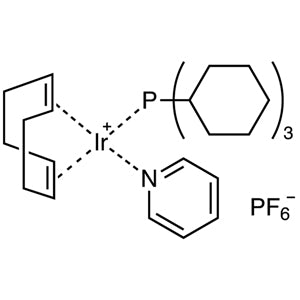
(1,5-Cyclooctadiene)(pyridine)(tricyclohexylphosphine)iridium(I)Hexafluorophosphate TCI C2824
Regular price Rp 2.199.750,00Regular price
![864163-80-4 (2,2'-Bipyridine)bis[2-(2,4-difluorophenyl)pyridine]iridium(III) Hexafluorophosphate - AMI Scientific](http://amiscientific.com/cdn/shop/files/TCI2510B4944.jpg?v=1767091849&width=533)

![(4,4'-Di-tert-butyl-2,2'-bipyridine)bis[(2-pyridinyl)phenyl]iridium(III) Hexafluorophosphate (CAS 676525-77-2) - TCI D4887 - AMI Scientific](http://amiscientific.com/cdn/shop/files/TCI2510D4887.jpg?v=1767108136&width=533)
![[5,5'-Bis(trifluoromethyl)-2,2'-bipyridine-kappa~2~N~1~,N~1'~][bis[3,5-difluoro-2-[5-(trifluoromethyl)-2-pyridinyl-kappaN]phenyl-kappaC~1~]]iridium Hexafluorophosphate (CAS 1973375-72-2) - TCI B6451 - AMI Scientific](http://amiscientific.com/cdn/shop/files/TCI2510B6451_a44c0f49-9dfa-42bb-83a6-0aceba622015.jpg?v=1767865822&width=533)
![(4,4'-Di-tert-butyl-2,2'-bipyridine-kappa~2~N~1~,N~1'~)[bis[5-fluoro-2-(5-methyl-2-pyridinyl-kappaN)phenyl-kappaC~1~]]iridium Hexafluorophosphate (CAS 808142-88-3) - TCI B6258 - AMI Scientific](http://amiscientific.com/cdn/shop/files/TCI2510B6258_754d364a-f6fd-4663-bb30-44092cbc4e6a.jpg?v=1767865062&width=533)
![(4,4'-Di-tert-butyl-2,2'-bipyridine-kappa~2~N~1~,N~1'~)[bis[3,5-difluoro-2-(5-methyl-2-pyridinyl-kappaN)phenyl-kappaC~1~]]iridium Hexafluorophosphate (CAS 1335047-34-1) - TCI B6254 - AMI Scientific](http://amiscientific.com/cdn/shop/files/TCI2510B6254_d6dc931a-826b-4975-abe2-3b3d296ce4a8.jpg?v=1767865045&width=533)
![(2,2'-Bipyridine)bis[3,5-difluoro-2-[5-(trifluoromethyl)-2-pyridinyl-kappaN][phenyl-kappaC]iridium(III) Hexafluorophosphate (CAS 1092775-62-6) - TCI B6161 - AMI Scientific](http://amiscientific.com/cdn/shop/files/TCI2510B6161_19dec429-90a9-45a3-a648-5726460c47b1.jpg?v=1767864767&width=533)