


This material, known as bis(2-phenylpyridinato)iridium(III) hexafluorophosphate (Ir(ppy)₂PF₆), is a metal complex widely used in catalytic and synthetic applications within laboratory settings. It belongs to the category of transition metal complexes and is particularly valued for its role in organic synthesis and catalytic reactions. The compound is a key reagent in various chemical processes, especially those involving oxidation and reduction reactions. Its unique molecular structure contributes to its effectiveness as a catalyst, making it a preferred choice for researchers seeking precision and efficiency in their experiments.
The compound exhibits high chemical stability and specificity, which are critical factors in its application. It maintains its structural integrity under a range of reactive conditions, allowing it to function effectively in both high- and low-temperature environments. This stability ensures consistent performance in laboratory settings, where reproducibility and reliability are essential. Additionally, its ability to act as a highly efficient catalyst across multiple reaction types makes it a versatile tool for chemical research. These properties make it a valuable asset for laboratories focusing on advanced synthetic methods and catalytic processes.
In Indonesian laboratories, this material is commonly used in organic chemistry, catalysis, and photchemical research. It is particularly relevant for studies involving the development of new materials, the synthesis of complex compounds, and the testing of chemical reactions that require a stable and effective catalyst. Its application is widespread in academic and industrial research, supporting innovation in chemical processes and material science.
TCI brochures (PDF)
- Visible Light Photoredox Catalysts 2026-04-28 · p. 3
- Organic Photoreaction Reagents 2025-02-13 · p. 7
- Organic Light-Emitting Diode (OLED) Materials 2026-08-18 · p. 8
- Transition Metal Catalysts 2026-04-10 · p. 11
Related TCI products
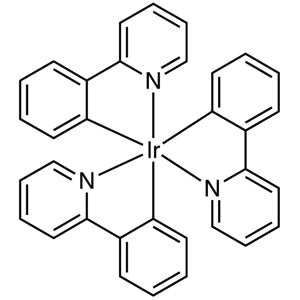
- TCI T3716 94928-86-6 Tris(2-phenylpyridinato)iridium(III)
- TCI T1946 94928-86-6 Tris(2-phenylpyridinato)iridium(III) (purified by sublimation)
- TCI B4944 864163-80-4 (2,2'-Bipyridine)bis[2-(2,4-difluorophenyl)pyridine]iridium(III) Hexafluorophosphate
- TCI D4887 676525-77-2 (4,4'-Di-tert-butyl-2,2'-bipyridine)bis[(2-pyridinyl)phenyl]iridium(III) Hexafluorophosphate
- TCI T2685 435293-93-9 Tris[1-phenylisoquinoline-C2,N]iridium(III) (purified by sublimation)
- TCI D5817 870987-63-6 (4,4'-Di-tert-butyl-2,2'-bipyridine)bis[3,5-difluoro-2-[5-trifluoromethyl-2-pyridinyl-kappaN)phenyl-kappaC]iridium(III) Hexafluorophosphate
- Organic synthesis applications benefit from this compound's ability to catalyze complex reactions with high efficiency and selectivity.
- Photocatalytic research utilizes its unique properties to facilitate light-induced chemical transformations under controlled conditions.
- Heterogeneous catalysis studies rely on its stability and reusability in various reaction environments.
- Material development projects leverage its role in creating advanced functional materials through precise chemical reactions.
- Analytical chemistry applications use it as a reagent in specialized detection and characterization techniques.
| Brand | TCI |
|---|---|
| CAS number | 106294-60-4 |
| Molecular formula | — |
| Purity | — |
| Category | Chemistry > Catalysis and Inorganic Chemistry > Transition Elements |
| Pack sizes | Available in various quantities as per standard laboratory requirements |
| Physical form | Solid |
| Storage | Store in a cool, dry place away from moisture and direct sunlight |
This material should be stored in a cool, dry environment to maintain its chemical stability and effectiveness. It is recommended to use airtight containers to prevent exposure to moisture and contaminants. Due to its chemical nature, it should be handled with appropriate personal protective equipment, including gloves and safety goggles. Avoid direct contact with skin and eyes, and ensure proper ventilation when working with the compound. It is important to store it away from incompatible substances to prevent any potential chemical reactions. Regular inspection of storage conditions ensures the material remains in optimal condition for use in laboratory applications.
—
Product Categories
Produk Terkait
-
Tris(2-phenylpyridinato)iridium(III) TCI T3716
Regular price From Rp 5.114.550,00Regular priceRp 3.592.050,00Sale price From Rp 5.114.550,00 -
Tris(2-phenylpyridinato)iridium(III)(purifiedbysublimation) TCI T1946
Regular price Rp 8.240.400,00Regular priceRp 5.778.150,00Sale price Rp 8.240.400,00 -
(2,2'-Bipyridine)bis[2-(2,4-difluorophenyl)pyridine]iridium(III)Hexafluorophosphate TCI B4944
Regular price Rp 8.983.800,00Regular priceRp 6.297.900,00Sale price Rp 8.983.800,00 -
(4,4'-Di-tert-butyl-2,2'-bipyridine)bis[(2-pyridinyl)phenyl]iridium(III)Hexafluorophosphate TCI D4887
Regular price Rp 6.518.400,00Regular priceRp 4.573.800,00Sale price Rp 6.518.400,00 -
Tris[1-phenylisoquinoline-C2,N]iridium(III)(purifiedbysublimation) TCI T2685
Regular price Rp 10.785.600,00Regular priceRp 7.557.900,00Sale price Rp 10.785.600,00 -
(4,4'-Di-tert-butyl-2,2'-bipyridine)bis[3,5-difluoro-2-[5-trifluoromethyl-2-pyridinyl-kappaN)phenyl-kappaC]iridium(III)Hexafluorophosphate TCI D5817
Regular price From Rp 3.763.200,00Regular priceRp 2.647.050,00Sale price From Rp 3.763.200,00 -
[5,5'-Bis(trifluoromethyl)-2,2'-bipyridine-kappa~2~N~1~,N~1'~][bis[3,5-difluoro-2-[5-(trifluoromethyl)-2-pyridinyl-kappaN]phenyl-kappaC~1~]]iridiumHexafluorophosphate TCI B6451
Regular price From Rp 4.559.100,00Regular priceRp 1,16Sale price From Rp 4.559.100,00 -
(4,4'-Di-tert-butyl-2,2'-bipyridine-kappa~2~N~1~,N~1'~)[bis[5-fluoro-2-(5-methyl-2-pyridinyl-kappaN)phenyl-kappaC~1~]]iridiumHexafluorophosphate TCI B6258
Regular price From Rp 3.340.050,00Regular priceRp 2.350.950,00Sale price From Rp 3.340.050,00



![TCI D5817 870987-63-6 (4,4'-Di-tert-butyl-2,2'-bipyridine)bis[3,5-difluoro-2-[5-trifluoromethyl-2-pyridinyl-kappaN)phenyl-kappaC]iridium(III) Hexafluorophosphate](http://amiscientific.com/cdn/shop/files/TCI2510D5817_d05615af-d157-48f0-933c-1a9117cbf00e.jpg?v=1792640168&width=533)
![(4,4'-Di-tert-butyl-2,2'-bipyridine)bis[3,5-difluoro-2-[5-trifluoromethyl-2-pyridinyl-kappaN)phenyl-kappaC]iridium(III) Hexafluorophosphate (CAS 870987-63-6) - TCI D5817 - AMI Scientific](http://amiscientific.com/cdn/shop/files/TCI2510D5817.jpg?v=1767109244&width=533)


